Recipe costing: know how much you earn on every dish
A recipe costing sheet is the financial blueprint of a recipe: what goes in, how much it costs to produce and what margin it leaves. Here is the complete guide to getting it right - and a free calculator to cost your first dish right now, without signing up.
What is a recipe costing sheet (and why half of all menus lose money without knowing it)
A recipe costing sheet breaks down a recipe into its ingredients with exact quantities, applies the purchase price of each, corrects for trim and cooking waste, and yields the real cost per serving. With that cost and the selling price you calculate the food cost: the percentage of the price that goes on raw materials.
The industry rule of thumb places the target food cost between 28% and 33%. The problem is not calculating it once: it is that purchase prices change every week and the spreadsheet from six months ago no longer tells the truth. A dish that was profitable in January may be losing money in August without anyone realising.
- Cost per serving: sum of (quantity x unit price) per ingredient, adjusted for its waste factor.
- Food cost % = cost per serving / selling price (excl. VAT) x 100. The number that decides whether a dish is business or charity.
- Suggested price = cost per serving / target food cost. If your cake costs EUR 1.80 and you target 30%, the ex-VAT price should be around EUR 6.
- Waste matters: a whole salmon loses 30-40% between bones, skin and trimmings. If you cost at the whole-fish price without correcting for waste, your costing is a lie.
Recipe costing and food cost calculator
Add the ingredients of a dish with their quantity, purchase price and waste. The calculator gives you cost per serving, food cost, gross margin and the suggested selling price for your target. Everything runs in your browser: we store nothing.
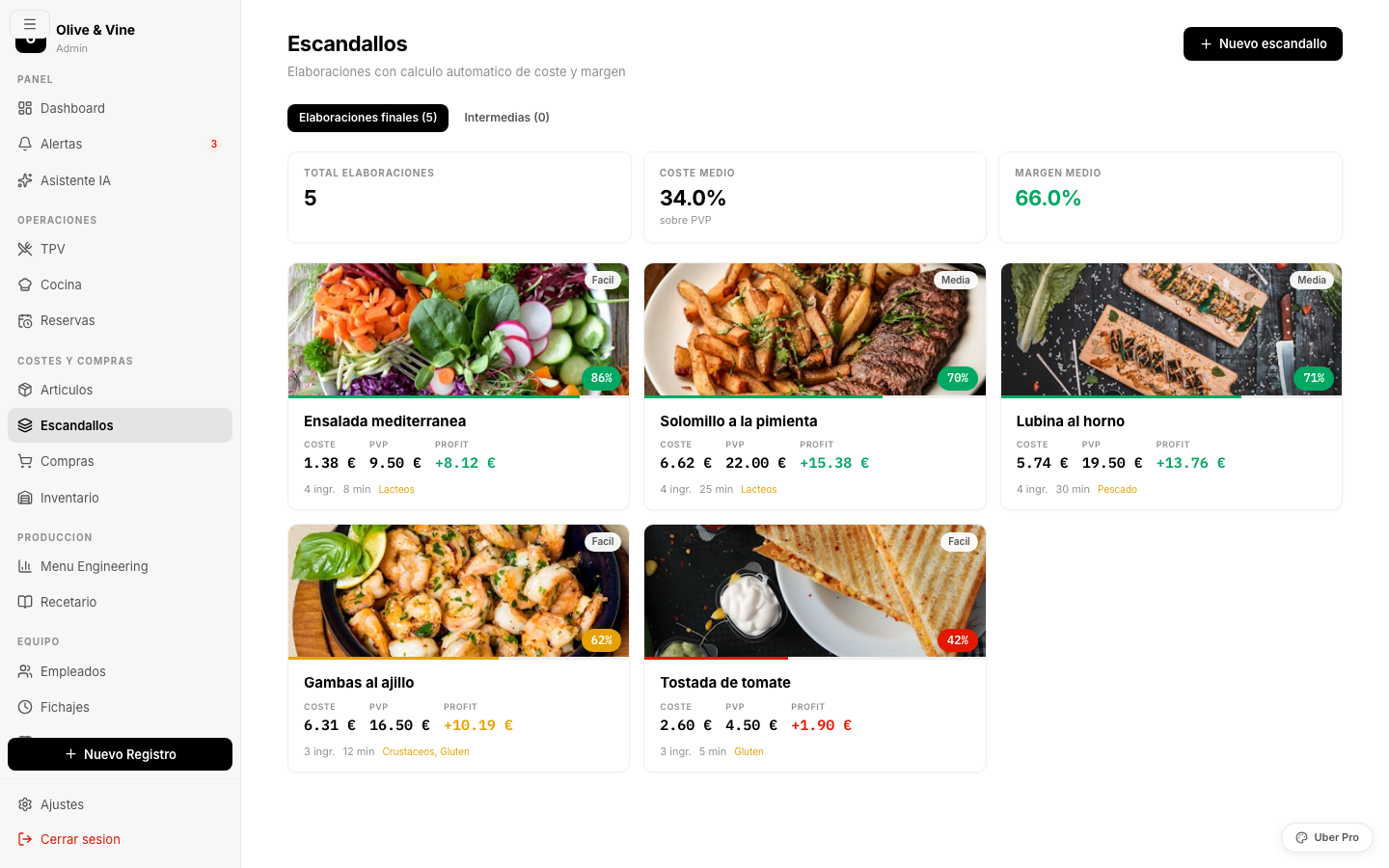
This, for your entire menu and updated automatically
In Soamee, every delivery note you record updates purchase prices and recalculates all recipe costings in cascade. The food cost of your menu, always up to date with alerts if a dish drops below its margin target.
How to cost a dish in 5 steps
Weigh the real recipe
Not the theoretical one: the one that comes out of your kitchen. Weigh every ingredient of a complete batch and note how many servings it yields. Recipes "from memory" typically deviate 10-20% from what actually goes into the pan.
Price every ingredient
Use the latest delivery note, not the price from memory. Convert everything to the same base (EUR/kg, EUR/L, EUR/unit) so you can multiply by recipe quantities.
Apply waste
Correct the price for the actual yield: if the price is for the raw product and you lose 30% cleaning it, the effective cost per usable kilo is 43% higher. This is the step almost every spreadsheet skips.
Divide by servings
Total batch cost divided by actual servings. You now have the cost per serving: the single most important number on your menu.
Calculate food cost and decide the price
Cost per serving / ex-VAT price x 100. If it exceeds your target, you have three levers: raise the price, adjust the portion or renegotiate/substitute ingredients.
The calculator is the first step. Ongoing control is the business.
We import your current recipe costings (or create them with you), connect them to your real purchases and from then on the food cost of your entire menu stays up to date automatically. We show you with your own menu in a free demo.
Common questions about recipe costing
What food cost is "good" for my type of restaurant?
Is the recipe costing calculated with or without VAT?
How do I calculate the waste of an ingredient?
How often should recipe costings be updated?
Tell us your challenge. We'll propose a solution.
No commitment. Within 24 hours, you'll receive a proposal with scope, timeline and budget. No fine print.