Control the food cost of every dish to the cent
Automatic recipe costings, menu engineering with a BCG matrix, waste control and an AI expiry traffic light. Know exactly how much you make — or lose — on every dish that leaves your kitchen.
The average food cost in an uncontrolled restaurant sits between 38% and 45%. With Soamee, restaurants that adopt our cost modules bring it below 30% within the first six months.
The food cost you don't control will ruin you
A restaurant can be full every night and still lose money. The cause is almost always the same: not knowing what each dish really costs to produce. Without that figure, pricing is guesswork — and guessing in hospitality is expensive.
The main cause isn't bad cooking: it's poor cost management. Many owners don't spot the problem until it's too late to turn it round.
In a restaurant turning over €400,000 a year, that's €16,000 to €32,000 literally thrown away. With control, much of it is recoverable.
The industry standard target is a food cost of 28-33%. Without up-to-date costings, most restaurants operate consistently above that range without realising.
Why does this happen in so many restaurants?
Out-of-date costings in a spreadsheet. They're done once and never touched again. The price of oil rises 40% and the salad costing still says €0.18.
Unrecorded waste. The chef bins 2 kg of expired fish and no record exists anywhere. That loss doesn't even show up in the P&L.
A menu designed on instinct. The best sellers are the ones people like most, not the ones with the best margin. You work twice as hard for the same money.
Prices that don't cover real costs. Without an up-to-date food cost, raising prices feels risky because you don't know whether you're already losing money or have room to move.
Inventory without a monetary value. You know how many units are there, but not how much capital they tie up or how much you lose each week to expiry.
No early warnings. The problem surfaces at month end when the P&L lands — too late to act on a period already closed.
Automatic costings: every dish's cost always current
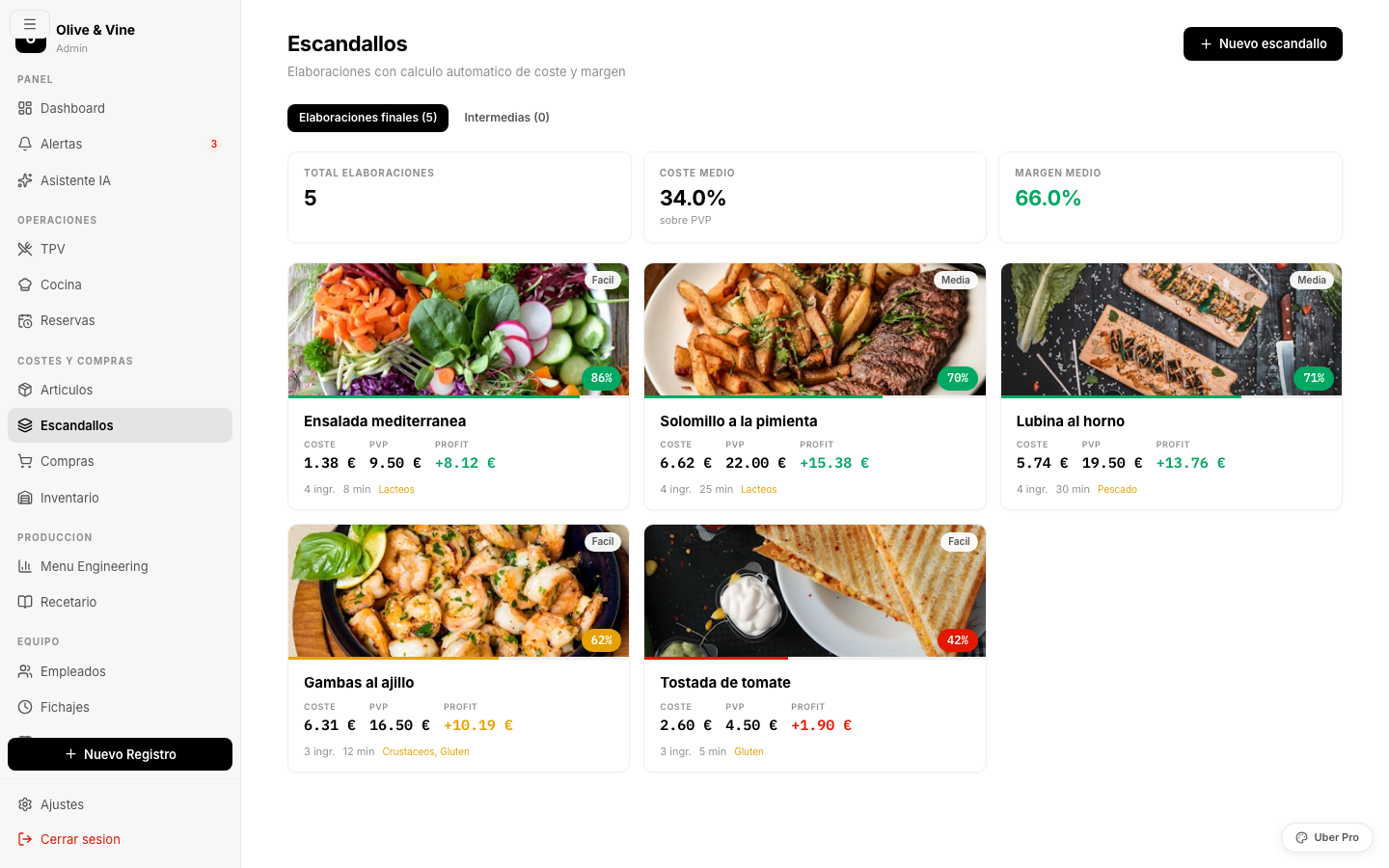
A costing isn't just a list of ingredients: it's the economic X-ray of each recipe. In Soamee, every dish on your menu has a sheet with ingredients, quantities in grams, unit cost and gross margin. And crucially: when any ingredient's price changes — because the supplier's delivery note went up — every costing containing it updates automatically.
That's the point where most restaurants lose control. They update the price in the purchasing module and never realise the rice pudding now has a 48% food cost instead of the 31% they worked out six months ago.
- Cascading price updates: change one ingredient's cost and every dish using it reflects the new food cost instantly.
- Minimum-margin alerts: set your target margin (70%, say) and the system flags in red any dish that falls below it.
- Suggested selling price: it shows the price needed to hit your target margin at today's ingredient costs.
- Allergen management per ingredient: the 14 allergens of European regulation propagate automatically to the dish sheet and the digital menus.
- Nested costings: one preparation can be an ingredient in another. The cost of your house stock, sauce or dough flows through to every dish that uses it.
- Yield loss factor per ingredient: the system automatically applies the loss percentage from trimming or cooking so the real cost is always exact.
Menu engineering: the science of designing a menu that sells and earns
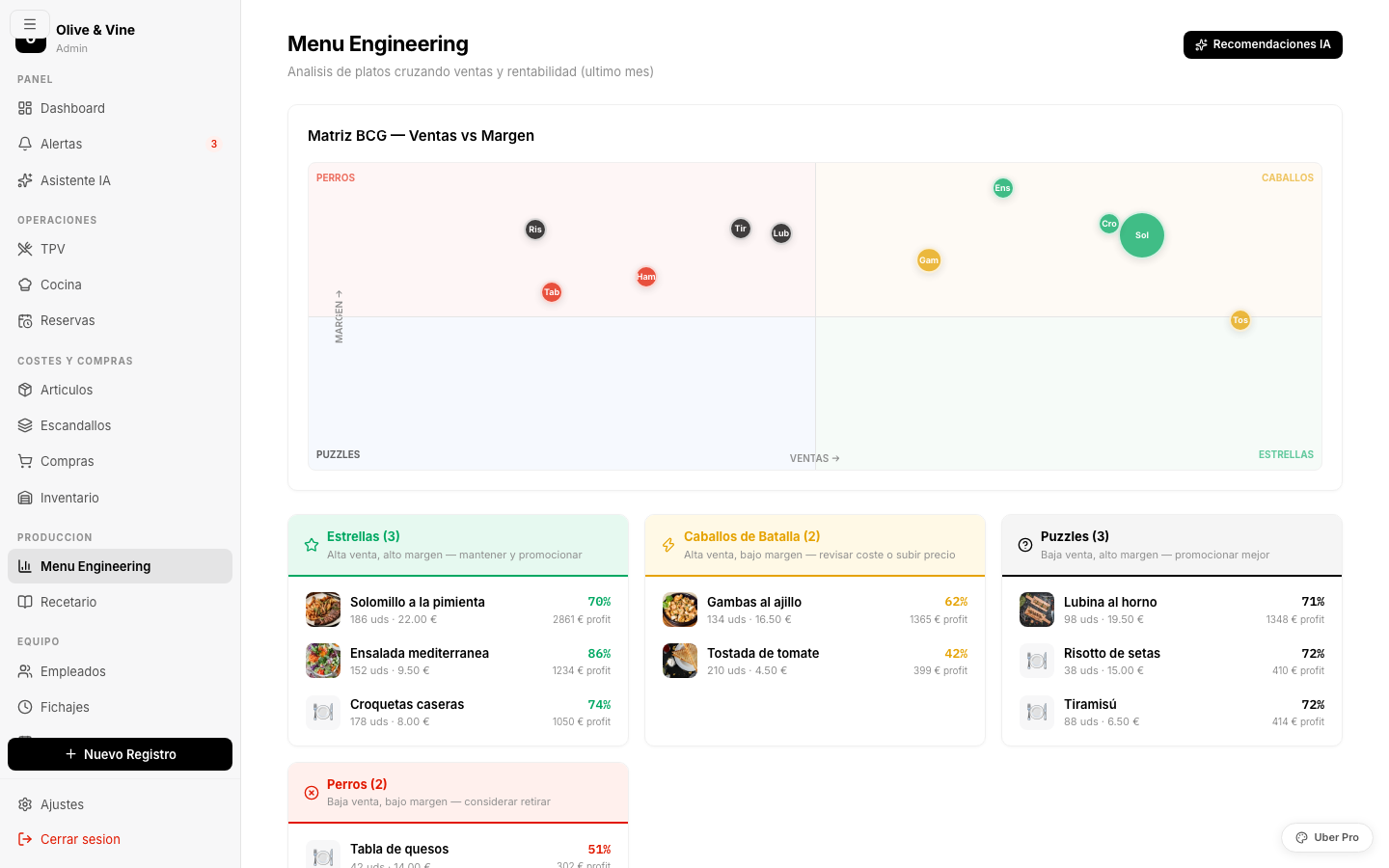
Menu engineering isn't an opinion: it's an analytical method that pairs each dish's contribution margin with its sales popularity. The result places every item on your menu in one of four BCG matrix quadrants. Knowing which quadrant a dish sits in tells you exactly what to do with it.
The four BCG quadrants applied to your menu
They're the engine of your business. Guests order them often and they leave you a good margin. Action: protect them. Never take them off the menu, give them a prominent spot (top right corner, first page) and train the team to recommend them actively. If the margin slips because an ingredient rises, adjust the price without fear: guests already want them.
They're ordered a lot but earn you little. Twice the work for the same money. Action: improve the margin. Three levers: (1) raise the price slightly — with high demand, guests will accept it; (2) rework the recipe with better-priced ingredients while keeping the result; (3) pair them with high-margin extras (a premium side, a suggested glass of wine).
Hidden potential. When they're ordered you earn well, but almost nobody picks them. Action: make them visible. Give them a more evocative name, improve their photo on the digital menu, train the team to recommend them, build a tasting menu or a daily special around them. If after three months of effort they still don't move, consider dropping them.
Neither liked nor profitable. They tie up stock, complicate the kitchen and confuse the guest. Action: consider removing them. First check the costing is right — sometimes a "dog" is a badly costed puzzle. If the numbers hold up, drop them. A shorter, coherent menu sells more than a long one full of mediocre options.
How does menu engineering work in Soamee?
The module automatically combines POS sales data with the margins from your costings. You calculate nothing: the platform places each dish on the matrix in real time and refreshes the classification daily with actual sales. Change an ingredient's price and the position on the matrix recalculates instantly.
Automatic classification updated with every sale recorded on the POS
Date-range filtering to compare seasons and spot changes
Concrete recommendations per dish: what to do, why, and how much the overall margin would improve
View by category (starters, mains, desserts, drinks) with a profitability summary
Price simulator: work out the margin impact of raising or lowering a dish's price
Export the analysis to PDF to present to partners or advisers
Waste: the money you throw away without knowing
Unrecorded waste is money that vanishes quietly. Three kilos of sea bass past their date go in the bin, twelve eggs break in transit, eight portions of paella nobody ordered get made. Without control, that money exists in no report; it simply disappears from your margin.
In Soamee each loss is logged in seconds: product, quantity, reason and monetary value. The platform automatically works out how much is lost by category and by cause, and the AI assistant spots patterns to suggest concrete corrective measures.
- Quick waste logging: product, quantity and reason in under 30 seconds. The chef does it from their phone the moment it happens.
- Reason categories: expiry, overproduction, breakage/accident, recipe error, guest return. Each category supports separate analysis.
- Monetary value of every loss: calculated automatically from the ingredient's current cost price in the inventory.
- Waste dashboard by period: total value, breakdown by product and by reason, weekly trend and comparison with previous periods.
- AI suggestions: "40% of last month's waste was cherry tomatoes past their date. Consider cutting the weekly order by 20% or putting them on the daily menu more often."
- Impact on the P&L: waste flows automatically into the P&L as additional raw-material cost, with its real impact on the margin.
The 5 types of waste that cost restaurants the most
Products that expire before they're used. The most avoidable cause, with good order planning and FIFO control.
Preparing more than you sell. Typical of daily menus and buffets without demand forecasting.
Loss inherent to the process: fish skin, bones, inedible parts. Manageable with accurate costings.
Accidents while handling or moving goods. Reducible with better organisation of the cold room and goods flow.
Badly made dishes, order errors, returns. A direct indicator of training and kitchen quality.
Indicative figures based on studies of the European hospitality sector.
Expiry control: never throw food away for not seeing it in time
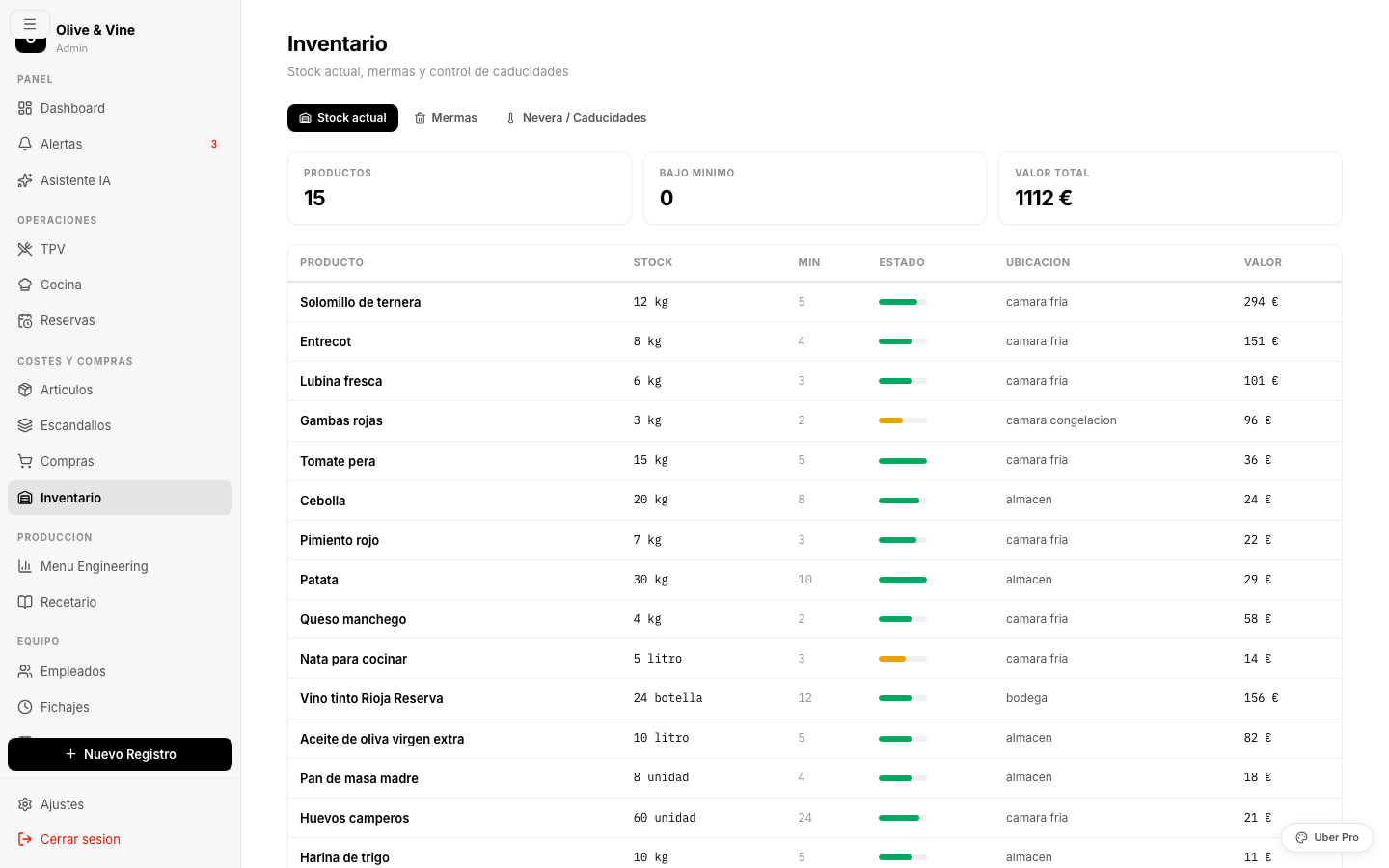
The inventory module includes a "Fridge" tab: a dedicated view listing every product by expiry urgency with a visual traffic-light system. At a glance, any team member knows what must be used today, what can wait and what is safely in the clear.
The AI assistant goes beyond the traffic light: it analyses what's at risk and actively proposes daily specials or preparations to use them up before they expire, avoiding waste without sacrificing quality.
- Automatic notifications when a product enters the orange or red zone
- Daily-special suggestions based on the most urgent products
- Automatic logging of expiries as waste with their monetary value
- FIFO compliance: the system tells you which batch to use first on every restock
How a set-menu restaurant cut its food cost by 15% in 4 months
The starting point
A set-menu restaurant in Madrid. 45 covers on average, menu at €12.50, à la carte at weekends. Annual turnover: €280,000. The owner knew something didn't add up: the room was always full, but at month end the money "never showed up".
Month 1: costings for every dish
All 32 à la carte dishes and the 5 set-menu options were costed. The mixed paella (the weekend best seller) turned out to have a 47% food cost. Selling price €14; real cost €6.60. The right price to hold the target margin should have been €17.50.
Month 2: menu engineering on the weekend card
The analysis flagged 4 "dogs" tying up ingredients with no return (with the mixed paella as a "workhorse"). One dish was dropped, three had their prices raised, and the paella was reworked with a different ingredient mix that cut €1.20 per portion with no perceptible change for the guest.
Month 3: waste and expiry control
All waste started being logged. In the first month the total came to €1,840 — nobody expected it that high. 60% was vegetables expiring in the fridge. With the expiry traffic light and AI suggestions for the daily menu, the following month it fell to €810.
Month 4: cumulative result
The case-study figures are illustrative, based on real results from restaurants with a similar profile. Individual results depend on each establishment's starting point.
Every day without up-to-date costings is money walking out
We run a free audit of how you operate today: we review your costings, estimate the real food cost of your menu and show you how much you could improve with Soamee. No commitment, no cost.
Everything you need to know about cost control
What is food cost and how is it calculated?
How long does it take to create all the costings for a menu?
Does menu engineering work for any kind of restaurant?
What kinds of waste can be logged in Soamee?
How does the AI help reduce waste from expiry?
Tell us your challenge. We'll propose a solution.
No commitment. Within 24 hours, you'll receive a proposal with scope, timeline and budget. No fine print.