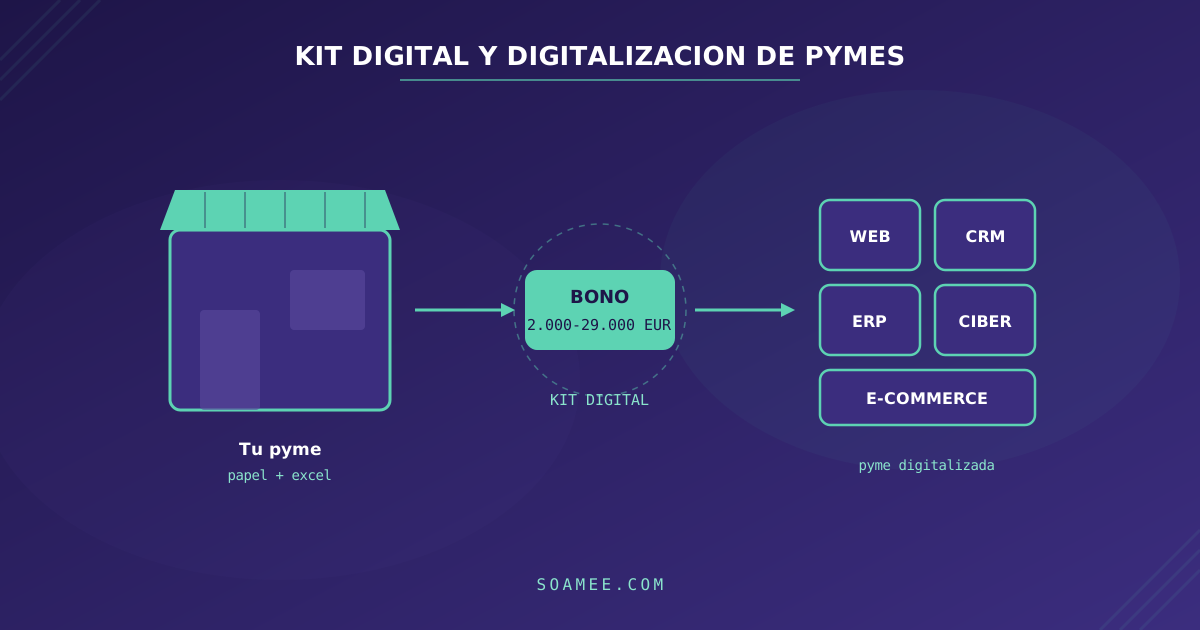
Quick answer: Kit Digital is a Spanish public program, financed with Next Generation EU funds and managed by Red.es, that gives SMEs and self-employed workers a voucher of between €2,000 and €29,000 to purchase digital solutions (web, e-commerce, CRM, ERP, cybersecurity…) through accredited digitalization agents. It has been the biggest boost to SME digitalization in Spain in the last decade.
Status today: the programme is still in force and Order TDF/39/2026 extended its rules until the funds are fully exhausted, but there is no open call at this moment. The last one closed on 31 October 2025 for segment III. With around 99% of the budget already committed and more than 850,000 grants awarded, what governs access is no longer a deadline but the credit available in each new call. If you are reading this in order to apply, the first step is to check the Red.es portal for an active call for your segment.
Now, the interesting question is not what it is, but what has changed thanks to it — and how to make the most of it so that in your company it becomes a real transformation and not just paperwork.
A before and after for the Spanish SME
Spain is a country of SMEs: over 99% of its business fabric. And for years, digitalization was the unfinished business — outdated websites, management on paper and spreadsheets, zero analytics. If that sounds familiar, we have a guide on the signs that your business needs to digitalize.
Kit Digital changed the equation in three ways:
- It removed the economic entry barrier. For a shop or a services company with 5 employees, a €6,000 voucher covers a professional website, a CRM or the migration to electronic invoicing that would otherwise be postponed indefinitely.
- It created an orderly market. The catalog of digitalization agents put standard prices, scope and timelines on services that were previously opaque to the non-technical buyer.
- It normalized the digital conversation. Thousands of accounting firms, associations and chambers of commerce have spent years talking about CRM, cybersecurity and electronic invoicing to companies that had never had that conversation.
The aggregate result: hundreds of thousands of vouchers granted and a generation of SMEs that now operates with a website, e-commerce, CRM or ERP where there used to be paper. We have seen it up close: we built the platform for Attomo Digital, a consultancy that manages more than 60 Kit Digital projects as a digitalization agent, and the volume and profile of companies arriving through that channel has not stopped growing.
What the voucher covers (and how much)
The amount depends on the company segment:
| Segment | Size | Voucher |
|---|---|---|
| III | 0-2 employees | €2,000-3,000 |
| II | 3-9 employees | €6,000 |
| I | 10-49 employees | €12,000 |
| IV | 50-99 employees | €25,000 |
| V | 100-249 employees | €29,000 |
The solution categories range from digital presence (web, e-commerce, social media, marketplace) to management (CRM, ERP, electronic invoicing, BI) and security (cybersecurity, secure communications, secure workplace). The calls for mid-sized companies have also added artificial intelligence solutions.
The deadlines and conditions of each call change — before planning anything, check the current status on Acelera Pyme, take the mandatory digital maturity test and verify which segment applies to you.
How to truly make the most of it: from paperwork to transformation
Here lies the difference between the SMEs that come out of the program transformed and those that only come out with a new website nobody visits.
1. Start with the process that hurts, not with the shop window
The temptation is to spend the voucher on what is visible (the website). The return is usually in what is invisible: the process that eats up hours every week. If your team lives in Excel to invoice, plan or control stock, a subsidized ERP has an immediate ROI — we cover it in how to migrate from Excel to an ERP and in our comparison of Holded vs A3ERP vs Odoo.
2. Think about data from day one
A CRM without criteria for what to capture is an expensive address book. Before redeeming the voucher, define what you want to be able to answer in 12 months: where do my customers come from? What margin does each line leave? That question determines whether you need a CRM, BI or both.
3. The voucher is the first step, not the ceiling
Kit Digital finances catalog solutions: standard products, implemented in a standard way. For most SMEs that is exactly what they need. But if your competitive advantage depends on a process that no standard software covers, the catalog falls short — that is where the territory of custom software, with its own ROI analysis begins.
4. Demand adoption, not just delivery
The solution is considered implemented when it is delivered, but the transformation happens when the team uses it. Agree with your digitalization agent on training and a support period. A tool without adoption is a wasted voucher — the real cost of not automating keeps running.
The program’s limits
To be honest, Kit Digital also has its shadows:
- Bureaucracy: the documentation requirements discourage some of the companies that need it most (although the digitalization agent takes on a good part of the paperwork).
- Uneven quality: not all digitalization agents deliver the same level. Ask for real examples of their work before signing.
- Catalog solutions: the voucher format fits poorly with singular needs — complex integrations, hardware, your own product.
- Timelines: months pass between application, granting and execution. Do not plan as if it were immediate.
Our take
Kit Digital has achieved something that a decade of evangelization could not: turning the digitalization of the Spanish SME into the norm instead of the exception. The subsidized website, CRM or ERP is the entry door; the real change comes when the company discovers what it can do with its data and its digitalized processes — and that second phase no longer needs a subsidy to justify itself, because it pays for itself.
Do you know which process hurts but not whether the catalog covers it? Let’s talk: we will tell you frankly whether your case can be solved with a standard subsidizable solution or whether you need something custom.