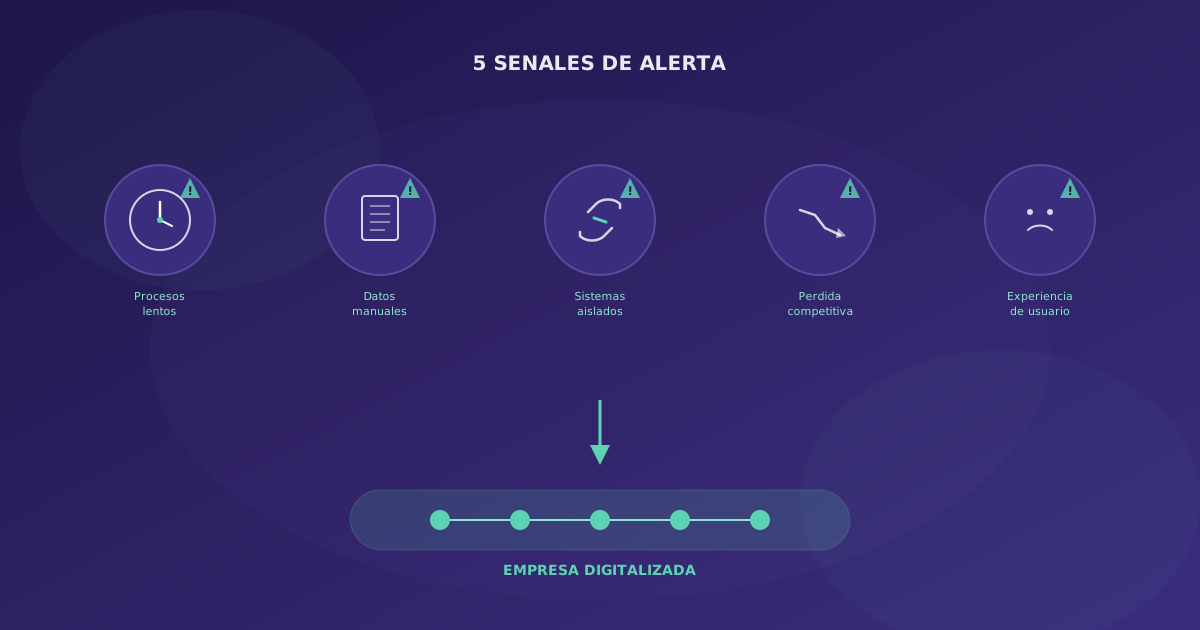
Digitalization is not a trend. It is the difference between companies that scale and companies that fall behind. But many business leaders cannot identify when their company has crossed the line between “we could improve” and “we are losing money every day by not digitalizing.”
At Soamee we work with SMBs and mid-market companies that come to us at different stages of digital maturity. After more than 50 digital transformation projects, we have identified 5 clear signs that a company needs to digitalize urgently. If you recognize 3 or more in your organization, every week that passes you are losing money.
The Impact Matrix: Manual vs Digitalized
Before diving into the 5 signs, let’s look at a general overview of the impact of digitalization on common processes. This data comes from real projects we have executed.
Comparison: Manual vs Digitalized Processes
| Process | Manual - Time | Digital - Time | Manual - Errors | Digital - Errors | Annual Savings |
|---|---|---|---|---|---|
| Invoicing | 4h/week | 20min/week | 8-12% | <1% | 9,200 EUR |
| Order management | 6h/week | 45min/week | 15-20% | 2-3% | 13,500 EUR |
| Reporting | 8h/month | Automatic | Outdated data | Real-time | 4,800 EUR |
| Customer support | All by phone | 70% self-service | No traceability | 100% traceable | 18,000 EUR |
| HR management | 5h/week | 1h/week | 10% | <2% | 10,400 EUR |
| ESTIMATED TOTAL SAVINGS (20-50 employee company) | 55,900 EUR/year | ||||
* Data based on real Soamee projects with 20-50 employee companies in Spain. Savings include personnel time valued at average company cost.
Now let’s look at the 5 signs that indicate your business needs to digitalize urgently.
Sign 1: Your manual processes cost more than a development team
This is the most obvious sign and, paradoxically, the most ignored one. When you calculate the real cost of manual processes, many companies discover they are spending more on inefficiency than it would cost to digitalize.
How to calculate the real cost
The calculation is simple but revealing:
Cost of a manual process = (Weekly hours x Employee hourly cost x 52 weeks) + (Error cost x Error frequency)
Real example: A food distribution company processed orders by phone and email. Two people spent 6 hours daily manually entering orders into their ERP. The calculation:
- 2 people x 6h/day x 5 days x 52 weeks = 3,120 hours/year
- Average hourly cost (with benefits): 22 EUR
- Annual cost in time alone: 68,640 EUR
- Transcription errors (5% of orders): 12,000 EUR/year in returns and corrections
- Total: 80,640 EUR/year for a process that was automated with a 25,000 EUR investment
The return on investment was 4 months. From the fifth month on, every euro saved was net profit.
Concrete signs that your manual processes are a problem
- Employees spending more than 50% of their time on repetitive tasks (copying data, filling forms, sending follow-up emails)
- Frequent errors generating customer complaints
- You need to hire more staff to absorb more volume, instead of optimizing
- The employees doing these tasks are the only ones who know how they work (people dependency risk)
Sign 2: Your competitors are already digitalized and taking your customers
If your direct competitor can send a quote in 2 minutes from an app and you need 2 days to prepare one in Excel, you are losing sales. This is not a matter of internal efficiency: it is a matter of market survival.
Indicators that you are falling behind
- Your customers compare you unfavorably with the competition: “At the other company I can check my order status online, here I have to call by phone.”
- Your response time is significantly longer: If you take days where others take hours, customers leave.
- You have no functional digital presence: Your competitor has a client portal, an app, or an online ordering system. You have a PDF and a phone number.
- You lose tenders due to not meeting technological requirements: More and more large companies require their suppliers to integrate digitally (EDI, supplier portals, electronic invoicing).
Real case
A machining workshop was losing contracts with automotive companies because it could not offer digital part traceability. Its competitors already had systems that generated quality reports automatically and sent them to the client in real time. The workshop invested 35,000 EUR in digitalizing its quality control and traceability. In the first year it recovered the investment by winning 3 contracts it had been systematically losing.
Sign 3: Your customers expect a digital experience you are not delivering
Customer expectations have changed radically. They no longer compare your service only with your direct competition: they compare it with Amazon, with their online bank, with any digital service they use daily.
What your customers expect in 2026
- 24/7 self-service: Check invoices, place orders, see the status of their orders without needing to call or send an email.
- Immediate responses: A chatbot or ticketing system that acknowledges receipt instantly, not a “we will respond within 48 business hours.”
- Multichannel communication: Email, WhatsApp Business, web portal. The customer chooses the channel, not you.
- Personalization: Relevant offers based on their purchase history, not a generic catalog for everyone.
- Transparency: Clear pricing, estimated delivery times, real-time tracking.
The cost of not meeting these expectations
According to Salesforce studies, 76% of consumers expect companies to understand their needs and expectations. 57% have stopped buying from a company because a competitor offered a better experience.
In B2B the situation is similar. Today’s decision-makers are digital natives or early adopters who expect the same fluidity in their business relationships as in their personal lives.
How to start
You don’t need to transform the entire customer experience at once. Start with the highest-friction points:
- Identify the 3 main reasons customers call or write to you. Those are your candidates for self-service.
- Implement a basic client portal where they can check invoices, orders, and project status.
- Add WhatsApp Business with automatic responses for the most frequent questions.
Sign 4: Your data is in silos and you cannot make informed decisions
If to prepare a monthly report you need to open Excel, copy data from the ERP, cross-reference it with a CSV from your email marketing tool, and paste it into a PowerPoint, you have a data silo problem.
What are data silos and why are they dangerous
A data silo exists when your company’s information is fragmented across systems that don’t talk to each other. The most common silos:
- Sales in a CRM (or worse, in individual spreadsheets from each salesperson)
- Accounting in an ERP that doesn’t connect with anything else
- Marketing in cloud tools (Mailchimp, social media) with no connection to sales
- Production/operations in proprietary systems or even on paper
- HR in another separate tool
The real consequences of silos
- Decisions based on incomplete data: If your CRM doesn’t sync with your ERP, you don’t know the real profitability of each customer (sales minus service costs).
- Duplicated effort: Multiple people entering the same data in different systems.
- Inconsistent reports: The sales director says we billed X, accounting says Y. Who is right? Nobody knows quickly.
- Lost opportunities: Without a unified customer view, you cannot cross-sell or detect churn patterns.
The solution is not buying more software
A common mistake is thinking that the solution to silos is buying a system that “does everything.” A single software that covers all of a company’s needs rarely exists. The real solution is integration:
- APIs to connect existing systems: Many modern tools have APIs that allow automatic data synchronization.
- Integration platforms: Tools like Make (Integromat), Zapier, or n8n allow connecting systems without custom development.
- Centralized data warehouse: For larger companies, a centralized data warehouse (BigQuery, Snowflake) where all data converges.
- Unified dashboards: Tools like Metabase, Looker, or Power BI that read from multiple sources and present a unified view.
Sign 5: You cannot scale without proportionally multiplying your team
This is the definitive sign that you need to digitalize. If to double your revenue you need to double your workforce, your business model has a very low ceiling.
The scalability test
Ask yourself these questions:
- If tomorrow you received double the orders, could you manage them with your current team? If the answer is no, you have a scalability problem.
- How long does it take to train a new employee to be productive? If it’s months, you have tacit knowledge dependency that should be in systems.
- Are your processes documented or do they live in people’s heads? If a key employee goes on vacation and nobody knows how to do their job, you have a serious operational risk.
How digitalization unlocks scalability
Digitalization allows your company to grow sublinearly: double revenue without doubling operational costs.
Concrete examples:
- Online vs phone orders: An online ordering system can process 1,000 orders per day at the same cost as 10. By phone, you need one person for every 30-40 orders.
- Automatic vs manual invoicing: An invoicing system can generate 10,000 invoices per month without human intervention. Manually, each invoice requires 10-15 minutes.
- Chatbot + ticketing support vs all-phone: A chatbot can resolve 60-70% of inquiries automatically. The human team focuses on complex cases.
Action plan to scale
- Identify your bottlenecks: What processes saturate first when volume increases?
- Prioritize by impact: Start with the process that most blocks your growth.
- Digitalize incrementally: Don’t try to transform everything at once. One well-digitalized process every 2-3 months is a sustainable pace.
- Measure the revenue/employee ratio: This KPI tells you if you are scaling efficiently. It should rise every quarter.
Where to start: the 90-day plan
If you have identified 3 or more of these signs in your company, you need an action plan. This is the framework we use at Soamee with our clients:
Month 1: Audit and prioritization
- Map all your main processes (sales, operations, finance, HR, customer service)
- Measure the time and cost of each manual process
- Identify the 3 processes with the greatest potential impact
- Define baseline KPIs (before digitalizing)
Month 2: Quick wins
- Implement basic integrations between your existing systems (Zapier, Make)
- Create a basic client portal (even if it’s just a page with document access)
- Add WhatsApp Business with automatic responses
- Digitalize the most critical process identified in month 1
Month 3: Consolidation and medium-term plan
- Measure quick win results vs baseline KPIs
- Present results to management with real savings data
- Define the 12-month digitalization roadmap
- Budget the necessary investments with estimated ROI
Conclusion
Every month that passes without acting, your manual processes cost you money, your competitors gain ground, and your customers get frustrated. The good news is you don’t need a multi-million-euro transformation. With an incremental approach, starting with the highest-impact processes, you can see results in weeks.
At Soamee we help companies take this step: from the initial audit to implementation and results measurement. If you recognize these signs in your organization, contact us for a no-obligation assessment. We’ll tell you exactly where to start and how much you can save.