Restaurant inventory without spreadsheets,
without paper, without surprises
Real-time stock, automatic low-level alerts, an expiry traffic light, AI delivery-note digitisation and waste control. Everything you need to stop losing money every week without noticing.
Integrated with the POS, costings, purchasing and finance. Sell a dish and the inventory drops by itself. Nothing to update by hand.
Manual inventory costs you more than you think
It isn't just time. It's real money vanishing every week where you can't see or measure it. A spreadsheet inventory, counting by hand at midnight and delivery notes in a folder are the biggest source of hidden losses in a restaurant.
In a restaurant turning over €30,000, that's €1,200 to €2,400 a month thrown away. Without control you can't know what's happening or why.
Physical counting, updating the spreadsheet, checking delivery notes, calling suppliers about invoice errors. Head-chef or manager hours that should be spent elsewhere.
You don't know how much you have, what it's worth, what expires this week or when to order. You buy by eye, and that's expensive.
What happens when you run inventory by hand
- Stock-outs that block service
A key ingredient runs out mid-Friday-night and there's no way to know until the chef reaches for it and it isn't there. The guest orders the special and it's gone.
- Overstock that expires and gets binned
With no real consumption history you over-order "just in case". Fresh fish, meat, dairy and vegetables expire before you use them. Every week something goes in the bin.
- Delivery-note and invoice mismatches you never spot
The supplier bills you for 12 kg of beef and you only received 10. Without automatically cross-checking note and invoice, you overpay without knowing. It happens more than you'd imagine.
- Out-of-date costings that eat your margin
The price of oil rises 40% and your costing still uses the old figure. You're selling at cost without realising.
The real cost of the inventory spreadsheet
A conservative estimate for an average restaurant turning over €25,000-35,000 a month. Your case may be higher or lower.
Know exactly what you have at any moment, without counting anything by hand
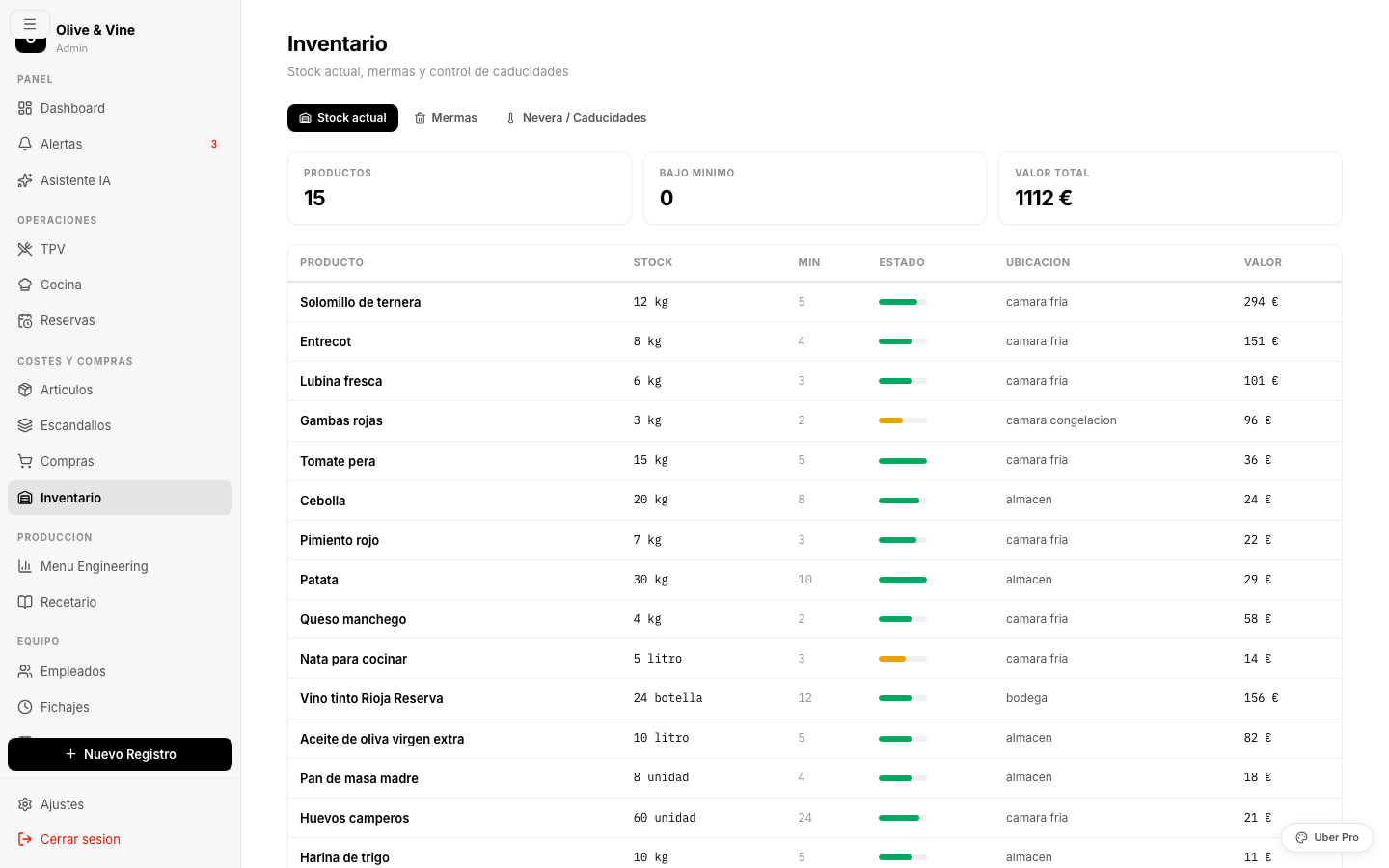
When the waiter charges for a dish on the POS, the stock of all its ingredients drops automatically per the costing. When a delivery note arrives and you log it, stock goes up. No spreadsheet to touch. Nothing to remember to update.
Every item in the store shows its current quantity, monetary value, reorder point and a visual level bar. At a glance you know what's fine, what's tight and what you need to order today.
- Automatic deduction on sale: every dish sold consumes its ingredients per the recipe, with no manual step.
- Minimum-stock alerts: you're notified when an ingredient drops below the threshold you set, before it runs out.
- Real-time inventory valuation: you always know how much capital is tied up in stock.
- Filters by category: separate views for meat, fish, dairy, drinks, dry goods and so on. Find any item in seconds.
- Movement history: full traceability of every in and out, with date, quantity and reason.
From a photo of the delivery note to updated stock in 30 seconds
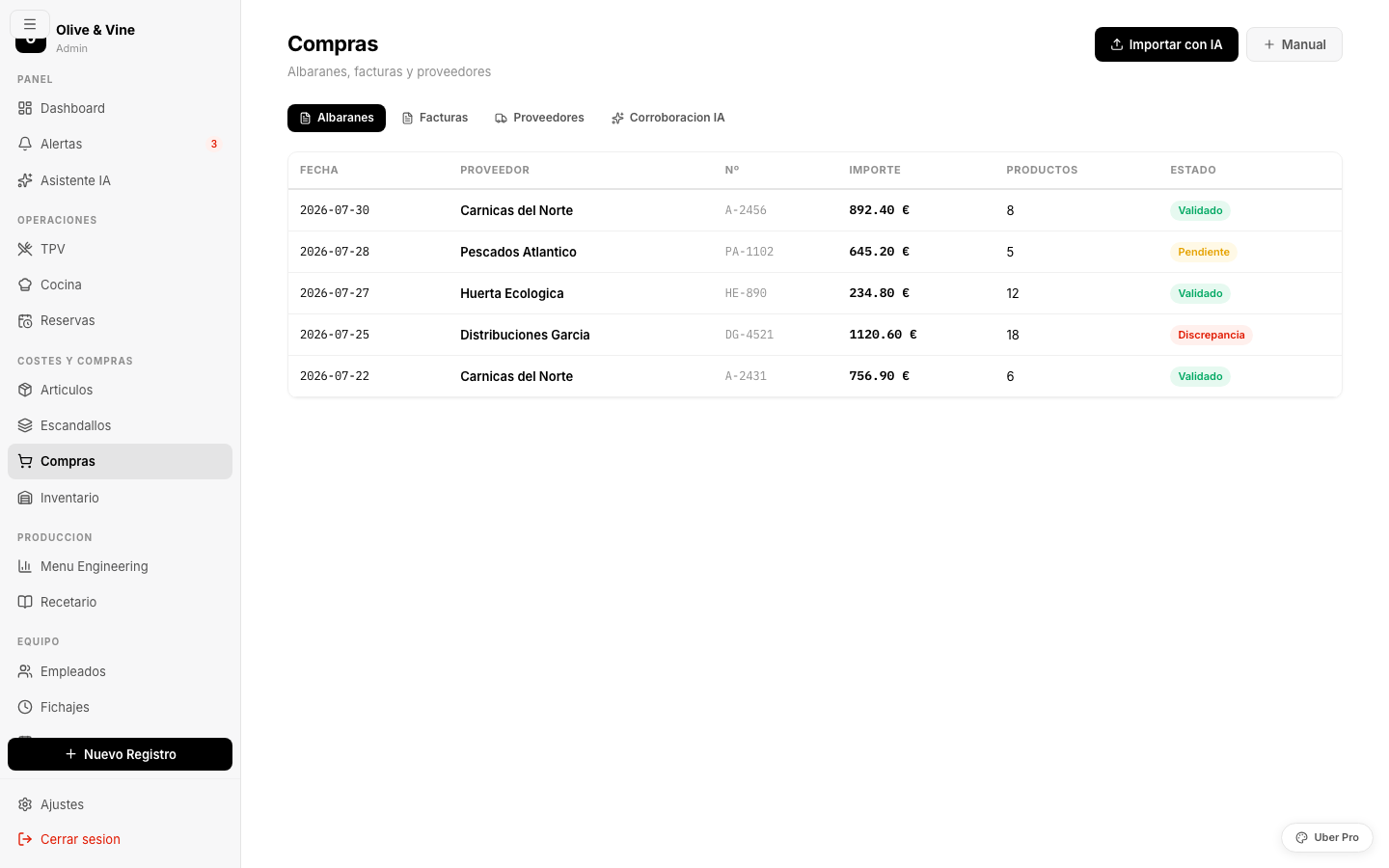
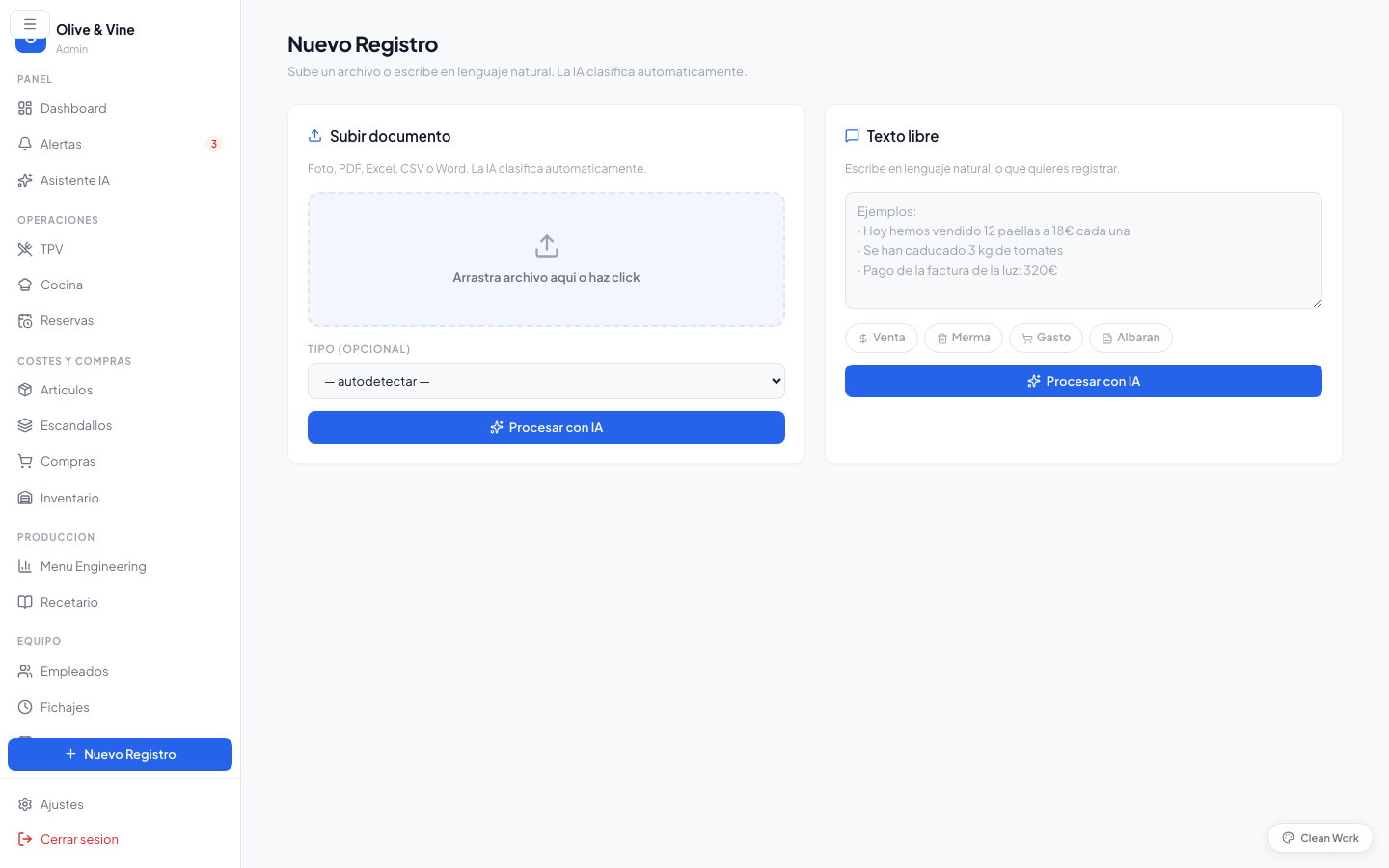
Your supplier arrives, drops off the goods and hands you a paper delivery note. You take out your phone, snap a photo and the AI automatically extracts supplier, date, products, quantities, units and prices. You confirm, and stock rises instantly.
When the digital invoice arrives (PDF, email, spreadsheet), the system cross-checks it against the logged delivery note. If quantities or prices differ, it warns you before you pay.
- AI OCR for any format: a photo of a paper note, the supplier's PDF, an order spreadsheet. The AI classifies and extracts the data whatever the format.
- Delivery note ↔ invoice check: automatic detection of discrepancies in quantity, price or products. Stop overpaying without knowing.
- Supplier directory: each supplier shows cumulative purchase volume, regular products and month-by-month price trend.
- Invoice due-date alerts: never another late-payment surcharge. The system warns you with configurable notice.
- AI-suggested orders: based on consumption history and current stock, the system proposes what to order and how much, so you neither run short nor over-buy.
Log every loss in seconds and understand why you're losing money
Unrecorded waste is invisible money. When you bin something you log it: item, quantity, reason (expiry, breakage, overproduction, spoilage, kitchen error) and the system automatically calculates the value lost.
With data building up week after week, patterns emerge. If you always bin chard on Wednesdays, maybe you order too much. If the most frequent reason is "overproduction", your mise en place has a problem. The data tells you exactly where to act.
- Quick waste logging: select item, quantity and reason in under 15 seconds. By voice too, with the AI assistant.
- Monetary value per loss: every entry shows what it's worth at the item's latest purchase price.
- Trend analysis: a ranking of the most-wasted products, weekly and monthly evolution, period comparison.
- Breakdown by reason: a distribution chart of waste by cause. Work out whether the problem is buying, storage or production.
- Stock integration: every loss is deducted from the inventory automatically, keeping stock accurate at all times.
After cutting the leafy-greens order and adjusting mise en place production based on the system's data. Real saving: €580/month.
With today's sea bass and the baby spinach you could run "Grilled sea bass on a bed of spinach" as the daily special. You use both products before they expire and create a dish with an estimated 67% margin.
Know what expires today and this week, and never bin anything that could still be used
The "Fridge" tab lists all fresh products by expiry urgency with a traffic-light system. Red: expires today or tomorrow, act now. Orange: expires in 2-5 days, plan ahead. Green: plenty of time.
But the traffic light isn't the powerful part — what the AI does with that information is. It combines products nearing expiry with your recipe book and suggests daily specials that use them, getting the most out of them before it's too late.
- Three alert levels: rojo (≤1 día), naranja (2–5 días), verde (>5 days). Ordered by urgency, not by name.
- AI dish suggestions: the assistant pairs upcoming expiries with the recipe book and proposes profitable combinations for the daily special.
- Proactive notifications: an automatic alert every morning summarising the red and orange products. Nothing catches you out.
- Expiry recorded at intake: when you log a purchase you enter the expiry date once. The system does the rest.
Digitise any document in seconds, without typing a thing
A photo of the paper delivery note. The supplier's invoice PDF. The inventory spreadsheet you've been dragging around for years. A bank statement with supplier charges. The AI classifies it, extracts structured data and brings it into the system, with your final review.
It doesn't matter that each supplier uses a different format, or that the note is badly lit or crumpled. The AI OCR engine is trained specifically on hospitality documents: it understands product abbreviations, units of measure (kg, L, unit, case) and price formats with VAT broken out.
- Photo from your phone: photograph the paper note. The OCR extracts supplier, products, quantities and prices in seconds.
- PDF upload: drag in the supplier's invoice and the AI processes it automatically, picking out product lines and totals.
- Spreadsheet import: bring your current inventory across without re-entering anything. Columns are mapped automatically, with a review before importing.
- You always review: the AI proposes, you confirm. Before saving any digitised document you can edit every field.
- Digital document archive: every delivery note and invoice is stored and searchable. Goodbye to the paper folder.
Potential saving: switching to Cárnicas López for this product saves €5.10/kg. At your 40 kg a month, that's €204 a month on this ingredient alone.
+46% in 12 months. Detected automatically. The system alerted you when it passed €4.50/L so you could look at alternatives.
Compare suppliers, spot price rises and negotiate with real data
Every delivery note you log is a data point. Over time the system builds a price history for each product by supplier. When the price of oil rises 20%, you see it before you pay. When you want to negotiate with a supplier, you have the numbers in hand.
The supplier directory shows for each one: monthly and annual purchase volume, most-bought products, price trend per item and delivery reliability. With that, conversations with suppliers change completely.
- Price trend per item: a monthly chart of each ingredient's price by supplier. Catch inflation before it hits your margins.
- Volume analysis: how much you buy from each supplier, what share of your total purchasing it represents and how it evolves.
- Supplier comparison: for the same product, which supplier is cheapest, with what service quality and on what terms.
- Price-rise alerts: an automatic notification when a supplier raises an item's price above a configurable percentage.
Inventory connected to your whole operation
It isn't an isolated module. The inventory talks to the POS, the costings, purchasing, finance and the AI assistant in real time.
POS → inventory
Every dish sold automatically deducts its ingredients from stock per the costing. Nothing to update by hand after service.
Purchasing → stock
Logging a delivery note (photo, PDF or manual) raises stock instantly. The inventory valuation updates with the current purchase price.
Inventory → costings
Costings read each ingredient's current price from the inventory. If a product's cost rises, the dish's food cost updates by itself.
Waste → finance
Every logged loss comes off stock and goes into the P&L's loss line. You see waste's real impact on your monthly result.
Expiries → AI assistant
The assistant knows what expires today and can suggest daily specials, adjust the menu or alert the head chef straight from the chat.
Stock → alerts
When an item drops below its minimum, the system can automatically draft an order to the relevant supplier.
Stop losing money to waste, stock-outs and mismatched delivery notes
We analyse how you operate today, work out how much you're losing on inventory and show you what your platform would look like. No commitment, no cost, no hot air.
We reply within 24 working hours. No commitment.
Frequently asked questions about inventory management
Does the inventory update itself when I make a sale on the POS?
Does it work if I have several storerooms or a separate cold room?
What if the OCR misreads a delivery note?
Can I import the inventory I already have in a spreadsheet?
How does expiry control work? Do I have to enter each product's date?
Tell us your challenge. We'll propose a solution.
No commitment. Within 24 hours, you'll receive a proposal with scope, timeline and budget. No fine print.