Artificial intelligence that understands your restaurant
Ask in plain language, digitise delivery notes with a photo, catch discrepancies in invoices, find out which dishes actually make money and anticipate demand before it happens. All from your restaurant's real data.
This isn't generic AI. It's an assistant trained on your operation, your costs, your suppliers and your menu. It answers with real figures, not platitudes.
AI isn't the future. It's what your competitors already use.
43% of European restaurants that make it past five years already use some kind of AI tool for management: cutting waste, optimising purchasing, forecasting demand. It isn't science fiction — it's what separates those who grow from those who close.
Restaurants using automatic suggestions based on stock nearing its use-by date cut food waste by more than a third.
Digitising delivery notes, cross-checking invoices and logging incidents in free text remove the repetitive manual work.
AI-driven menu engineering identifies low-margin dishes and proposes concrete actions: raise the price, rework the ingredients or drop them.
The "I already do that in a spreadsheet" trap
A spreadsheet doesn't warn you when the cost of cod rises 12% and your recipe costing goes stale. It doesn't notice that you've been overpaying your oil supplier's invoices for three weeks. It doesn't tell you at nine in the morning that you have 4 kg of sirloin expiring today and should add a sirloin special to the lunch menu.
Soamee's AI does. Because it has real-time access to all your business data: purchasing, inventory, sales, costs and suppliers. And it acts, not just reports.
- Actualización manual
- Sin alertas automáticas
- Datos aislados
- Sin predicción
- Error humano frecuente
- Tiempo real y automático
- Alertas proactivas
- Todo conectado
- Predicción de demanda
- Cero trabajo manual
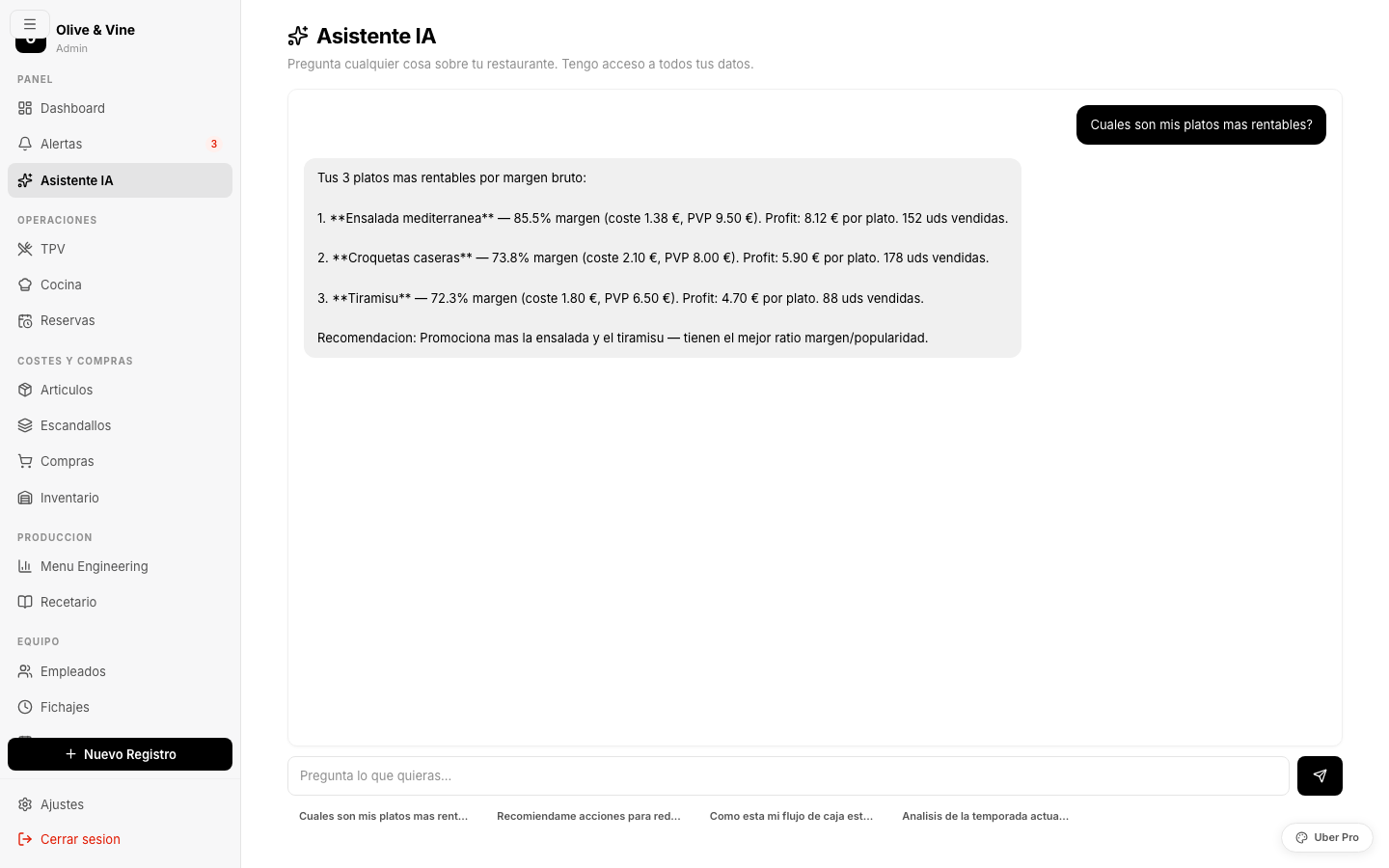
Ask anything. Get answers backed by real data.
Soamee's assistant is not a generic chatbot hooked up to the internet. It's a model that works on your restaurant's real data: your sales, your purchases, your inventory, your recipe costings and your suppliers. Write in plain language and get answers with concrete figures.
There are no commands or special formats to learn. If you could ask an operations director, you can ask the assistant.
- Full access to sales, costs, inventory, HR and purchasing
- Answers with exact figures and period-on-period comparisons
- Actionable recommendations, not just information
- Conversation history so decisions can be traced
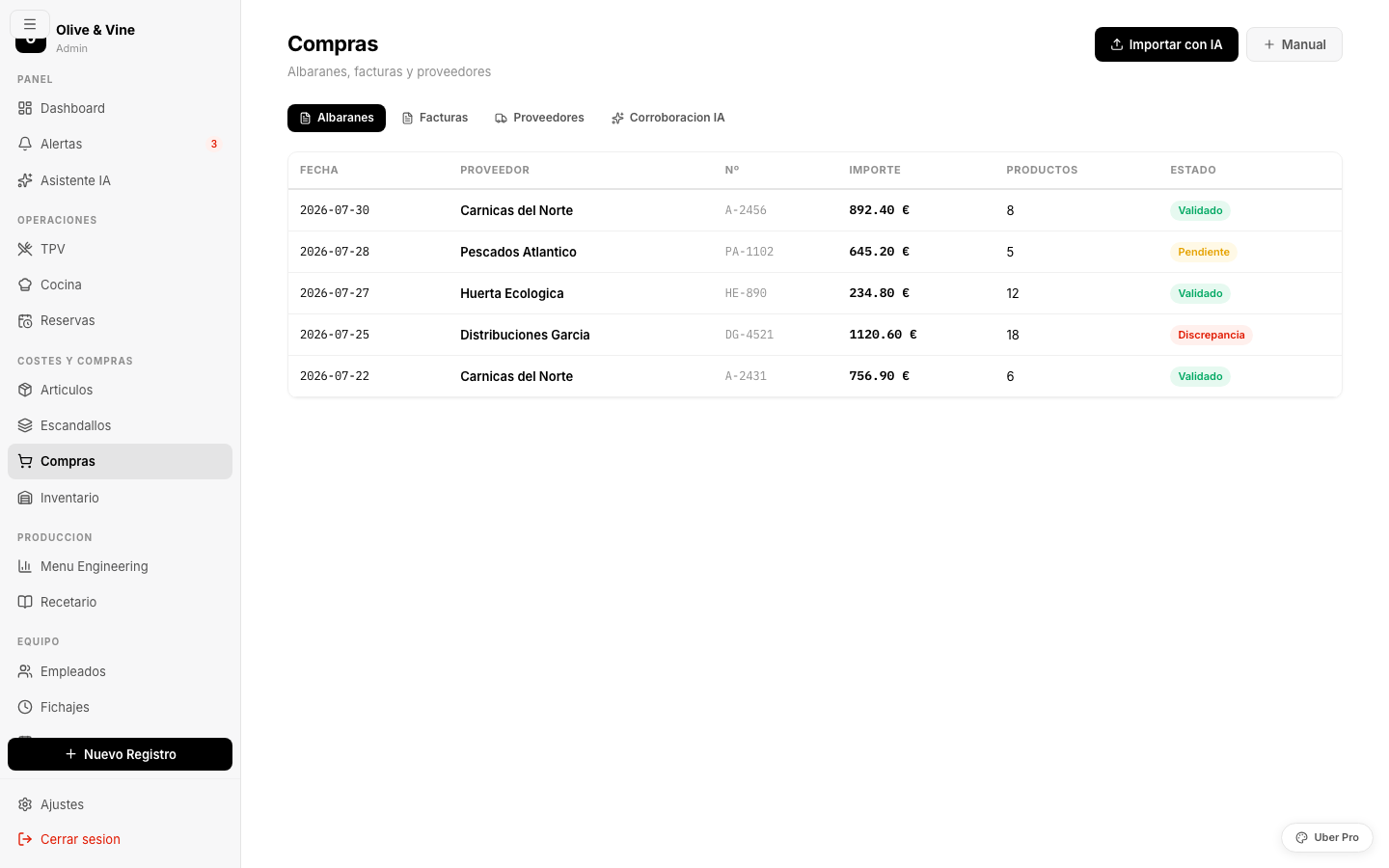
Photograph the delivery note. The AI extracts everything on its own.
Paper delivery notes arrive every day. Copying that data into the system by hand is slow, dull and error-prone. With Soamee you take out your phone, photograph the note and the AI automatically extracts the supplier, the date and every product with its quantity, unit of measure and unit price.
The system recognises the formats of over 200 common distributors in the sector. If the note is a PDF or spreadsheet, it processes that too. Average time to digitise a delivery note drops from 8 minutes to 15 seconds.
- Extraction from photo, PDF or spreadsheet — any format
- Recognises supplier, date, products, quantities and prices
- Updates the inventory automatically once you confirm
- Detects new products and offers to add them to the catalogue
- A full history of delivery notes by supplier and date
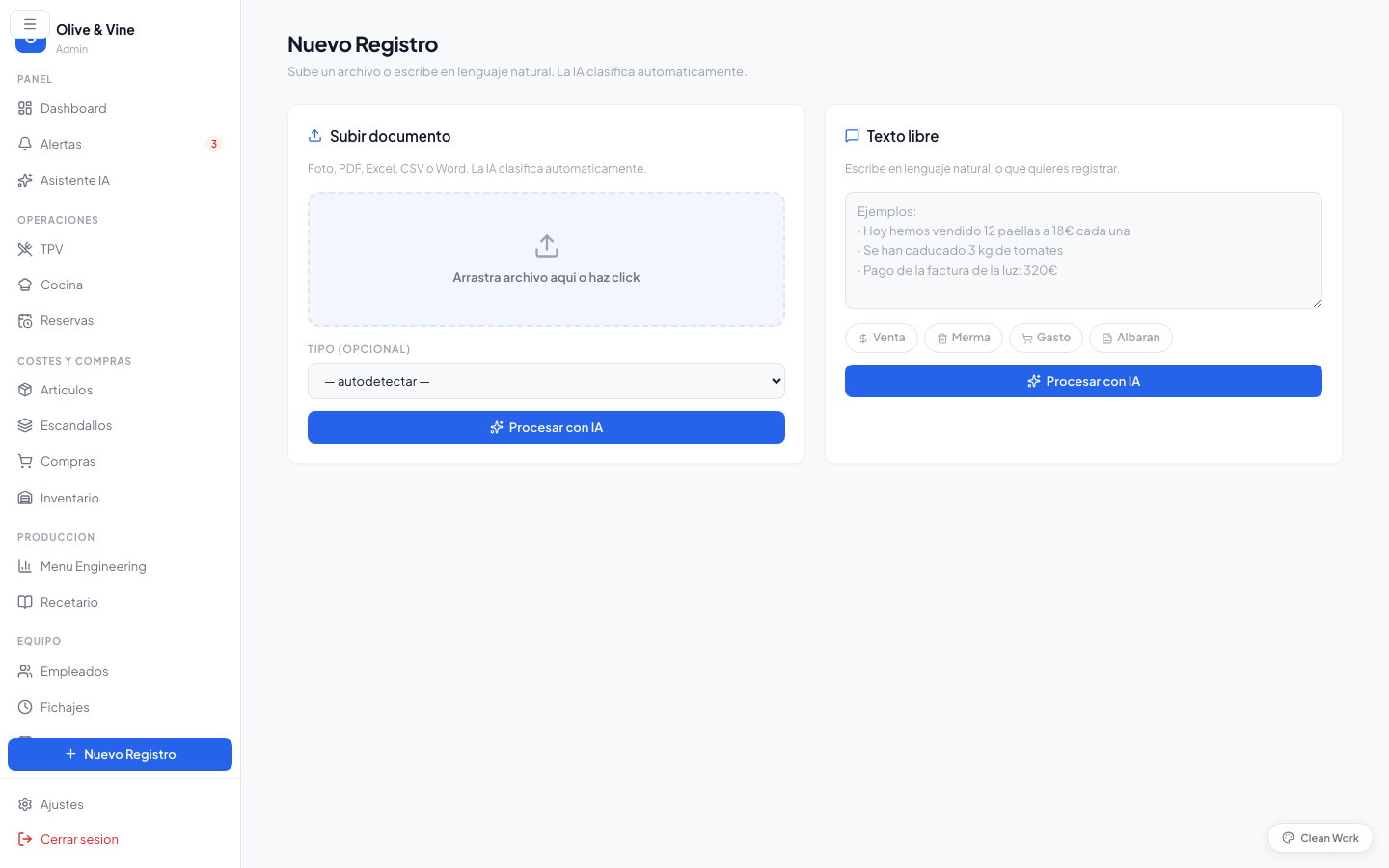
Delivery note vs invoice: the AI catches every discrepancy
How many times have you paid an invoice that didn't quite match what you received? In hospitality, mismatches between delivery note and invoice are more common than you'd think: different quantities, prices revised without notice, products billed that never arrived. Every one of those comes out of your pocket.
Soamee automatically cross-checks every invoice against its delivery note. If there's a difference — even €0.30 on the kilo price of beef — the system flags it in red and notifies you before you approve the payment. Nothing to review by hand.
- Line-by-line comparison between delivery note and invoice
- Real-time alerts for price or quantity differences
- A record of historical discrepancies by supplier
- Approval flow: an invoice is only marked as paid after confirmation
The AI tells you what to run as the daily special so nothing goes to waste
Every morning the system reads your digital fridge: which products are closest to their use-by date, what quantities are available and which dishes from your menu or recipe book can be made with those ingredients. From that, it suggests 2 to 4 daily specials matched to your actual stock.
The criterion isn't only "what expires first". The assistant combines that with each dish's margin and its historical popularity. It suggests what's urgent to use up AND what will leave you a good margin. Two goals, one recommendation.
- Daily suggestions based on real expiry dates in the inventory
- Cross-referenced with the recipe book and costings to work out the special's margin
- A notification to the kitchen manager first thing
- A direct cut in food waste and shrinkage
- A history of accepted suggestions to sharpen future recommendations
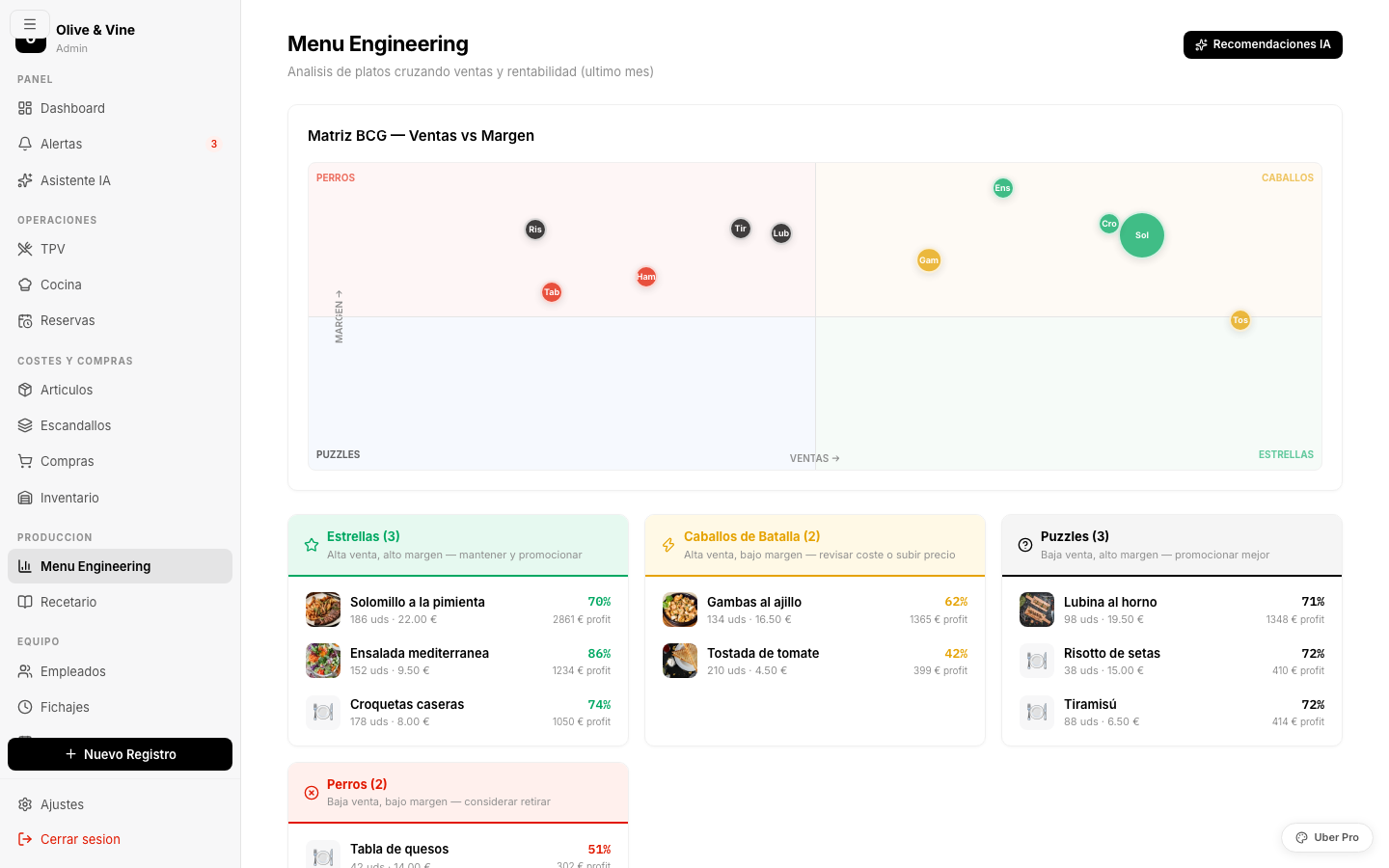
A BCG matrix of your menu: calculated and kept up to date automatically
Menu engineering is the most effective way to improve a restaurant's profitability without raising the average ticket. It pairs each dish's contribution margin with how often it sells and sorts the whole menu into four quadrants. The problem is that doing it by hand takes hours and usually happens once a year, if at all.
With Soamee the matrix updates automatically with every sale. At any moment you can see the real state of your menu and act on it.
High margin + high sales. Keep them, feature them on the menu, don't touch the price.
High sales + low margin. Raise the price or rework the ingredients.
High margin + low sales. Give them visibility, promote them, reposition them on the menu.
Low margin + low sales. Candidates to drop or redesign completely.
- A matrix that updates in real time with every sale recorded
- Concrete recommendations per quadrant — not just a classification
- Period comparison to see how each dish evolves
- Alerts when a dish moves quadrant
Type "3 kg of tomatoes past their date" and it's logged
One reason inventory control fails in restaurants is the friction of logging. If recording waste means opening a menu, searching for the product, picking a reason and saving, nobody does it. The result: theoretical stock never matches the real thing.
With Soamee's free-text logging, the manager writes in plain language from any device. The AI reads the message, identifies the product, the quantity, the unit and the type of movement (waste through expiry, waste through overproduction, stock adjustment, goods received), classifies it and records it. All in one step.
- Classifies waste, intake and adjustments automatically
- Recognises products from a partial or generic name
- Works from any device in 10 seconds
- A quick confirmation before recording, to avoid mistakes
Anticipate demand. Buy exactly what you need.
Buying too much means waste. Buying too little means "sorry, that dish is off". Both mistakes cost money. Soamee's predictive analysis combines sales history by weekday, time slot, seasonality and external events (holidays, local happenings) to forecast demand with a margin of error under 8%.
The result is a weekly purchasing proposal: which product to order, in what quantity and from which supplier. Accept it as it is, adjust it, or use it as a basis for negotiating with your distributors.
By day, time slot and dish type. The system learns with every week that passes.
It spots patterns: more salads in summer, more stews in winter, more cake on Sundays.
An automatically generated shopping list with quantities matched to the forecast.
It compares historical prices per supplier to suggest where to buy each product.
- A model that improves with every week of accumulated data
- Manual adjustment always available — the system doesn't decide alone
- Forecasts by category, product and time slot
- Deviation alerts when actual sales differ from the forecast
Every AI capability on a single platform
These aren't separate modules you have to integrate. Everything runs connected, on the same data and from the same interface.
Conversational assistant
Ask whatever you like in plain language. Answers from your real business data, not generic replies.
Delivery-note OCR
Photo of the delivery note → data extracted in 15 seconds. Works with paper, PDF and spreadsheets from any supplier.
Delivery note ↔ invoice check
Automatic detection of price, quantity or product discrepancies between the delivery note received and the invoice issued.
Daily menu suggestions
Every morning it proposes daily specials based on inventory expiry dates and each dish's margin.
Automatic menu engineering
A BCG matrix updated in real time. Your whole menu classified, with actionable recommendations per quadrant.
Free-text logging
Write any incident in plain language. The AI classifies it and files it in the right module, friction-free.
Demand prediction
Sales forecast by day and time slot with cumulative learning. A purchasing proposal matched to expected demand.
Proactive alerts
The system spots anomalies before they become problems: dishes with margins below the minimum, critical stock, invoices without a delivery note.
Supplier optimisation
Historical price analysis by supplier and product. The system suggests where to buy each ingredient to maximise margin.
Request an AI demo.
See how it works with real data.
In the demo we show you the conversational assistant, the delivery-note OCR and menu engineering working on a real restaurant's data. No PowerPoint decks.
No commitment. No cost. We reply within 24 working hours.
What people ask us about the AI
Does the AI need any setup, or does it work on its own from day one?
Does the conversational assistant access my real financial data?
Does the delivery-note OCR work with any supplier?
Can I use just the AI part without taking the whole platform?
Is my data safe? Does the AI use it to train external models?
Tell us your challenge. We'll propose a solution.
No commitment. Within 24 hours, you'll receive a proposal with scope, timeline and budget. No fine print.