In 2019, three researchers at ETH Zurich gathered every AI ethics guideline they could find published by companies, governments and organisations. They counted 84 documents. Five principles came up most often: transparency, justice and fairness, non-maleficence, responsibility and privacy. The list has grown since then, and many mid-sized companies now have their own “responsible AI principles” page.
That page won’t tell you whether your chatbot treats a customer called Lucía the same as one called Fátima. To find out, you have to send it both conversations and compare the answers. This post is about that step: how to go from a principle to a test you can run, measure and repeat.
Why principles aren’t enough
The same year, the philosopher Brent Mittelstadt published a paper whose title sums it up: Principles alone cannot guarantee ethical AI. His argument compares AI with medicine, where the principles approach comes from (autonomy, beneficence, non-maleficence, justice). In medicine, principles work because they rest on four things that software development doesn’t have:
- A shared goal. A doctor works for the patient’s health. A product team works for the company, and the user’s interests sometimes line up with that and sometimes don’t.
- A profession with a history. Centuries of cases, codes of conduct and professional bodies that interpret what “do no harm” means in each situation.
- Methods for getting from principle to case. Ethics committees, clinical protocols, informed consent.
- Consequences for breaking the rules. A doctor can lose their licence. A developer who ships a biased model, for now, can’t.
The practical conclusion for a company is that a principle only does something when someone turns it into a test with a threshold and gives it an owner.
The seven European requirements and the test for each one
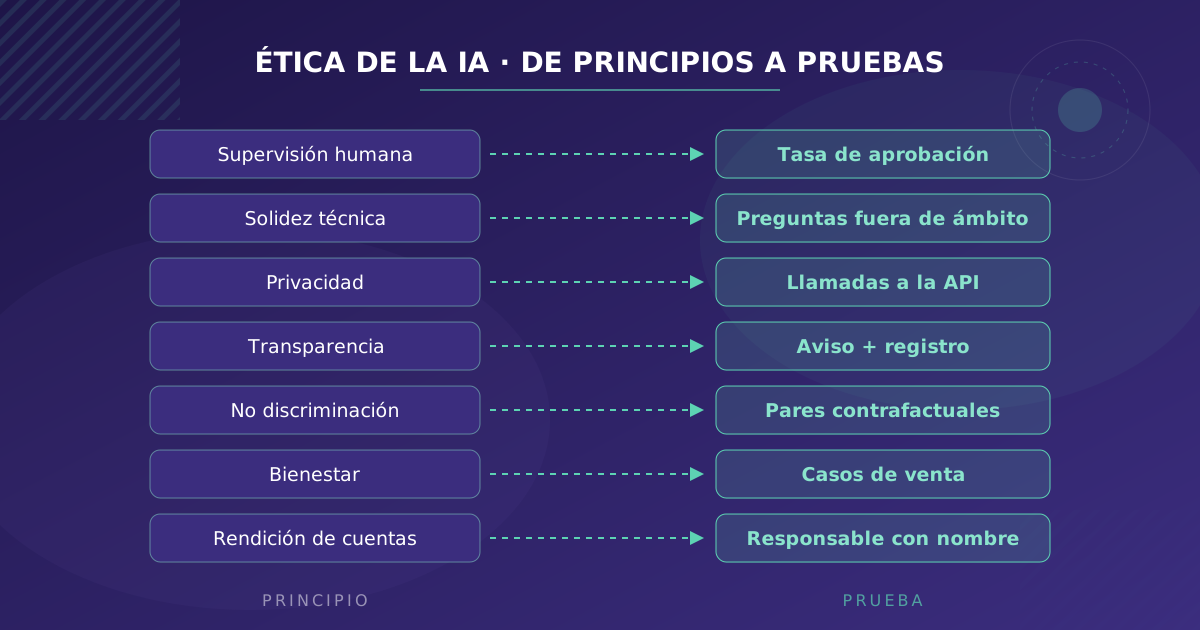
In 2019 the European Commission’s High-Level Expert Group published seven requirements for trustworthy AI. They are the direct predecessor of the EU AI Act, so they make a sensible starting point. This is how we translate them for a typical business system, such as a customer service chatbot or an assistant that sorts incoming requests:
| Requirement | Concrete question | Test |
|---|---|---|
| Human agency and oversight | Can a person review and override what the system decides? Do they actually do it? | Measure the approval rate and the time per review of whoever supervises |
| Technical robustness and safety | What does the system do with out-of-scope questions or attempts to manipulate it? | A battery of out-of-scope questions and prompt injection attempts |
| Privacy and data governance | What personal data goes out to the model provider, and where is it processed? | Review the API calls and the data processing agreement |
| Transparency | Does the user know they’re talking to an AI? Can you reconstruct why it gave a particular answer? | Check the notice in the first reply, and check that every reply is logged with its context |
| Diversity and non-discrimination | Does the answer change if the user’s name, gender or age changes? | Counterfactual tests: pairs of conversations identical except for that one detail |
| Societal and environmental well-being | Does the system push users towards decisions that hurt them? | Review the cases where the system recommends or sells |
| Accountability | Who answers for it if the system gets it wrong? Can the user complain? | A named owner per system, and a complaints channel that reaches a person |
None of these tests needs a research team. Counterfactual tests, for example, use the same idea Bertrand and Mullainathan used in 2004 to measure hiring discrimination: they sent identical CVs with different names and counted how many got a callback. With a language model you can do the same with hundreds of pairs in an afternoon, and score the differences in tone with an LLM as a judge calibrated against human review.
When two principles clash
The part codes of ethics avoid most is that principles conflict with each other, and that is where ethics stops being a list and becomes a decision.
Fairness against fairness. In 2016, ProPublica analysed COMPAS, a system that scores the risk of reoffending in the United States, and found it made more mistakes with Black defendants by labelling them high risk. The company replied that the system was equally well calibrated for both groups: the same score meant the same probability of reoffending. Both things were true at once. That same year, Kleinberg, Mullainathan and Raghavan proved that, except in exceptional cases, it is mathematically impossible to satisfy both definitions of fairness at once when the groups have different base rates. You have to choose which one matters more in your case, and the model can’t make that choice for you.
Transparency against privacy. To explain why the system said something, you need to keep the whole conversation with its context. To minimise personal data, as the GDPR requires, you should keep as little as possible. The usual way out is to keep everything for a short period, pseudonymised, and hold on longer only to the cases flagged as incidents. It’s a compromise, and it should be written down as one.
Human oversight against cost. Reviewing every decision a system makes wipes out much of the saving that justified automating in the first place. Reviewing a sample is cheaper, but leaves decisions unreviewed. The useful question is which decisions can’t go unreviewed (rejecting a candidate, refusing a service) and which can (classifying a ticket).
In all three cases, what can be demanded of a company is the same: decide explicitly, write down the reason and put the name of whoever decided it. This is what Mittelstadt found missing: a method for getting from principle to case, however modest.
Which part is mandatory
The EU AI Act turned part of those seven requirements into law, on different dates:
- From August 2026, any chatbot has to disclose that it is an AI, and synthetic content has to be marked (Article 50).
- From December 2027, after the delay introduced by the Digital Omnibus, high-risk systems (recruitment, credit, insurance, education, essential services) need risk management, quality data, logging, human oversight and, in some cases, a fundamental rights impact assessment.
We explain this in more detail in our EU AI Act guide. The other requirements, such as user well-being or what to do when fairness clashes with itself, fall outside the law for most systems and are up to each company.
Where an SME should start
- Take inventory. List every AI system used in the company, including the AI features in your CRM, ATS or helpdesk. There are usually more than management thinks.
- Pick a system that affects people and write down three questions from the table above that apply to it.
- Turn each question into a test with a threshold. For example: “across 200 pairs of conversations that differ only in the name, the difference in the rate of replies that offer a solution is no more than two points”.
- Run it, store the result and repeat it every time you change model or prompt. An LLM’s behaviour changes with each version, and a test that passed in March tells you nothing about the June version.
- Document the conflicts that come up and who decided what.
If you’d rather we did it, we run responsible AI audits: inventory, test batteries on the systems that matter, and a report with an action plan your technical team and your legal adviser can both work from.