
The most uncomfortable case study to publish is your own. There is no client to credit and no third-party business numbers to hide behind: only a repository anyone can audit. This is the story of how soamee.com went from being an ordinary corporate site to the field test of our methodology.
The challenge
A boutique agency has an arithmetic problem. Our international clients come from Spain, Portugal, Italy, Germany and the English-speaking world, and every market wants to read in its own language. The site we needed was not a five-page site: it was a full catalogue of services, industries, integrations, comparisons and our own products, multiplied by five.
Run the numbers the classic way and the project does not add up. Translating and maintaining every landing page by hand eats the time that should go to client projects, and we all know how that story ends: Spanish stays current, German freezes for two years, and you end up with a site that makes a worse impression than having no German version at all.
The three concrete problems were:
- Multilingual parity: every new piece of content had to ship in five languages or not ship. No “temporary” exceptions that last forever.
- Constant technical quality at speed: publishing fast is easy; publishing fast without leaving broken metadata, phantom images and dead links behind is not.
- Opportunity cost: not one hour of the team spent on tasks a machine can do and verify.
Our solution
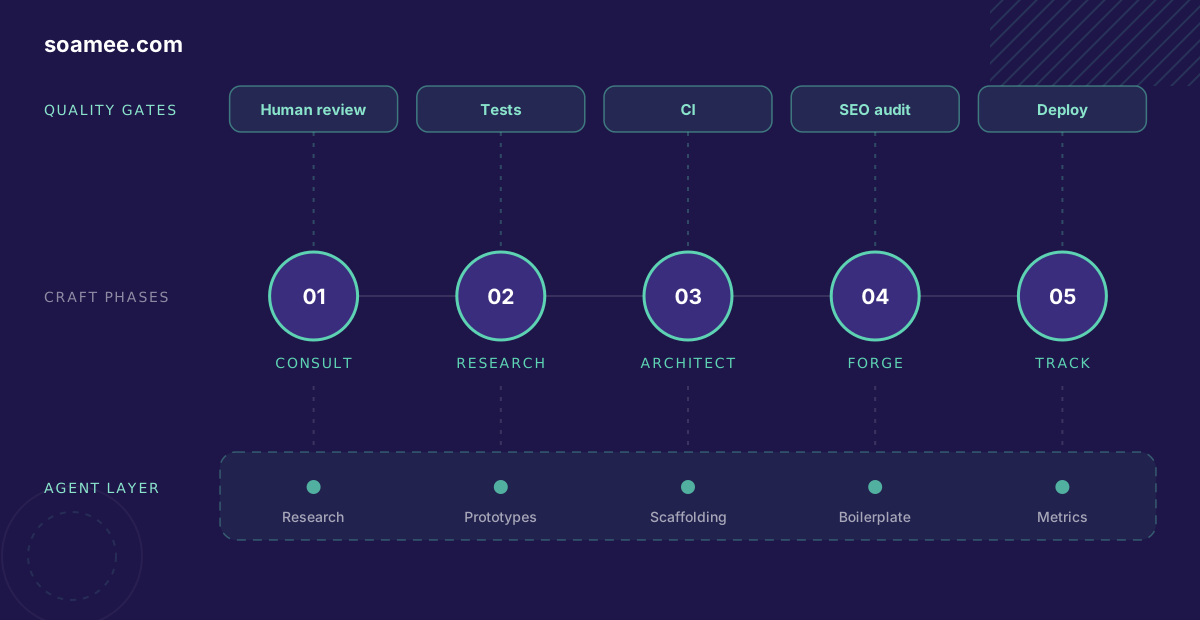
We applied to our own house the pipeline we use with clients: the CRAFT process (Consult, Research, Architect, Forge, Track) with a layer of AI agents underneath and a set of automated quality gates on top.
The decisions are still human
The site architecture, the design system, the content taxonomy and the editorial judgement were decided by the team. Agents do not pick what to build: they execute what has already been decided. Every change goes through human review before merging, no exceptions.
The agent layer handles the repetitive part
Wherever the work is mechanical and verifiable, we delegate:
- Translations into four languages of every article and landing page, reviewed afterwards
- Page scaffolding from templates and already-structured data
- Bulk migrations and refactors touching hundreds of files at once
- Check scripts and CI automations
The quality gates are never skipped
This is the part that makes the speed sustainable. Every change clears automated checks before reaching production, and the same checks run locally through a pre-push hook:
- Translation coverage: if content ships in Spanish without its four translations, the push fails
- Image verification: every referenced image exists, and two different entries never reuse the same file
- SEO audit: titles, descriptions,
h1s, canonicals andhreflangfor every built URL - Schema.org validation: the JSON-LD of every template, checked
- Social cards: every URL gets its own card with its own copy, rendered on demand
On top of that run the scheduled audits: Lighthouse, a broken-link detector, a metadata guard and ranking snapshots. 22 automations in total.
Social cards, one example of the approach
A small detail illustrates the difference well. Every URL on the site has its own social thumbnail, carrying the title and description of that specific page and the design of its section. Not a single image is stored in the repository: they are rendered on demand with satori and resvg, with no browser involved, and cached in memory.
Doing that by hand for a thousand pages is not viable. Automated, it is one template per content family plus an endpoint. That is the kind of work that changes category once the marginal cost of execution collapses.
Results
- 996 pages published and maintained, dynamic routes excluded
- 5 languages at genuine parity: Spanish, English, Portuguese, Italian and German
- 635 blog articles (127 Spanish originals plus their four translations)
- 130 case studies published (26 cases × 5 languages), always in sync
- 67 components in our own design system, no bought templates
- 22 CI automations watching translations, images, SEO, Schema.org, links and performance
The number that matters most to us is not the volume but the parity. Keeping five languages aligned is the first thing any capacity-constrained team abandons: it is the honest indicator of whether a pipeline works or merely sounds good on a landing page.
What did not work
We publish the small print too, because a case study without it is worth nothing.
Original visual design was where we got the least help: generated output tended towards the generic, and it had to be redone by hand until the identity clicked. Product decisions and complex business logic remained entirely human and consumed exactly the time you would expect. And in the first weeks we underestimated review: without the quality gates, speed produced debt faster than it produced pages. The automations were born precisely there.
Tech stack
- Framework: Astro 5 in hybrid mode (SSR with
@astrojs/node) - Styling: Tailwind CSS v4 with our own design system
- Interactivity: React islands where they are needed
- Content: Markdown Content Collections for blog and cases
- Social images: satori + resvg, rendered on demand
- CI/CD: GitHub Actions and deployment on Dokku
- Quality: in-house Node checkers running in CI and in git hooks
How we work
Every project follows our artisan process, adapted to each client's specific needs.
Discovery & Requirements
Deep dive into business, users and objectives. Ideation workshops, market research and MVP scope definition.
Design & Architecture
Wireframes, interactive prototypes and technical architecture. Client validation before writing code.
Development & Testing
2-week sprints with demos. CI/CD, code review and continuous testing. Feedback every iteration.
Delivery & Evolution
Production deploy, monitoring and support. Post-launch metrics and continuous improvement roadmap.