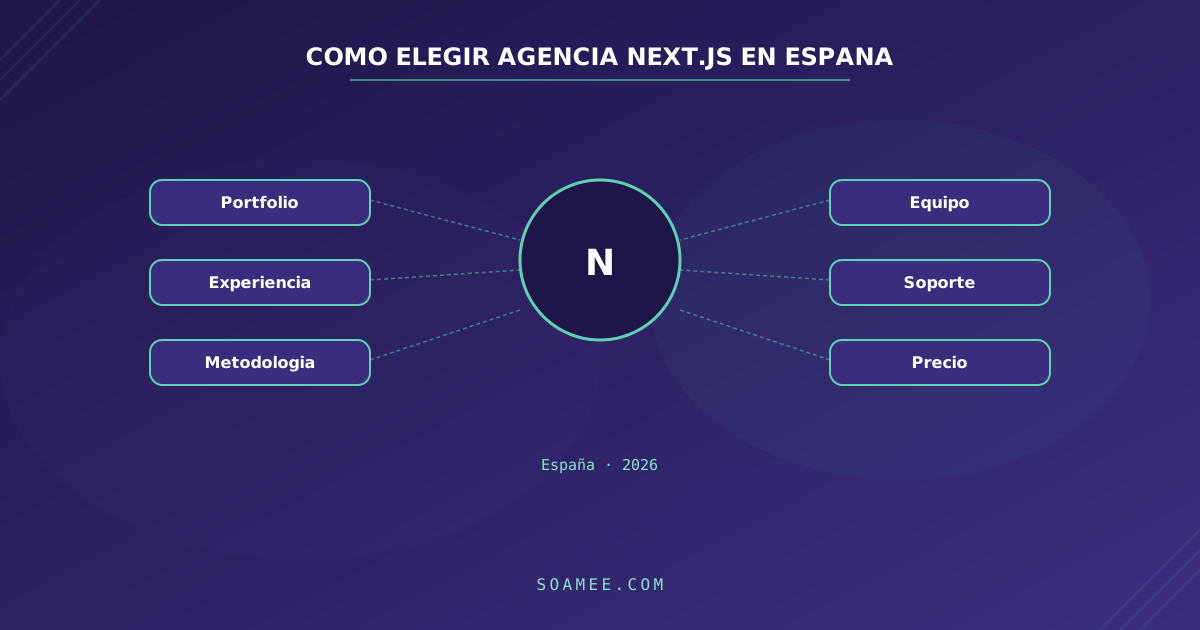
Next.js has become the go-to framework for building websites and digital products with React. But that popularity has a side effect: almost any development agency claims to “do Next.js”, even if their real experience is limited to setting up a landing page from a template. Choosing the wrong technical partner costs months and tens of thousands of euros.
This guide summarizes what you should evaluate when choosing a Next.js agency in Spain, which red flags indicate you are dealing with the wrong vendor, and a final checklist you can use in your sales meetings.
Why the Framework Matters (and Why Hiring Goes Wrong)
Next.js is not “React with a router”. It is a full-stack framework with its own rendering decisions (SSR, SSG, ISR, streaming), a multi-layer caching model, and an architecture — the App Router with React Server Components — that radically changes how an application is structured.
What does this mean in practice? A team that has only built SPAs with React can deliver a Next.js project that works in the demo and collapses in production: pages rendered on the client when they should be served from the server, cached data that never gets invalidated, runaway hosting costs, or disastrous technical SEO.
If your website is an acquisition channel (SEO, campaigns, conversion), the difference between a correct implementation and a mediocre one is measured in traffic and sales, not just code quality. We explain this in detail in our comparison Next.js vs Astro in 2026.
What to Look at When Evaluating a Next.js Agency
1. Real App Router and SSR Experience
Since Next.js 13, the App Router with React Server Components is the standard. The learning curve is considerable and there is a lot of “tutorial knowledge” in circulation. Concrete questions that separate those who master it from those who have merely read about it:
- When would you use a Server Component and when a Client Component? Where do you draw the boundary?
- How do you manage data caching and revalidation (
revalidate, tags, on-demand)? - What rendering strategy would you use for a 10,000-product catalog? And for a private dashboard?
- How do you keep the client bundle from growing out of control?
You don’t need to understand the answers in detail: pay attention to whether they answer with lived cases (“in one project we ran into…”) or with generalities from the documentation.
2. Verifiable Cases in Production
The PDF portfolio is worthless. Ask for real production URLs and spend twenty minutes checking them:
- Core Web Vitals: run the URLs through PageSpeed Insights. A Next.js specialist consistently delivers LCP < 2.5s on mobile.
- Technical SEO: look at the served HTML (View source). Is the content in the initial HTML or is everything painted with JavaScript?
- Contactable references: ask to speak with one or two clients. A five-minute call says more than any sales proposal.
In our case studies we publish names, URLs and results precisely for this reason: because it must be verifiable.
3. In-House Team vs Subcontracted
A significant share of agencies in Spain subcontract development to freelancers or external factories. It’s not illegitimate, but it changes what you are buying:
| Factor | In-house team | Subcontracted |
|---|---|---|
| Quality consistency | High (shared standards, internal code review) | Variable depending on who touches it |
| Turnover during the project | Low | High (the freelancer takes another project) |
| Accumulated knowledge | Stays in the agency | Leaves with each person |
| Communication | Direct with whoever writes the code | Through intermediaries |
| Accountability | Clear | Diluted |
Ask explicitly: who will write my project’s code? Are they on staff? Can I interview them before signing? If the answer is evasive, you already have your answer. We expand on this comparison in agency vs in-house team.
4. Work Process and Transparency
A serious Next.js project needs process, not just talent:
- Repository under your name from day one, with full access to the code
- CI/CD and preview environments (every branch automatically deployed for review)
- Short sprints with demos: working software every one or two weeks
- Clear definition of “done”: tests, code review, performance criteria
5. Maintenance and Evolution
Next.js ships major versions frequently and the React ecosystem moves fast. An unmaintained project accumulates debt within months. Before signing, clarify:
- Do they offer a maintenance contract with a response SLA?
- Does it include version updates and security patches?
- Do they monitor errors and performance in production (Sentry or similar)?
- What does a monthly evolution retainer cost?
6. Where It Gets Deployed and Who Pays the Bill
The hosting decision drives recurring cost: Vercel is convenient but can get expensive at high traffic; a container-based deployment (AWS, Hetzner, Dokku) gives cost control in exchange for more operations. A good agency presents you the options with estimated numbers instead of pushing you by default towards the platform that is most convenient for them.
Red Flags
- “Yes to everything” in the first meeting, without asking you uncomfortable questions about scope, content or integrations.
- Fixed quote without discovery: nobody can seriously estimate a product without understanding the flows and integrations.
- They show no code or URLs, only pretty screenshots.
- Price far below market: in Spain, professional Next.js development rarely goes under 45 EUR/hour; much lower rates imply chained subcontracting or unsupervised juniors.
- Covert lock-in: repository in their account, infrastructure in their name, no deployment documentation.
- No technical opinion: if they never push back, you are not hiring judgment, only hands.
Checklist for Your Decision
Use this list in meetings with each candidate agency:
- ☐ They showed me 3+ Next.js projects in production, with URLs
- ☐ Those projects’ Core Web Vitals are good on mobile
- ☐ They explained concrete App Router/SSR decisions with real cases
- ☐ I know who will code my project and whether they are on staff
- ☐ I can interview the team before signing
- ☐ The repository will be under my account from the start
- ☐ There is CI/CD, preview environments and regular demos
- ☐ They offer maintenance with an SLA, not just “support on demand”
- ☐ They presented hosting options with estimated costs
- ☐ I spoke with at least one real reference
- ☐ The contract makes intellectual property clear (all code is mine)
- ☐ They started by proposing a short phase (discovery or pilot), not a 12-month contract
If an agency passes 10 of the 12 points, you are looking at a serious partner.
And Why Spain?
If your company is outside Spain, hiring here combines rates 30-50% lower than the UK or Germany with a European timezone, native GDPR and one of southern Europe’s largest React/Next.js talent pools. We analyze it in depth in nearshore software development from Spain.
Frequently Asked Questions
How much does a Next.js agency charge in Spain?
Between 45 and 90 EUR/hour depending on seniority, city and specialization. A corporate website with Next.js usually starts at 15,000-25,000 EUR; a product with SSR, authentication, integrations and an admin panel can exceed 60,000 EUR. Be wary of far lower quotes without a convincing explanation.
How do I verify that an agency truly masters Next.js?
With evidence, not with talk: production URLs, Core Web Vitals measured by you, technical questions about the App Router and caching, and contactable references. Whoever has solved those problems explains them with concrete examples.
Is a Next.js specialist agency better than a generalist one?
If the website is a critical business channel, specialist: they will know the caching, rendering and serverless cost traps before falling into them. For a simple website with few pages, a competent generalist (or even a simpler stack) may be enough.
What should Next.js project maintenance include?
Framework and dependency updates, error and performance monitoring, security patches, an evolution retainer and a response SLA. Maintenance is not optional in an ecosystem that ships major versions every year.
Conclusion
Choosing a Next.js agency in Spain is above all an exercise in verification: real projects in production, an identifiable in-house team, a transparent process and maintenance committed by contract. Serious agencies fear none of the questions in this guide; the others give themselves away.
At Soamee we build products with Next.js and React from Madrid for clients in Spain, Europe and the United States, with an in-house team and verifiable public cases. If you are evaluating options, book a free consultation or take a look at our web development service and our Next.js developers in Europe.