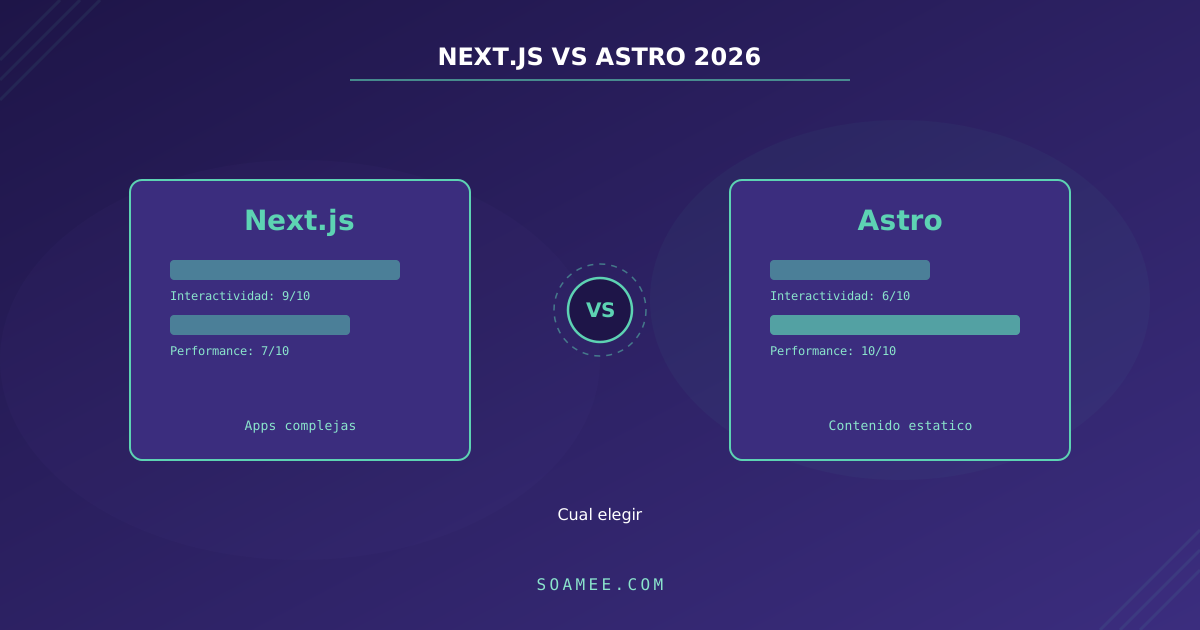
Next.js and Astro are two of the most relevant frameworks in the web ecosystem in 2026, but they solve fundamentally different problems. Choosing between them without understanding these differences is like choosing between a truck and a sports car without knowing whether you need to transport goods or win a race.
At Soamee we use both frameworks in production. Our own website is built with Astro. Projects like trasterOne and InfoAdex are built with Next.js. This first-hand experience allows us to make an honest comparison, without favoritism.
Current State of Each Framework
Next.js (Vercel)
Next.js 15 has consolidated its position as the most complete React framework. Server Components are now the default paradigm, the App Router is mature, and Server Actions simplify data mutations. The integration with Vercel remains the best deployment experience, although it works perfectly on any Node.js hosting.
Current version: Next.js 15.x Engine: React 19 + Server Components Rendering: SSR, SSG, ISR, streaming Runtime: Node.js (or Edge)
Astro
Astro has evolved from being “a static site generator” to a complete web framework with Content Collections, Server Islands, and native View Transitions. Its zero-JS-by-default philosophy remains its greatest strength, but it now supports interactive islands with any framework (React, Vue, Svelte, Solid).
Current version: Astro 5.x Engine: Agnostic (React, Vue, Svelte, Solid, none) Rendering: SSG by default, optional SSR, Server Islands Runtime: Node.js (SSR) or static
Technical Comparison
Performance
| Metric | Next.js 15 | Astro 5 |
|---|---|---|
| JS sent to client (typical page) | 80-200 KB | 0-30 KB |
| Time to Interactive (content) | 1.2-2.5s | 0.3-0.8s |
| Lighthouse Performance (content) | 85-95 | 95-100 |
| Lighthouse Performance (interactive app) | 80-95 | 70-90 |
| Build time (500 pages) | 60-120s | 30-60s |
| Cold start (SSR) | 200-500ms | 100-300ms |
Astro wins clearly for content-oriented sites. By not sending unnecessary JavaScript, pages load faster, have better Core Web Vitals, and higher Lighthouse scores. For the Soamee website, we chose Astro precisely for this reason: a corporate site does not need to hydrate a complete framework on every page.
Next.js wins for interactive applications. When you need shared state between components, client-side navigation, complex forms, or real-time updates, React’s model with Server Components is more natural and efficient.
Architecture and Paradigm
Next.js: everything is React
App Router → Server Components (RSC) → Client Components where neededNext.js assumes your application is React. Server Components render on the server, Client Components hydrate on the client. Routing is file-based and Server Actions handle mutations. Everything is integrated.
Astro: islands of interactivity
Astro pages (0 JS) → Interactive islands (React/Vue/Svelte) where neededAstro starts from the opposite premise: pages are static HTML by default. You only add JavaScript where you truly need it, and you can use any framework for those interactive islands.
Ecosystem and DX
| Aspect | Next.js 15 | Astro 5 |
|---|---|---|
| Component ecosystem | Huge (shadcn, Radix, etc.) | Uses React/Vue/Svelte components |
| Built-in CMS | No (use headless CMS) | Content Collections (Markdown/MDX) |
| Official integrations | Middleware, API routes, caching | 100+ integrations (Tailwind, sitemap, etc.) |
| Deploy | Vercel, Netlify, Docker, Node.js | Any static hosting + Node.js |
| Learning curve | Medium-high (RSC, caching, etc.) | Low-medium |
| TypeScript | First-class | First-class |
When to Choose Next.js
1. SaaS Applications and Dashboards
If you are building a SaaS product with authentication, roles, interactive dashboards, and complex flows, Next.js is the natural choice. The App Router with nested layouts, Server Components for queries, and Client Components for interactivity is a solid architecture.
With trasterOne we built a complete marketplace with map search, payment system, dashboards for owners and tenants, and a multi-step booking flow. All of this requires shared state and client-side navigation that Next.js handles natively.
2. Applications with Complex Authentication
Session management, OAuth, roles and permissions, conditional redirects: Next.js has native middleware and a mature ecosystem (NextAuth/Auth.js) for handling these scenarios.
3. Applications with Real-Time Data
If you need WebSockets, Server-Sent Events, or frequent polling, the Next.js model with API routes and Server Actions is more straightforward than trying to add these capabilities to an Astro site.
4. 100% React Teams
If your team already works with React and your application is interactive by nature, Next.js is the natural extension. It makes no sense to learn Astro only to write all pages in React anyway.
When to Choose Astro
1. Corporate and Marketing Websites
For corporate websites, landing pages, portfolios, and marketing sites, Astro is unbeatable. Zero JavaScript by default means ultra-fast pages, excellent Core Web Vitals, and better SEO.
The Soamee website (soamee.com) is built with Astro precisely for this reason. Every page loads in under 1 second, has a Lighthouse 100 performance score, and we do not need JavaScript on most pages.
2. Blogs and Content Sites
Astro’s Content Collections are the best implementation we have seen for managing Markdown/MDX content. Automatic typing, frontmatter validation, optimized queries. It is like having a built-in CMS without the complexity of one.
3. Technical Documentation
Starlight, Astro’s documentation theme, is probably the best documentation tool in the ecosystem. If you need technical docs, look no further.
4. Sites with Occasional Interactivity
If your site is mostly content but needs an interactive form, a carousel, or a search component, Astro’s islands are perfect. You add React (or Vue, or Svelte) only where you need it.
When the Decision Is Not Clear
There are scenarios where both frameworks are viable:
E-commerce
- Catalog + blog: Astro (content-heavy, limited interactivity)
- Cart + complex checkout: Next.js (shared state, multi-step flows)
- Hybrid: Astro for product pages + React island for the cart
Platforms with Public + Private Areas
- Public pages (home, blog, pricing): Astro would be ideal
- Private dashboard: Next.js would be ideal
- Pragmatic decision: Use Next.js for everything and optimize public pages with SSG
With Xceed and InfoAdex we chose Next.js because the entire application was interactive. But if we had had a large portion of public content, Astro would have been a valid option for that layer.
Migration Between Frameworks
From Next.js to Astro
It is viable if your site has become primarily content and the interactive parts are occasional. Astro can import React components directly, so the migration can be gradual.
From Astro to Next.js
It makes sense if your site has evolved into an interactive application and islands are no longer sufficient. Astro components (.astro) need to be rewritten, but React components you already have will work directly.
Migration Cost
In our experience, a typical migration between frameworks takes 4-8 weeks for a medium site (50-100 pages). The biggest cost is not the code, but replicating the specific optimizations and configurations.
Frequently Asked Questions
Can I use React in Astro?
Yes. Astro supports React components as interactive islands. You can have an Astro page with a React form, a Vue search component, and the rest as static HTML. It is one of its greatest strengths.
Is Next.js slower than Astro?
It depends on context. For static content, yes: Next.js sends more JavaScript. For interactive applications, Next.js can be faster because its hydration model is more efficient than multiple independent islands.
Which has better SEO?
Both are excellent for SEO. The difference is that Astro has better performance by default (less JS = faster pages = better Core Web Vitals), but Next.js with well-configured SSG achieves similar results.
What do large companies use?
Next.js is used by companies like Netflix, TikTok, Twitch, and Nike. Astro is used by companies like Google (Firebase docs), Microsoft, Porsche, and The Guardian.
Our Recommendation
| Your project is… | Use |
|---|---|
| SaaS / Dashboard / Interactive app | Next.js |
| Corporate website / Marketing | Astro |
| Blog / Content | Astro |
| Complex e-commerce | Next.js |
| Technical documentation | Astro |
| Marketplace with search/filters | Next.js |
| Landing pages / Microsites | Astro |
| App with authentication/roles | Next.js |
If you are not sure which framework is right for your project, we can help. In our web development service we analyze the requirements and recommend the optimal architecture. Book a free consultation and let us look at it together.