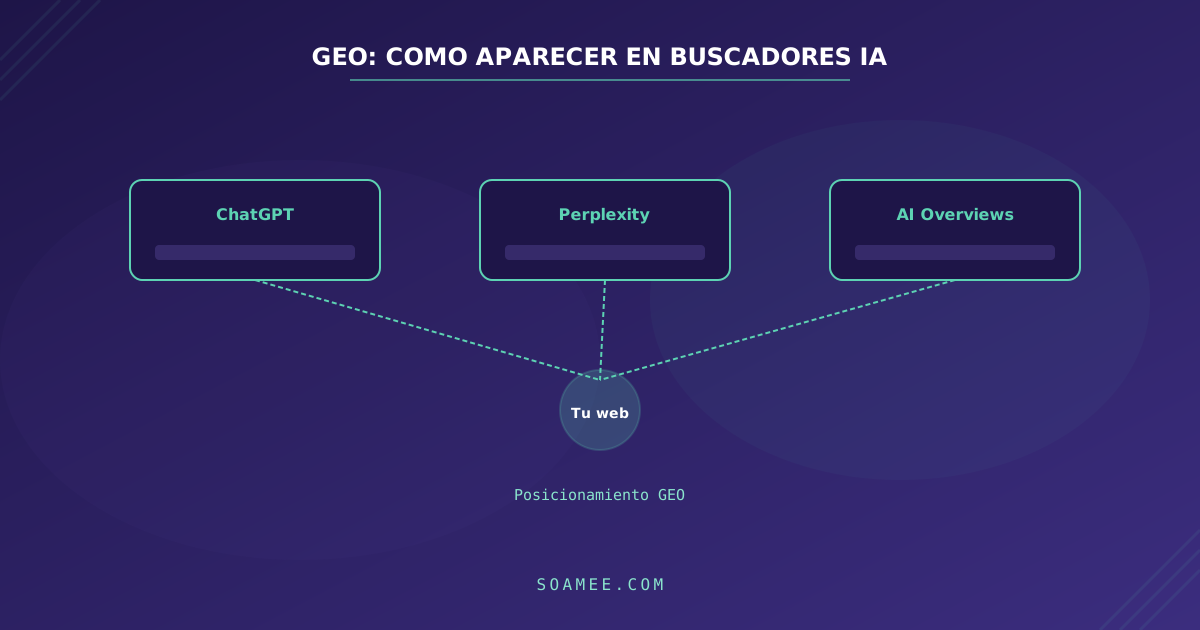
More and more clients tell us the same story: a lead shows up to the first meeting saying “I found you by asking ChatGPT.” No Google click, no ad. The discovery happened inside a conversation with an AI — and in there, you either get cited, or you don’t exist.
That is what GEO (Generative Engine Optimization) solves: getting generative AI systems to use you as a source when answering questions about your industry. In this guide we explain what it is, how these systems choose their sources, how it differs from classic SEO, and which tactics you can apply today.
What GEO (and AEO) is and why it matters in 2026
GEO is the discipline of optimizing content so that generative engines — ChatGPT, Perplexity, Gemini, Google’s AI Overviews — retrieve it, cite it, and attribute it in their answers. You will also hear about AEO (Answer Engine Optimization), focused on answering specific questions directly; in practice they overlap so much that the tactics are the same.
Why does it matter now? Because a growing share of discovery no longer goes through ten blue links: AI Overviews appear in an ever-larger fraction of searches, and the pattern repeats in every analytics account we audit — fewer clicks from the classic SERP, more sessions with referrals from chatgpt.com or perplexity.ai. Few of them, but with extremely high intent, because they arrive with the recommendation already made.
The underlying shift: in classic search you competed for the click; in generative search you compete to be the source of the answer. And whoever is not a source is invisible.
How AI systems choose their sources
There is no public algorithm, but the observable behavior is consistent: these systems retrieve candidate pages from a search index and then extract and synthesize whatever answers the question. To pass both filters, five things matter:
- Crawlable content. If your site blocks GPTBot, PerplexityBot, or ClaudeBot in
robots.txt, or the content only exists after executing JavaScript on the client, there is nothing to cite. Server-rendered HTML, just like for Google. - Direct answers. Models extract fragments that answer the question in a self-contained way. A clear definition in the first paragraph has far better odds than the same idea diluted across eight hundred words of introduction.
- Structured data. Schema.org (
FAQPage,Article,Product,LocalBusiness) makes content machine-readable: it defines entities, relationships, and factual data without ambiguity. - Authority and mentions. Models “learn” who the reference is on each topic from how often a brand appears in sources they consider reliable: media outlets, industry directories, Wikipedia, Reddit, G2. It is the GEO equivalent of backlinks — but mentions count, with or without a link.
- Freshness. Given equivalent sources, systems with search prioritize up-to-date content, with visible dates and recent data. A 2022 article with 2021 figures loses to one that is kept current.
GEO vs. classic SEO
The inevitable question: does this replace SEO? No. They are complementary layers on the same foundation:
| Classic SEO | GEO | |
|---|---|---|
| Goal | Rank and win the click | Be cited in the answer |
| Who reads you | Crawler + person | Crawler + language model |
| Unit of success | Position and CTR | Citation, mention, and attribution |
| Key signals | Keywords, backlinks, Core Web Vitals | Direct answers, structured data, brand mentions |
| Measurement | Search Console, rankings | AI referrals in GA4, mentions in answers |
| Outcome | Traffic from the SERP | Traffic + a recommendation with the decision half-made |
The dependency is direct: generative engines retrieve candidates from traditional search indexes, so a page that does not rank is unlikely to be cited. Everything you were already doing well in SEO — including a good programmatic SEO strategy, whose structured, data-rich pages are exactly what these systems want to cite — still counts. GEO adds the “extractable and citable” layer on top.
Concrete GEO tactics
1. A direct-answer block at the top of the page
Every important page should open with a 40-70 word paragraph that answers the main question in a self-contained way: what it is, who it is for, how much it costs. That is the fragment a model can lift verbatim. After that, elaborate as much as you like — the opening block is for machines and for humans in a hurry, which is almost everyone.
2. FAQ with Schema.org
Frequently asked questions with FAQPage markup are perfect ammunition for answer engines: explicit question, concise answer, machine-readable format. Use your customers’ real questions (the ones that come through your form, the ones people ask on Reddit or in industry forums), not the ones you wish they asked.
3. llms.txt
An emerging standard: a Markdown file at the root of your domain (/llms.txt) that summarizes what your company is and links your key content, so AI agents can understand your site without crawling all of it. Adoption is still early: treat it as a cheap bet (twenty minutes), not a pillar. And in the meantime, make sure your robots.txt is not blocking GPTBot and friends by accident.
4. Citable content with proprietary data
Models cite what contributes facts: figures, comparisons, benchmarks, methodologies. “68% of our projects migrate from a previous agency” is citable; “we are the quality leader” is not. If you have proprietary data from your operations or your industry, publishing it well-structured is the highest-return GEO tactic there is — nobody else can copy it.
5. Presence in the sources LLMs cite
Ask ChatGPT and Perplexity about your category (“best software consultancies in Madrid”) and look at which sources they cite: almost always media outlets, industry directories, Reddit, G2/Capterra, Wikipedia. Being present in those sources — through digital PR, well-maintained directory listings, genuine participation in communities — moves the needle more than any meta tag.
How to measure it
GEO has a reputation for being unmeasurable. It is measurable, just with different tools:
- Referrals in GA4: create a custom channel grouping traffic from
chatgpt.com,perplexity.ai,copilot.microsoft.com,gemini.google.com, andclaude.ai. You will see small volumes and suspiciously high conversion rates — that is the signature of AI traffic. If your GA4 is not in good shape, start there: we cover it in how to implement GA4 with events and conversions. - AI Overviews in Search Console: Google reports them inside search performance; watch for impressions where you appear as a source.
- Brand mentions: periodically ask the main assistants about your category and record whether you appear, in what position, and with which sources. There are tools that automate this; a monthly spreadsheet already gives you the trend.
- “How did you hear about us?”: part of AI-influenced traffic arrives as direct. A field in your contact form remains the most honest attribution tool in existence.
What we do at Soamee
On our own website we practice what we preach — and you can see it in the code. Our service pages open with geo-answer blocks: a direct-answer paragraph marked up with schema.org/Answer right after the hero, summarizing the service in a self-contained, extractable fragment. On top of that: per-page FAQ with FAQPage in JSON-LD, static server-rendered HTML with Astro, and concrete data instead of generalities. It is the same GEO layer we build for clients on top of their SEO.
GEO checklist
- AI crawlers allowed in
robots.txt(GPTBot, PerplexityBot, ClaudeBot, Google-Extended depending on your policy) - Server-rendered HTML: the content exists without executing JavaScript
- Direct-answer block (40-70 words) at the top of every key page
- FAQ with Schema.org
FAQPagebased on real questions - Schema.org per page type (
Article,Product,LocalBusiness…) -
llms.txtpublished at the domain root - Citable proprietary data: figures, comparisons, or benchmarks only you can publish
- Visible dates and up-to-date content on the pages you want cited
- Presence in the sources cited by assistants in your category (directories, media, communities)
- “AI” channel in GA4 with the assistants’ referrals + monthly tracking of mentions
Conclusion
GEO is neither a fad nor a replacement for SEO: it is the logical consequence of more and more decisions starting inside a conversation with an AI. The good news is that the signals generative engines ask for — useful, structured content with real data, properly rendered — are the same ones that have worked in search engines for years. The difference lies in executing them with two readers in mind: the person and the model.
And like almost everything in growth, half the work is engineering: structured data, rendering, measurement. That part, we know how to do.
Want your brand to appear when someone asks an AI about your industry? Discover our GEO service →