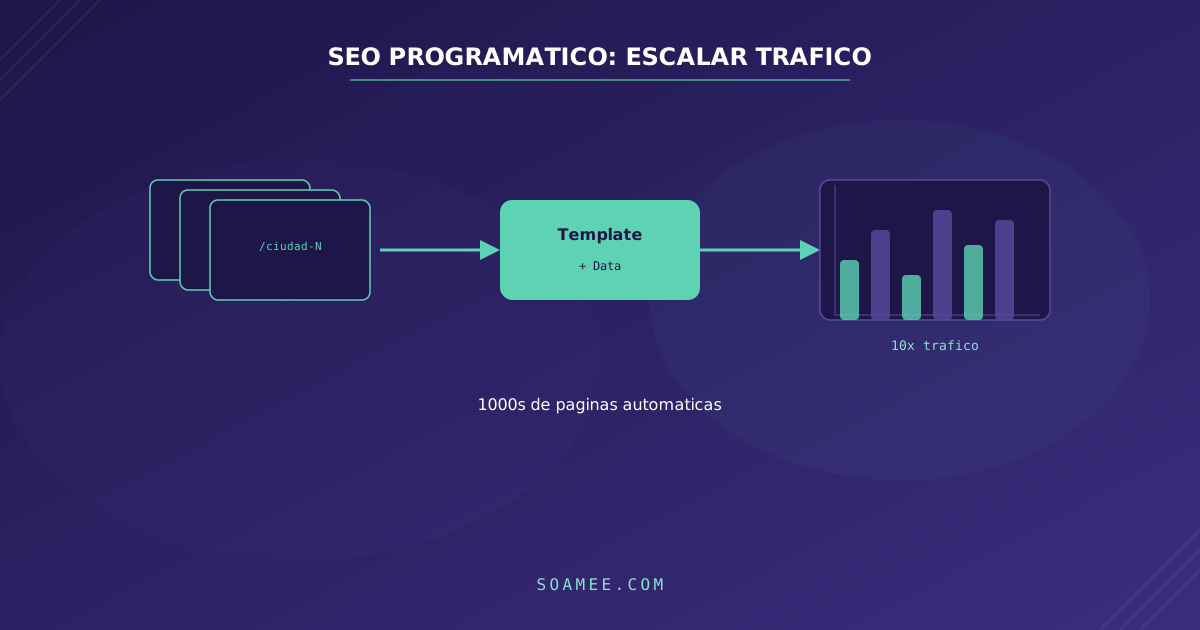
Writing one good landing page takes hours. Writing ten thousand is impossible… by hand. Programmatic SEO exists for exactly that: when search demand is spread across thousands of specific queries — “storage units in Chamberí”, “cheap storage units in the Eixample” — and you have the data to answer each one, the solution is not a copywriter: it is code.
It is one of the most profitable growth levers we know, and also one of the easiest to get wrong. In this guide we explain what it is, when it works, when it is plain spam, how it is built technically, and how we applied it in a real case.
What is programmatic SEO
Programmatic SEO consists of automatically generating landing pages from data. The formula is simple:
Template × Dataset = thousands of unique pages
Instead of writing every page, you design a template (structure, components, dynamic copy) and cross it with a structured dataset. The classic patterns:
- City × category: “storage units in Madrid”, “storage units in Barcelona”, “coworking in Valencia”
- Product × attribute: “running shoes for overpronators”, “CRM for real estate agencies”
- Entity × comparison: “X vs Y” for every relevant pair in your industry
- Location × operator: a page for each provider in every area where it operates
The big marketplaces have always done it: Idealista has a page per neighborhood, Tripadvisor per restaurant, Zillow per zip code. They don’t write those pages: they generate them from their database.
When it works (and when it’s spam)
Here is the line that separates a winning strategy from a penalty. Programmatic SEO works when two conditions hold at the same time:
- Long-tail demand with intent exists. Thousands of specific searches, each with little individual volume but clear intent (compare, buy, book). If nobody searches for “storage units in Pontevedra”, that page is dead weight.
- You have a proprietary dataset with real value. Up-to-date prices, availability, ratings, locations, features. Data the user cannot find aggregated anywhere else.
If either one is missing, what you are generating has another name: spam.
What Google says
Google’s guidelines are explicit against two patterns:
| Pattern | What it is | Example |
|---|---|---|
| Thin content | Pages with no substantial content or added value | 500 identical city pages where only the city name changes |
| Doorway pages | Pages created only to rank and redirect, with no value of their own | Near-duplicate landing pages all funneling to the same generic form |
Since the helpful content updates, Google evaluates whether a page exists for the user or for the search engine. Automatic generation is not the problem — Google says so literally: what matters is the value, not the production method.
How to stay on the right side
- Unique content per page: real data that genuinely changes between pages (number of facilities, prices from, ratings, a map of the area), not template text with the city swapped in.
- A minimum data threshold: if a combination does not have enough content (zero results, a single data point), do not generate the page — or mark it
noindexuntil you have it. - Real value: the acid test is asking whether the page would be useful even if Google did not exist. A comparison site with 300 real facilities in Madrid, yes. A landing page with two generic paragraphs, no.
Technical architecture
This is where programmatic SEO becomes an engineering problem, not a marketing one. The components:
1. A framework with SSG/ISR
Thousands of pages need server-rendered HTML — a SPA’s CSR is poison for SEO at scale. The two options we use:
- Next.js with ISR (Incremental Static Regeneration): pages are generated statically and regenerated on demand when the data changes, without a full rebuild. Ideal when the dataset updates daily.
- Astro with SSG: pure static generation, perfect when data changes less frequently and you prioritize maximum load speed.
2. Semantic URLs
The URL is a signal of relevance and architecture: /storage-units-madrid/ and /storage-units-barcelona-eixample/ say exactly what is inside. No /landing?city=28&cat=3. The URL hierarchy should mirror the dataset hierarchy (city → neighborhood → operator).
3. A dynamic sitemap
With thousands of pages appearing and disappearing as the dataset changes, the sitemap cannot be a static file: it is generated automatically from the database, with a real lastmod, so Google discovers and indexes every new page without waiting for the crawl.
4. Schema.org per page
Every page carries its JSON-LD with structured data of the appropriate type: LocalBusiness, Product, AggregateRating, FAQPage. It is what turns a landing page into a rich snippet with stars and prices in the results — and, as we will see, it also feeds AI search engines.
5. Programmatic interlinking
Internal linking is generated too: every city page links to its neighborhoods, every neighborhood to its operators, every operator to nearby areas. This distributes authority, creates crawl paths for Google, and — not a minor point — is useful navigation for the user.
Real case: trasterOne
This is how we applied it at trasterOne, Spain’s number one self-storage comparison site. The challenge: ranking a brand-new platform in a fragmented market where individual operators already had SEO presence.
The solution was a Next.js architecture with SSR and ISR that automatically generates thousands of landing pages by city, neighborhood, and operator — Madrid with 333 facilities, Barcelona with 327 — with no manual intervention. Every page carries its Schema.org (LocalBusiness, Product, AggregateRating), the sitemap regenerates as facilities are added, and the URLs are semantic and local (/trasteros-madrid/, /trasteros-barcelona-eixample/).
The key point: every page has real value. Behind it sits a dataset of 2,000+ storage facilities across Spain and Andorra with prices, Google Reviews ratings, filters, and a 3-step booking flow. These are not doorway pages: they are the product. The result is the sector’s reference platform in 7 major cities, recognized with the AESS Innovation Award 2025 from the Spanish Self-Storage Association.
Programmatic SEO and AI search engines (GEO)
There is an increasingly valuable side effect: the same structured pages that rank on Google feed the answers of ChatGPT, Perplexity, and AI Overviews. When someone asks an assistant “where can I rent a cheap storage unit in Madrid?”, the model looks for sources with concrete, structured, up-to-date data — exactly what a good programmatic strategy produces.
Schema.org per page, well-defined entities, and factual data (prices, locations, ratings) are gold for GEO (Generative Engine Optimization). The investment is the same; the acquisition surface keeps growing.
Implementation checklist
Before generating your first page, verify:
- Validated demand: keyword research on the long-tail combinations (aggregate volume + intent)
- A dataset with value: proprietary, up-to-date, and sufficient data per page
- A minimum threshold defined: which combinations do NOT get generated (or go
noindex) - A template with real dynamic content, not generic text with substituted variables
- SSG/ISR configured (Next.js or Astro) with complete HTML rendered on the server
- Semantic URLs that mirror the dataset hierarchy
- A dynamic sitemap connected to the database
- Schema.org JSON-LD per page according to content type
- Automatic interlinking between levels (city → neighborhood → detail)
- Indexation monitoring in Search Console: pages discovered vs. indexed
Conclusion
Programmatic SEO is not a trick to inflate page counts: it is the right way to serve long-tail demand when you have the data to answer it. The difference between a strategy that compounds traffic for years and a thin-content penalty comes down to two questions: does the search exist? and does my page answer it better than anyone else’s?
If both answers are yes, the rest is engineering — and that part we know how to do.
Have a dataset with potential and want to turn it into organic traffic? Discover our growth marketing service → or see how we did it in the trasterOne case →