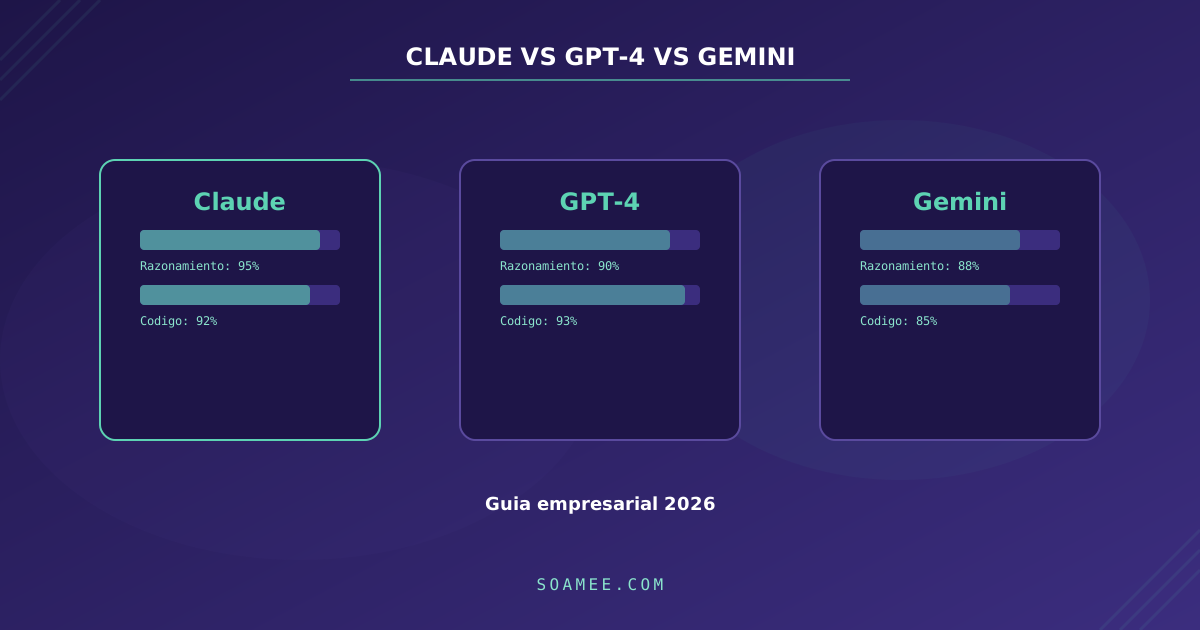
In Q4 2026, the AI model landscape has shifted significantly from the first half of the year. Claude Opus 5.5 matches Fable 5.1 capability at 40% lower cost, OpenAI has split GPT-6 into two models (Luna for volume, Sol for reasoning), and xAI has put Grok 4.7 on the enterprise map. Gemini continues to push on context and cost.
This guide compares available models as of October 2026 from the perspective that matters to businesses: what each does, what it costs, and when to use it.
Technical Comparison: Q4 2026
| Feature | Claude (Anthropic) | GPT-6 (OpenAI) | Gemini (Google) | Grok 4.7 (xAI) |
|---|---|---|---|---|
| Context window | 1M tokens | 272K tokens (Sol) | 1M+ tokens | 256K tokens |
| Max output | 128K tokens | 32K tokens | 64K tokens | 32K tokens |
| Multimodal | Text, image, code | Text, image, audio, code | Text, image, audio, video, code | Text, image, code |
| Instruction following | Excellent | Very good | Good | Good |
| Complex reasoning | Excellent (Fable 5.1) | Excellent (Sol) | Very good | Very good |
| Code generation | Excellent | Excellent | Very good | Very good |
| Response speed | Fast (Sonnet 5.5) | Fast (Luna) | Fast (Flash) | Fast |
| Agents / MCP | Native MCP support | Assistants API / GPTs | Vertex AI Agents | X/Twitter integration |
Token Pricing (October 2026)
| Model | Input (per 1M tokens) | Output (per 1M tokens) | Notes |
|---|---|---|---|
| Claude Fable 5.1 | $10 | $50 | Maximum capability, 1M context |
| Claude Opus 5.5 | $4 | $20 | Fable-level for less |
| Claude Sonnet 5.5 | $2 | $10 | Best quality/price ratio |
| Claude Haiku 4.5 | $0.25 | $1.25 | Economical, fast |
| GPT-6 Sol | $2 | $10 | Reasoning, 272K context |
| GPT-6 Luna | $0.10 | $0.50 | High volume, fast |
| Gemini 3.1 Pro | $2 | $12 | General use |
| Gemini 2.5 Flash | $0.30 | $2.50 | Ultra-economical |
| Grok 4.7 | Check xAI | Check xAI | Real-time X data access |
Check each provider’s official documentation for current pricing. Cache pricing varies: Claude and OpenAI offer cache reads from $0.01-0.25/M tokens.
Strengths by Use Case
Claude: Agents, Code and Long Documents
Anthropic has moved the entire family to 1M token context. Fable 5.1 is the most capable model, but Opus 5.5 performs at the same level on most tasks for 40% less. Sonnet 5.5, released September 28, generates output 30% faster than Sonnet 5.
Key strengths:
- Complex agents: The MCP protocol was created by Anthropic. Agent teams in Claude Code let you split tasks across specialized sub-agents
- 128K token output: Generate complete reports, contracts or entire codebases in a single call
- Code and debugging: Opus 5.5 solves more command-line tasks than Opus 5 with 40% fewer calls
- Text watermarking: Fable 5.1 includes invisible watermarks with detection API
Ideal for: Companies building complex AI agents, legal/financial document analysis, enterprise internal assistants. More details in our Claude Opus 5.5 and Fable 5.1 analysis.
GPT-6: The Luna/Sol Split
OpenAI has divided GPT-6 into two models with opposite profiles. Luna is the cheapest on the market ($0.10/M input) and the default model for ChatGPT Free. Sol is the reasoning model, directly competing with Claude Opus and Fable.
Key strengths:
- Luna — volume at minimum cost: At $0.10/$0.50 per million tokens, processing 10 million simple queries costs less than $5 in input
- Sol — reasoning: Analytical capability comparable to Fable 5.1 at the same price as Sonnet 5.5
- Mature ecosystem: The largest number of integrations, plugins and third-party tools
- Native audio: Built-in voice support without additional models
Ideal for: High-volume query companies (Luna), applications needing deep reasoning (Sol), quick integrations with existing tools. Detailed comparison at GPT-6 Luna vs Sol.
For technical integrations with OpenAI, the ecosystem offers the most mature libraries on the market.
Gemini: Massive Context and Multimedia
Gemini remains the option with best multimedia support (native video) and the most direct Google Cloud integration. Gemini 2.5 Flash pricing ($0.30/M input) keeps it competitive against GPT-6 Luna.
Key strengths:
- 1M+ token context: Process complete code repositories, entire technical manuals
- Native video: Unique ability to analyze video directly
- Google integration: Access Google Search, Workspace, BigQuery without intermediary APIs
- Gemini 2.5 Flash: Second cheapest model on the market after GPT-6 Luna
Ideal for: Companies in the Google ecosystem, multimedia content processing, large-scale data analysis, budget-conscious applications.
Grok 4.7: Real-Time Data
Grok 4.7 from xAI is the least known option in enterprise settings, but has a unique advantage: real-time access to X (Twitter) data.
Key strengths:
- Real-time data: Direct access to X posts, trends and conversations
- Fewer restrictions: Less censored outputs than Claude or GPT for certain use cases
- 256K context: Competitive for long documents
Limitations: Smaller ecosystem, fewer enterprise integrations, less transparent pricing. Full analysis at Grok 4.7 vs Claude vs GPT-6.
Multi-Model Strategies
Companies that best optimize cost and quality use multiple models with intelligent routing:
Complexity-Based Routing
- Simple queries (FAQ, classification): GPT-6 Luna ($0.10/M) or Gemini Flash ($0.30/M)
- Medium queries (analysis, summarization): Claude Sonnet 5.5 ($2/M) or GPT-6 Sol ($2/M)
- Complex queries (multi-step reasoning, decisions): Claude Opus 5.5 ($4/M) or Fable 5.1 ($10/M)
With this structure, a company processing 1 million queries per month (80% simple, 15% medium, 5% complex) goes from ~$4/M tokens with a single mid-tier model to ~$0.50/M tokens with routing.
Task-Type Routing
- Agents and workflows: Claude (native MCP, best instruction following)
- Mass content generation: GPT-6 Luna (minimum cost) or Sol (quality)
- Data analysis: Gemini (1M+ context, BigQuery integration)
- Multimedia: Gemini (native video and audio)
- Social media monitoring: Grok 4.7 (real-time X data)
Redundancy and Fallback
- Primary model: Claude Sonnet 5.5
- Fallback on timeout or error: GPT-6 Sol
- Economical model for spikes: GPT-6 Luna or Gemini Flash
How to Choose: Decision Framework
Factor 1: Application Type
| Application | Recommended model |
|---|---|
| Complex AI agents | Claude Opus 5.5 or Fable 5.1 |
| Customer support chatbot | Claude Sonnet 5.5 or GPT-6 Sol |
| Mass content generation | GPT-6 Luna or Gemini Flash |
| Long document analysis | Claude (1M context) or Gemini |
| Video/audio processing | Gemini |
| Internal coding assistant | Claude Opus 5.5 or GPT-6 Sol |
| High-volume classification | GPT-6 Luna or Haiku 4.5 |
| Structured data without free text | Jev (System One) |
Factor 2: Existing Ecosystem
- Google Cloud: Gemini has advantage via native integration
- Azure: GPT-6 deploys via Azure OpenAI
- AWS: Claude via Bedrock, GPT-6 and Gemini also available
- Own infrastructure: Any works via API
Factor 3: Budget
- Minimum cost per query: GPT-6 Luna ($0.10/$0.50/M)
- Quality/price balance: Claude Sonnet 5.5 or GPT-6 Sol (both $2/$10/M)
- Maximum quality: Claude Fable 5.1 ($10/$50/M)
Factor 4: Compliance
- GDPR: Verify processing region. All three main providers offer EU processing
- Sensitive data: All offer no-training-on-client-data options
- Regulated sector: Claude and GPT-6 have mature SOC2 certifications
Benchmark: Real Enterprise Tasks
Based on our experience implementing solutions with these models:
| Task | Claude Opus 5.5 | GPT-6 Sol | Gemini Pro | Grok 4.7 |
|---|---|---|---|---|
| Contract data extraction | Excellent | Very good | Good | Good |
| Meeting executive summary | Very good | Excellent | Very good | Good |
| Support ticket classification | Excellent | Very good | Very good | Good |
| Code analysis and refactoring | Excellent | Excellent | Very good | Very good |
| Invoice processing (OCR) | Very good | Very good | Excellent | Good |
| Brand monitoring on social media | Good | Good | Good | Excellent |
For a complete overview of all available models, see our AI model map October 2026.
Our Recommendation
-
For most companies starting out: Claude Sonnet 5.5 as the primary model. At $2/$10 per million tokens, it performs close to Opus on most enterprise tasks.
-
For high-volume companies: Multi-model routing. GPT-6 Luna for simple queries, Claude Sonnet 5.5 or GPT-6 Sol for medium queries, Opus 5.5 for complex ones.
-
For companies in Google ecosystem: Gemini Pro as primary model with Claude as fallback for complex reasoning.
-
For multimedia applications: Gemini for audio/video processing, complemented with Claude for text.
-
For structured data pipelines: Consider Jev (System One) for steps needing typed outputs without hallucinations, combined with an LLM for generative steps.
If you need help defining which model or combination best fits your case, we work with all platforms. Our artificial intelligence team can assess your case and design the optimal multi-model architecture, whether with Claude API, OpenAI, or a combination.
Request a free consultation and let’s analyze the options for your company.