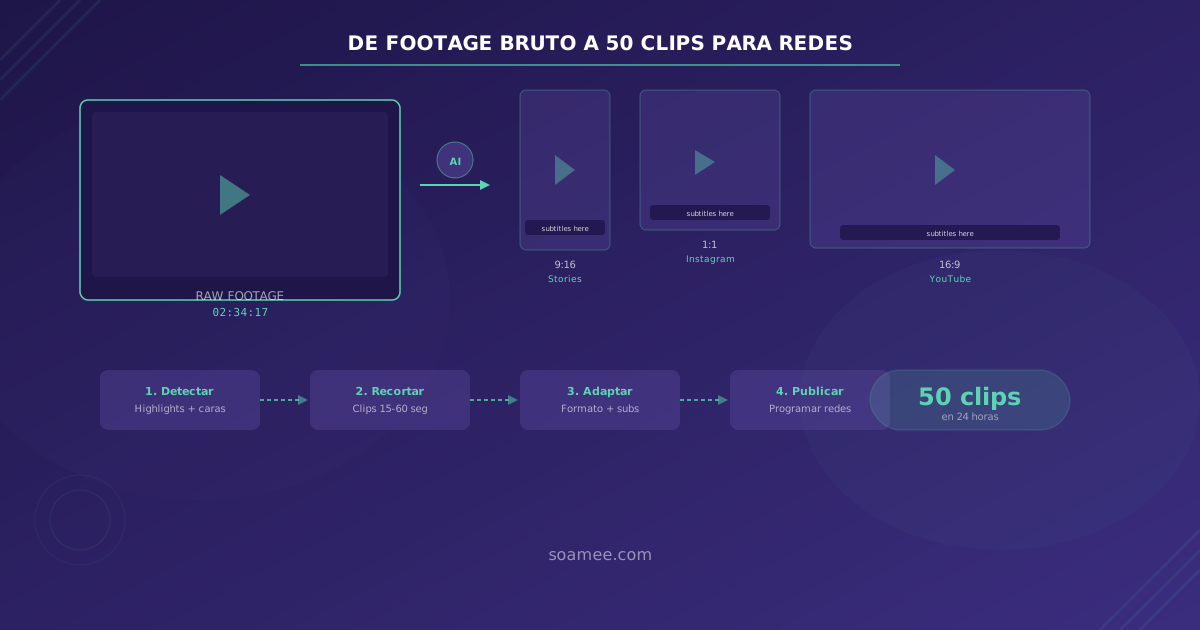
A television studio produces hours of content every day. Debate shows, interviews, morning magazines, news programs. All that material airs once and, in the best case, gets uploaded in full to the network’s website. But the real potential of that content on social media goes unexploited: the viral moments, the impactful statements, the analyses that audiences would want to share.
The problem? Manually extracting social media clips is too slow. By the time the social team manages to edit and publish an interesting segment, the moment has passed. The social media conversation has moved on to another topic.
This article explains how a TV studio can implement an automated workflow that transforms hours of raw footage into dozens of social media-optimized clips in under 24 hours, using artificial intelligence at every step of the process.
The Problem: The Gap Between Production and Social Media
In most television studios, the social media workflow is surprisingly manual:
- Someone from the social team watches the show (or parts of it).
- They identify moments that could work on social media.
- They ask the editing team to cut them.
- The editor produces the clips in the correct format.
- The community manager adds text, subtitles, and publishes.
This process can take between 4 and 48 hours per show. By the time the clip is published, the relevance window has closed.
The result: studios publish few clips and lose engagement, or publish quickly but with low quality. Neither option is acceptable in 2026, when social media presence is a fundamental part of audience strategy.
The Solution: An Automated Pipeline with AI
A well-designed pipeline with artificial intelligence can process a 60-minute show and generate between 30 and 50 social media-optimized clips in under 4 hours, without significant human intervention.
Here’s how each step works:
Step 1: Automatic Ingest and Analysis
When the show finishes airing (or even during broadcast, if working with a live signal), the material enters the processing pipeline:
- Full transcription via ASR (Whisper, AssemblyAI) with speaker identification.
- Visual content analysis: scene detection, shot changes, gestures, audience reactions.
- Audio analysis: detection of energy peaks, applause, laughter, moments of vocal tension.
- Sentiment analysis: AI evaluates the emotional content of each segment.
All this generates a complete map of the show with “viral potential” scores for each segment.
Step 2: Intelligent Highlight Selection
With the analyzed program map, AI selects the moments with the highest social media potential, based on multiple signals:
- Emotionally charged statements: phrases that generate debate or surprise.
- Conflict or humor moments: those that naturally attract engagement.
- Data or revelations: novel information that audiences would want to share.
- Visual reactions: gestures, facial expressions, spontaneous moments.
AI not only identifies these moments but determines the optimal cut point: where the clip starts and ends so it makes narrative sense out of context.
Step 3: Multi-Format Clip Generation
Each selected highlight is automatically processed into multiple formats:
- Vertical (9:16): for Instagram Stories, TikTok, YouTube Shorts. AI applies intelligent reframing, centering the composition on speakers through facial detection.
- Square (1:1): for Instagram and Facebook feeds. Automatic reframing of the horizontal shot.
- Horizontal (16:9): for YouTube, Twitter/X, and LinkedIn. The original format is maintained, adjusting margins if needed.
Intelligent reframing is key: it’s not about simply cropping the center of the frame, but following the active speaker, adjusting composition according to the rule of thirds, and maintaining visual quality.
Step 4: Automatic Subtitling
Subtitles are mandatory for social media — 85% of Facebook users and 70% of Instagram users consume video without sound.
The pipeline automatically adds subtitles:
- Native style for each platform: typography, size, position, and animation adapted to each network’s conventions.
- Animated word-by-word subtitles: the word-highlight subtitle style popularized by TikTok that improves retention.
- Multilingual: if the studio’s audience is international, versions with subtitles in each language are generated.
Step 5: Text and Metadata Generation
For each clip, AI automatically generates:
- Clip title: descriptive, with a hook to capture attention.
- Caption for each platform: adapted to the optimal tone and length of each network (short for Twitter, longer for LinkedIn, with hashtags for Instagram).
- Tags and categories: for internal organization and platform SEO.
- Thumbnail: automatic selection of the most visually impactful frame.
Step 6: Review and Publishing
At this point, the community manager receives a dashboard with 30-50 clips ready to publish, each with:
- Preview in each format.
- Suggested text for each platform.
- Estimated engagement potential score.
The social team only needs to review, approve (or adjust), and schedule publishing. What used to be hours of work becomes 30 minutes of curation.
Pipeline Tools and Technologies
This pipeline is built by combining several technologies:
- ASR and text analysis: Whisper, AssemblyAI.
- Computer vision: object and face detection models (YOLO, MediaPipe).
- Intelligent reframing: tools like AutoPod, or custom solutions based on facial detection.
- Stylized subtitle generation: render engines with per-platform templates.
- LLMs for text generation: GPT-4, Claude, or other models for captions, titles, and hashtags.
- Orchestration: AI agents that coordinate the entire pipeline, handle errors, and make decisions about which content to prioritize.
Real Results
Studios that implement this type of automation typically report:
- 300-500% increase in social media posting volume.
- 70-80% reduction in social content production time.
- 40-60% increase in engagement thanks to publishing within relevance windows.
- 100% utilization of produced content: no more shows that air and are forgotten.
ROI is measured not only in operational efficiency but in audience: more clips, published faster, in the right formats, generate more traffic back to the network’s main content.
Implementation Considerations
Rights and Compliance
Before publishing clips on social media, make sure that:
- Digital distribution rights are covered (not all broadcast contracts include social media).
- Content complies with each platform’s policies.
- Incidental music doesn’t generate copyright claims on YouTube or Instagram.
Editorial Supervision
AI selects content based on engagement signals, not editorial criteria. A controversial moment may generate lots of engagement but damage the show’s image. Human supervision during the review phase is essential.
Iteration and Learning
The system improves over time. Engagement metrics from published clips feed back into the highlight selection model, making predictions increasingly accurate for each show’s specific content type.
How Soamee Can Help
At Soamee we design and implement social media content automation pipelines for television studios and production companies. From integration with your broadcast infrastructure to developing AI agents that manage the entire flow autonomously.
It’s not about buying a tool: it’s about building a system that understands your content, knows your audience, and produces clips that work. Every pipeline we design adapts to each client’s content type, brand, and goals.
Does your studio produce hours of content that never reach social media? Let’s talk.