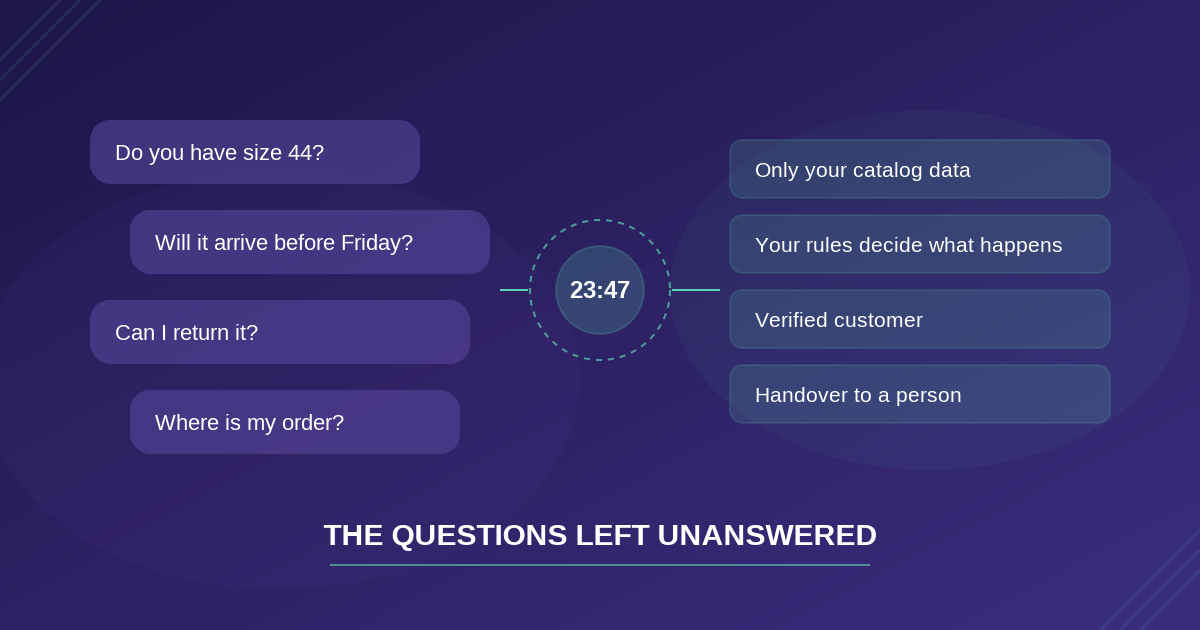
It is 23:47 and someone in your store asks whether the trainers they are looking at will arrive before Friday. Nobody is there to answer. In the morning the question is still in the inbox and the cart is still half-full, or gone.
The number of those questions grows with sales. Ecommerce in Spain turned over 114.8 billion euros in 2025, 20.6% more than the year before, according to the CNMC press release of 3 July 2026 (in Spanish). And many of the reasons carts get abandoned are questions the store could have answered before payment. In Baymard Institute’s survey of US shoppers who abandoned a purchase for a reason other than “just browsing”, 20% did so because delivery was too slow, 13% because of the returns policy and 12% because they could not calculate the total cost up front.
What people ask before buying
If you go through a store’s conversations, four families show up:
- Product. “Do you have size 44?”, “what’s the difference between these two?”, “does it work with my Mac?”, “do I need another cable?”.
- Stock and restocking. “When will it be back in stock?”, “do you have it in black?”.
- Delivery and returns. “Do you ship to the Canary Islands?”, “can I return it if it doesn’t fit?”, “is there a warranty?”.
- An order already placed. “Where is my order?”, “can I change the address?”.
The first three are answered with data the store already has: the product page, the stock and its policies. The fourth requires knowing who is asking.
Why an FAQ chatbot falls short
An FAQ chatbot tells everyone “delivery takes 2 to 4 days”, but it does not know whether size 44 is left or whether that specific product fits what the customer already owns. A language model without access to the data has the opposite problem: it answers everything in fluent prose, including what it does not know. For a store, an invented restocking date is worse than no answer, because it turns into a complaint.
Six rules so a shopping assistant does not make things up
- Only the store’s data. Catalogue, stock, policies and orders. Policies are quoted as written. When there is no reliable data (a restocking date, an unconfirmed compatibility), it says so and offers a person.
- Talking and acting are kept apart. The model understands the question and proposes; the store’s fixed rules decide what gets executed. Checking an order or opening a claim with the carrier can happen on its own. Refunds, compensation and address changes are approved by a person.
- Verified customer before showing an order. A one-time code sent to the purchase email is enough to avoid showing personal data to the wrong person.
- A way out to a person, with the context ready. When someone from the team steps in, they get a summary (what the customer wants, what is missing, next step) and the assistant stops replying in that conversation.
- A log of every action. What data it looked up, which rule it applied, who approved it and the outcome. Without that, a mistake cannot be reviewed.
- No manufactured urgency. No fake stock, no countdowns, no discounts that do not exist.
The legal side matters too: who is liable for what a chatbot says and what users must be told is covered in legal liability of an AI chatbot.
Rolling it out without risk
- Review before publishing. Test its answers against the questions you get most, and fix the product page or the policy when an answer goes wrong for lack of data.
- Start in copilot mode. The assistant drafts the reply and your team reviews and sends it.
- Release it to a share of visitors and widen it once the answers are right.
Moving from demo to production has its own pitfalls, which we go through in chatbot demo vs production.
What the questions tell the store
Conversations are also a record of what is missing: sizes people ask for that are not in the catalogue, product pages without the weight, shipping costs that kill purchases when the customer finds them at the end. A store that reads those questions every week fixes pages and policies before losing the next sale.
Peithou, our shopping assistant
These rules are the ones behind Peithou (site in Spanish), the AI agent for online stores we are building at Soamee: it recommends from the real catalogue and stock, handles orders and returns with each store’s rules and hands the case to a person when needed. It is in an open pilot programme; on its site you can watch the demo and apply for a place.
If your store needs an assistant built around your catalogue and systems, we explain how in AI assistant for ecommerce. And if you are weighing what else generative AI can do for a store, see generative AI for ecommerce and retail.