Imagine two companies that acquire 1,000 users this month. The first bought them with ads: next month it will have to pay again for the next 1,000. The second has a mechanism through which those 1,000 users generate, on their own, 200 more. A year later, the first is still paying the same bill; the second has built a machine that compounds.
That second mechanic is a growth loop, and it is the difference between growing by stacking campaigns and growing by product design. This is a follow-up to our AARRR funnel guide: what loops are, what types exist, and how to design the first one for your business.
The limits of the funnel
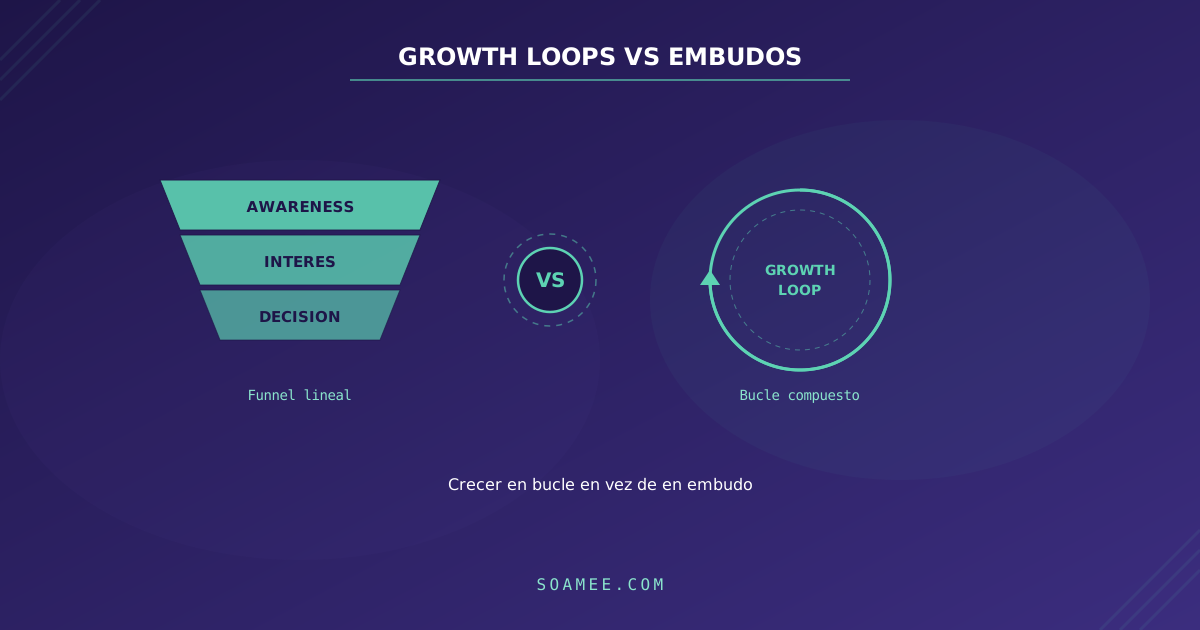
The funnel is linear: users enter at the top (acquisition) and exit at the bottom (revenue, referral). It is an enormously useful model for diagnosis — we use it in every audit — but it has three limits as a growth model:
- It has to be refilled constantly. A funnel does not generate users: it consumes them. If you stop pouring traffic in at the top, business stops coming out at the bottom. Growth depends on continuous, external effort.
- CAC can only go up. Paid channels saturate and get more expensive: you compete with more and more advertisers for the same audience. A business that grows only through the funnel watches its acquisition cost rise year after year.
- Outputs are not reused. In the funnel’s mental model, whatever a user produces (their content, their data, their recommendations) stays at the bottom, as a byproduct. Nobody reinvests it back at the top.
A growth loop inverts that logic: the output of one cycle becomes the input of the next. A new user generates something — a review, an invitation, a data point, a euro of margin — that brings in the next user. The result is not linear, it is compound: the same effort produces more and more.
Funnel and loop don’t compete: they complement each other
Before going on, an important nuance. The fact that loops are the more powerful growth model does not make the funnel obsolete. They are different tools for different questions:
- The AARRR funnel answers “where is my growth leaking?”. It is a diagnostic model: stages, conversion rates, bottlenecks. We dedicate a full guide to it.
- The growth loop answers “what mechanic makes my users generate the next ones?”. It is a design model.
In practice they are used together: the funnel tells you that you are losing 70% of users at activation; and no loop works with a product that neither activates nor retains, because a loop amplifies what is there — good or bad.
Funnel vs. loop, at a glance
| Funnel | Growth loop | |
|---|---|---|
| Shape | Linear: in at the top, out at the bottom | Circular: output feeds the input |
| Growth | Additive: every user costs the same | Compound: every cycle makes the next one cheaper |
| Fuel | Budget and external campaigns | Your own users and their assets |
| CAC over time | Tends to rise | Tends to fall |
| Who runs it | Marketing | Product + engineering + marketing |
| What it’s for | Diagnosing and optimizing stages | Designing growth mechanics |
| Copyable by competitors | Easy (bid higher on ads) | Hard (it lives inside the product) |
The four types of growth loops
1. Viral loops: users who bring users
The user invites others because the product is worth more with more people, or because they get something in return.
- Dropbox is the textbook case: free space for every invited friend who signs up. The incentive was the product itself, and every new user arrived with reasons to invite already built in.
- WhatsApp did not even need incentives: the product was useless without your contacts, so every new user pressured their entire address book to join.
The metric that governs this loop is the viral coefficient (k): invitations sent × conversion rate of those invitations.
2. Content loops: UGC that ranks and attracts
The user generates content, that content ranks in search engines and attracts new users who generate more content.
- TripAdvisor built its empire this way: every review is an indexable page; millions of reviews capture millions of “hotel in X” searches, which bring travelers who leave more reviews.
- Zillow did the same with real estate data: every home is a page that answers a specific search.
The non-UGC variant is the programmatic SEO used by comparison sites and marketplaces: generating thousands of landing pages from structured data (one per city, category, or combination with search demand). Every new inventory entry creates a new page; every page brings users who expand the inventory.
3. Paid loops: when LTV finances CAC
The most counterintuitive one: ads can also be a loop, if designed as one. The mechanic: you invest in acquisition, customers generate margin (LTV), and that margin gets reinvested into more acquisition. The loop spins as long as LTV/CAC is healthy and payback is short: if you recover CAC in 3 months, you can reinvest the same capital four times a year. If your payback is 18 months, you don’t have a loop: you have a cash bonfire. That is why this loop does not live in the ads dashboard, but in retention and pricing.
4. Data loops: more usage, better product
Every use of the product generates data that improves it, and a better product attracts and retains more users. It is Google’s loop (every search improves the results), Waze’s (every trip improves the routes), and that of any recommendation system that learns from behavior. It is the slowest to start and the most defensible once it spins: your advantage grows with every user and cannot be copied with budget.
How to design your first loop
You don’t need to be Dropbox. The process we follow with clients has three steps:
- Identify the asset every user generates. Every user produces something when using your product: content (reviews, profiles, questions)? data (prices, availability, behavior)? natural invitations (collaboration, sharing results)? reinvestable margin? That asset is the raw material of your loop. If it is being lost today, there is your opportunity.
- Design the mechanism that reinvests it. The asset has to flow back to the top: content, indexed on pages that rank; data, turned into a better product or programmatic pages; invitations, integrated into the natural usage flow (not hidden in a menu).
- Measure cycle time and the amplification factor. Every loop boils down to two numbers: how long a full turn takes (from new user to generated user) and how many new users each turn produces. A loop with 1.2 amplification and a one-week cycle is worth more than a 2.0 loop that takes a year. Instrument it like any funnel: events per cycle stage, and optimize the stage holding it back most.
Loops are not bought: they are built
Here lies the key difference from traditional channels, and the reason loops are the business of product and engineering, not just marketing. A viral loop requires touching the invitation flow inside the product. A content loop requires SEO architecture, programmatic page generation, and structured data. A data loop requires pipelines and instrumentation. None of that is done from an ads dashboard — it is code.
It is the reason we approach growth from engineering: the same teams that build the product are the ones who can design the loop, instrument it, and make it spin faster and faster. And it is also its best property: a well-built loop is a competitive advantage that cannot be copied by raising the bid on Google Ads.
Conclusion
The funnel tells you where you lose users; the loop makes the users you already have generate the next ones. One diagnoses, the other compounds. If your growth depends 100% on refilling the funnel every month, the question you should be asking is not “which channel do I try next?”, but “what asset are my users generating that I am throwing away today?”.
Want to identify and build your product’s growth loop? Discover our growth marketing service →