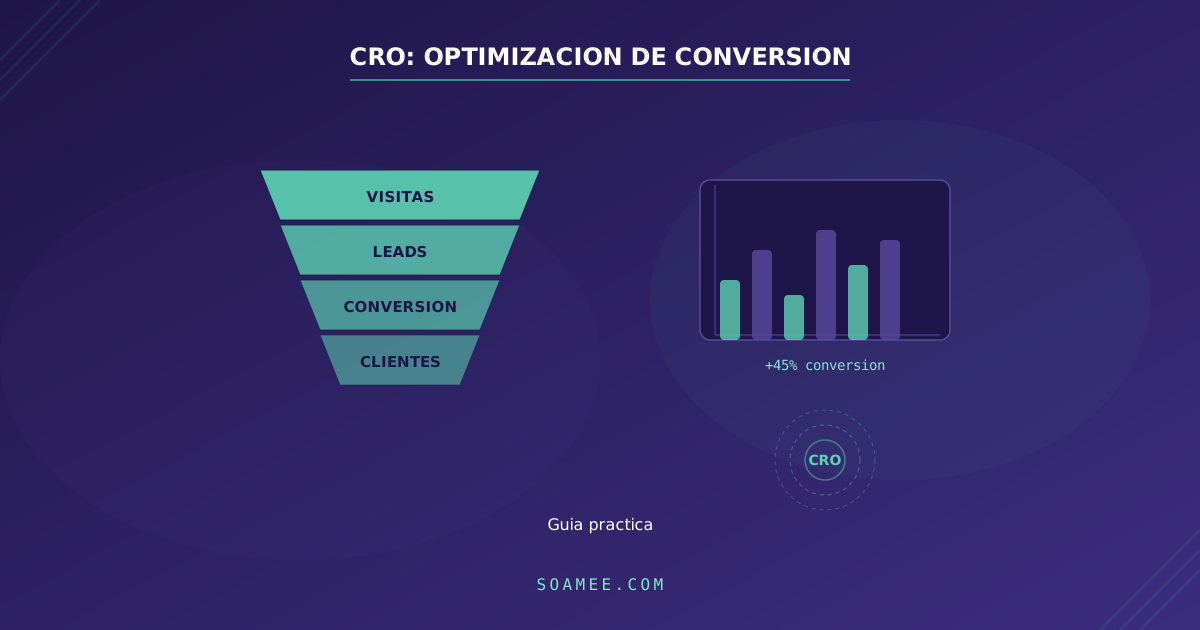
Doubling your conversion rate has the same effect on revenue as doubling your traffic. With one difference: doubling traffic means (at least) doubling your acquisition spend, while doubling conversion means paying half as much for every customer. If your CAC is 100 EUR with a 2% conversion rate, moving to 4% brings it down to 50 EUR without touching a single ad.
That is the promise of CRO. The problem is how it is practiced in many companies: changing a button color because someone on LinkedIn said so and calling that experimentation. In this guide we explain how we do conversion optimization with method: process, statistical rigor, what to optimize first, and what to do when you don’t have the traffic to test.
What CRO is (and what it isn’t)
CRO (Conversion Rate Optimization) is the systematic process of increasing the percentage of visitors who complete a valuable action: buying, signing up, requesting a demo, starting a trial.
Two important nuances:
- It is not a list of tricks. The “47 tactics to convert more” don’t work because the friction on your website is not the friction on the article’s website. CRO is research and experimentation on your funnel and your users.
- It does not optimize only the landing page. Conversion is decided across the entire journey: load speed, clarity of the value proposition, the form, the checkout, all the way to the confirmation email. It is the conversion layer of the AARRR funnel, not a cosmetic patch on the homepage.
At Soamee we have proven it on real projects: applying this process, we have improved conversion by an aggregate +85% across the projects where we worked the full funnel. Not with a trick, but with cycles of research → hypothesis → test → learning.
The CRO process in five steps
1. Research: know before you opine
Every optimization starts by understanding where and why people drop off. Three sources that complement each other:
- Quantitative analytics (GA4, PostHog, Mixpanel): the step-by-step funnel tells you where they abandon — which page, which form step, which device.
- Heatmaps and session recordings (Hotjar, Clarity, PostHog): they show you how they behave — how far they scroll, what they click that isn’t clickable, where they hesitate, the “rage clicks”.
- Interviews and surveys: they tell you why. Five conversations with users who abandoned the checkout are worth more than fifty dashboards. A one-question exit survey (“what stopped you from finishing today?”) is cheap gold.
2. Hypotheses, not hunches
Every finding becomes a structured hypothesis: “Since we observed [data], we believe that [change] will produce [measurable effect] on [metric]”. Example: “Since 60% abandon at the ‘phone’ field, we believe making it optional will increase form completion by at least 15%“.
3. Prioritization with ICE
Hypotheses go into a backlog and are scored with ICE: expected Impact, Confidence (how much evidence backs it?), and Effort (inverted: less effort, more points). You execute first whatever moves the needle most with the least work. Without explicit prioritization, the loudest opinion always wins.
4. Test
The hypothesis is validated with the right experiment: an A/B test if there is volume, a measured before/after change if there isn’t (below we explain when each applies).
5. Documented learning
Win or lose, every test gets documented: hypothesis, result, segments, decision. A losing test with a learning is worth more than a winning one nobody remembers why it worked. That repository is the real asset of a CRO program.
A/B tests with rigor (or better not at all)
A poorly executed A/B test is worse than not testing: it gives you statistical confidence in a false conclusion. Three non-negotiable rules:
- Calculate the sample size before you start. Define the minimum detectable effect (MDE): the smallest improvement worth detecting. The smaller the effect, the more sample you need — detecting a +5% requires far more traffic than detecting a +20%. Any test calculator gives you the number; if the answer is “you need 4 months of traffic”, the test is not viable and you should look for bigger changes.
- Do not stop the test as soon as it’s “winning”. It is the most common mistake. Checking the results every day and stopping when significance appears (peeking) inflates false positives: with enough looks, any test “wins” at some point. Set the duration in advance — at least 1-2 full business cycles, usually 2-4 weeks — and stick to it.
- Require statistical significance (95%) and one change per test. If you test five changes at once and the variant wins, you don’t know which one worked. And distrust +40% improvements in two days with 200 visits: it is almost always noise.
What to optimize first
When we audit a website, the biggest leaks are almost always in the same four places:
- Form friction. Every unnecessary field costs conversions. Asking for phone, company, and job title to download a PDF is paying dearly for data you won’t use. Fewer fields, autocomplete, inline validation, and ask for the rest later.
- Speed. Core Web Vitals are not just SEO: they directly affect conversion. Every extra second of load time increases abandonment, especially on mobile, where most of the traffic and the worst experience usually live. Optimizing LCP and INP is one of the few changes that improves conversion on every page at once.
- Value proposition above the fold. In five seconds, without scrolling, a visitor should be able to answer: what is this, who is it for, and why should I care? If your hero says “We drive end-to-end digital synergies”, there is your first test.
- Social proof. Client logos, verifiable figures, reviews, case studies — near the decision point, not hidden on a “clients” page. Purchase anxiety is reduced with evidence, not adjectives.
What if I don’t have traffic to test?
With few conversions per month, an A/B test would take a year to produce a signal. That’s fine: CRO is not a synonym for A/B testing.
- Apply proven heuristics: clarity of the proposition, friction reduction, visual hierarchy, speed. They are “tests someone else already lost”: changes with years of accumulated evidence across thousands of websites.
- Double down on qualitative research: with little traffic, 5 usability tests and 10 interviews reveal more than any dashboard.
- Make big changes, not micro-tweaks: without volume you cannot detect a +5%, so don’t chase a +5%. Redesign the whole page with what you learned and measure before/after with humility (knowing it is not a controlled experiment).
Common CRO mistakes
| Mistake | Why it hurts | What to do instead |
|---|---|---|
| Copying other people’s tactics | Their friction is not yours | Research your own funnel |
| Stopping tests as soon as they “win” | False positives from peeking | Duration fixed in advance |
| Testing without enough sample | Results that are noise | Calculate MDE and sample first |
| Optimizing only the landing page | The leak may be in checkout or onboarding | Look at the full funnel |
| Measuring clicks instead of business | A “winning” CTA can bring worse leads | Target metric = valuable conversion |
| Not documenting learnings | Tests and mistakes get repeated | Experiment repository |
| Ignoring speed | Bad Core Web Vitals sink mobile conversion | Optimize performance first |
CRO inside the growth system
CRO does not live in isolation: it is the conversion lever inside a larger system. Research comes out of the AARRR funnel analytics, hypotheses compete in the same ICE backlog as every other experiment, and learnings feed everything from ad copy to product onboarding. It is one more piece of what we cover in our growth marketing guide: measure well, experiment with method, and scale only what works.
And like almost everything in growth, half the work is engineering: instrumenting events without breaking analytics, building tests that degrade neither speed nor SEO, genuinely optimizing Core Web Vitals. That is why we approach it from the code, not from a dashboard.
Conclusion
CRO done well is boring to describe and profitable to practice: research, formulate hypotheses, prioritize with ICE, test with rigor, and document. No shortcuts, no viral tricks, no stopping the test while it’s winning. The reward is the best one in marketing: growing without paying more for each customer.
Want to know how much conversion you are leaving on the table? Discover our growth marketing service →