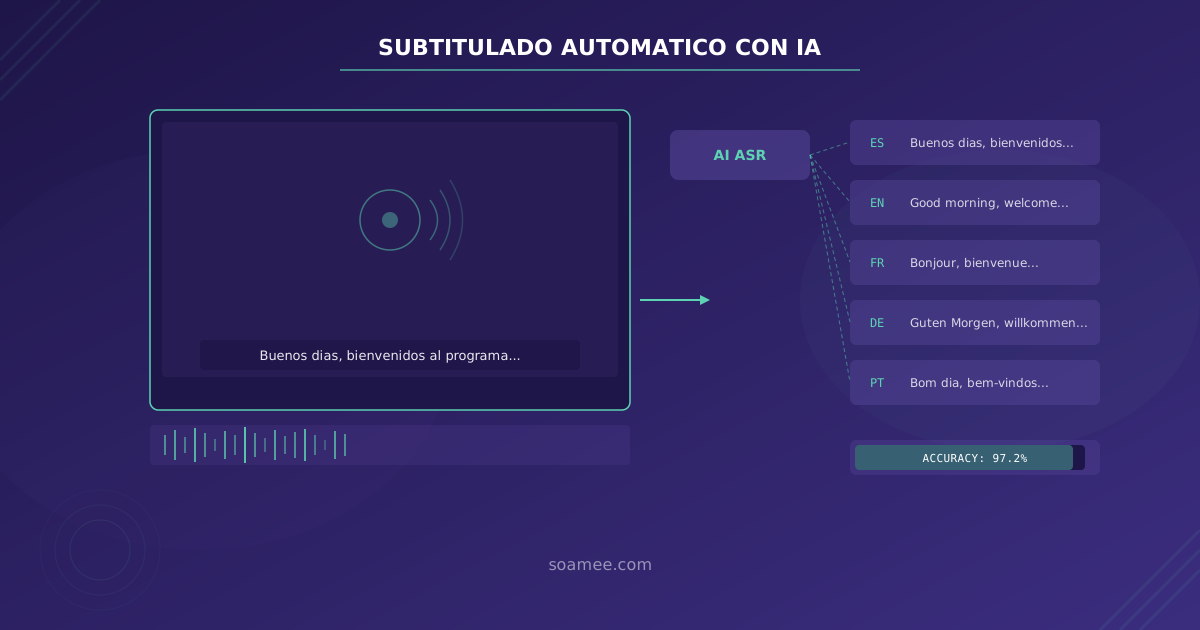
Subtitling has always been one of the most expensive and slowest tasks in audiovisual post-production. A professional subtitler takes between 5 and 10 hours to subtitle one hour of content, depending on audio complexity and format requirements. Multiply that by each target language, and costs skyrocket quickly.
In 2026, artificial intelligence has radically changed this equation. Automatic speech recognition (ASR) systems have reached accuracy levels that seemed impossible just three years ago. But technology alone doesn’t solve the problem: you need a well-designed workflow that combines AI speed with the precision that broadcast standards demand.
This guide covers everything a production company needs to know to implement professional AI-powered automatic subtitling.
The State of ASR in 2026: Real Accuracy, Not Promises
When we talk about automatic subtitling, we’re fundamentally talking about two technologies:
- ASR (Automatic Speech Recognition): converting speech to text.
- NMT (Neural Machine Translation): automatically translating the generated text into other languages.
Whisper and Its Successors
OpenAI Whisper was a turning point when it launched in 2022. Its current version (Whisper v4) achieves accuracy rates above 97% in Spanish, English, French, German, and Portuguese under clean audio conditions. In TV studio conditions, where audio is controlled, accuracy can exceed 98%.
But “clean audio conditions” is the key phrase. In real environments — outdoor shoots, overlapping dialogue, regional accents, technical terminology — accuracy drops significantly. This is where tool choice and workflow design make the difference.
AssemblyAI and Enterprise Alternatives
AssemblyAI has positioned itself as the most solid enterprise alternative, with specific advantages for audiovisual production:
- Advanced speaker diarization: identifies and separates individual speakers in multi-participant conversations, crucial for debate shows or group interviews.
- Custom vocabulary: allows defining glossaries of program-specific terms (people’s names, brands, technical terminology) that the model prioritizes during transcription.
- Entity detection: automatically identifies proper names, places, dates, and numbers, applying correct formatting.
Other relevant options include Deepgram (optimized for low latency in live broadcasting), Rev AI (with a hybrid AI + human review model), and Google Cloud Speech-to-Text (broad language coverage).
The Real Challenge: Temporal Synchronization
Generating accurate text is only half the problem. A professional subtitle must:
- Appear and disappear synchronized with speech: with frame-level tolerances.
- Respect minimum and maximum durations: a single-word subtitle lasting 3 seconds is as bad as a 5-line paragraph lasting half a second.
- Split into lines logically: respecting sense units (don’t split between an article and its noun).
- Not exceed characters per line: generally 42 characters for European broadcast.
- Respect reading speed: typically between 15 and 20 characters per second, depending on the target audience.
Current AI systems handle basic synchronization acceptably, but segmentation and reading speed rules require specific post-processing. This is where specialized tools like EZTitles, OOONA, or Subtitle Edit (open source) add an automatic correction layer on top of ASR output.
Glossaries and Terminology: The Secret Weapon
One of the most significant differences between amateur and professional automatic subtitling is the handling of specific terminology.
Imagine a cooking show where the chef mentions “brunoise,” “mirepoix,” and “chiffonade.” Without a glossary, ASR will interpret these terms as phonetically similar words in the detected language, generating absurd errors.
How to Implement Effective Glossaries
- Build the glossary before shooting: presenter names, guests, brands, technical terms related to the show’s topic. A 50-100 term glossary can improve accuracy by 5-8%.
- Feed the glossary with each production: each processed show generates new terms. Build a living glossary that improves over time.
- Separate glossaries by show/series: sports program terms aren’t the same as nature documentary terms.
- Include phonetic variants: if a name is pronounced ambiguously, add variants so the model recognizes them.
AssemblyAI and Whisper (with fine-tuning) allow incorporating these glossaries directly into the transcription process. The difference in accuracy is notable.
Automatic Translation: Multilingual Subtitling
Once you have the transcript in the original language, the next step for international production is translation into other languages. This is where neural machine translation (NMT) comes in.
The State of Machine Translation
Current NMT models — DeepL, Google Translate API, Microsoft Translator — produce translations that, for well-covered language pairs (ES-EN, ES-FR, ES-DE, ES-PT), approach professional translator quality in technical and descriptive texts.
However, for subtitles there are critical nuances:
- Translation length: a 42-character subtitle in Spanish can become 60 characters in German. The translation must respect the target format’s length constraints.
- Register and tone: models tend toward a neutral register. If your show has an informal tone or uses slang, you’ll need adjustments.
- Cultural context: jokes, wordplay, and cultural references don’t translate literally. AI still doesn’t handle these cases well.
Recommended Workflow for Multilingual Subtitling
- ASR in original language with glossary.
- Review and correction of original subtitles (human or assisted).
- Machine translation to target languages with length constraints.
- Human review of translations (ideally by native speakers in the audiovisual sector).
- Timing and segmentation adjustment per language.
- Automated final QC.
This workflow reduces multilingual subtitling costs by between 60% and 75% compared to the fully manual process, while maintaining professional quality.
Costs: Manual vs. AI
Let’s put real figures on the savings:
Traditional Manual Subtitling
- Original language transcription and subtitling: 8-15 EUR/minute of content.
- Translation and adaptation per additional language: 6-12 EUR/minute.
- QC per language: 2-4 EUR/minute.
- Total for 1 hour, 5 languages: approximately 3,000-6,000 EUR.
AI Subtitling + Human Review
- Automatic ASR + post-editing: 2-5 EUR/minute.
- Machine translation + review: 2-4 EUR/minute per language.
- Automated QC + verification: 0.50-1 EUR/minute.
- Total for 1 hour, 5 languages: approximately 800-1,800 EUR.
The savings are significant, but the truly differentiating factor is time: what used to take a full week can now be completed in 24-48 hours.
European Accessibility Act: What You Need to Know
The European Accessibility Act (EAA), whose full enforcement took effect in June 2025, establishes accessibility requirements that directly affect subtitling:
- All audiovisual content distributed in the EU must include subtitles for deaf or hard-of-hearing people (SDH).
- SDH subtitles must include not only dialogue, but speaker identification, relevant sound effects, and music with narrative significance.
- Video-on-demand services must provide subtitles in at least the primary language of the distribution market.
AI makes EAA compliance much easier:
- Speaker diarization: automatic identification of who is speaking.
- Non-verbal sound detection: AI can identify and label applause, laughter, music, sound effects.
- Complete SDH subtitle generation: combining transcription, speaker identification, and sound description.
Production companies that haven’t yet adapted their workflows to the EAA are assuming significant regulatory risk. AI implementation not only reduces compliance costs but makes it technically feasible for large content catalogs.
Step-by-Step Guide: Implementing AI Subtitling
Step 1: Audit Your Volume and Requirements
Before choosing tools, you need to answer:
- How many hours of content do you produce per month?
- How many languages do you need to cover?
- What technical standards do your clients/distributors require (file format, CPL, CPS)?
- Do you need SDH subtitles for accessibility compliance?
Step 2: Select Your ASR Stack
For low volumes (under 20 hours/month), cloud APIs from AssemblyAI or Whisper API are sufficient. For high volumes, consider deploying Whisper on-premise on your own GPUs or using enterprise solutions like Verbit.
Step 3: Build Your Base Glossary
Invest time in creating a glossary with your shows’ terminology. This initial investment pays for itself in the first productions.
Step 4: Define Your Review Workflow
Decide the level of human review needed:
- Automated QC only: acceptable for internal content or social media.
- Light review: a reviewer checks points the system flags as low confidence. Suitable for most content.
- Full review: a subtitler reviews all output. Necessary for premium broadcast or cinema.
Step 5: Automate the Pipeline
Connect tools via APIs to make the workflow automatic:
Video ingest → ASR → Post-processing → Translation → QC → DeliveryEach step should generate alerts only when there are problems requiring human intervention.
Step 6: Measure and Optimize
Establish clear metrics:
- WER (Word Error Rate): word-level error rate. Target: under 5%.
- Processing time: hours from ingest to final delivery.
- Human intervention rate: percentage of subtitles requiring manual correction.
Common Mistakes to Avoid
- Blindly trusting output without review: even with 98% accuracy, a 2% error rate in one hour of content means dozens of incorrect words.
- Ignoring glossaries: the difference between 92% and 98% accuracy usually lies in the glossary.
- Using the same configuration for everything: a studio show with a lapel mic has nothing in common with an outdoor report in windy conditions.
- Not formatting subtitles after ASR: raw ASR text doesn’t meet the segmentation, reading speed, and positioning rules that broadcast requires.
- Underestimating German and Hungarian: these languages generate significantly longer subtitles. If you don’t adjust length constraints per language, subtitles will be unreadable.
How Soamee Can Help
At Soamee we develop automated AI subtitling workflows for production companies and TV studios. We integrate the best ASR tools with post-processing, translation, and QC pipelines that adapt to your quality standards and regulatory requirements.
Whether you need to subtitle your entire catalog for EAA compliance or want to reduce costs in daily production, we can design a custom solution. We also develop specialized AI agents that manage the entire subtitling pipeline autonomously, from ingest to delivery.
Contact us for a no-obligation initial consultation.