If you sell products online, you already know that photography is one of the most decisive factors in conversion rate. According to multiple ecommerce studies, product listings with professional photography convert 30% to 50% more than those with mediocre photos. The problem is that professional product photography is expensive, slow, and difficult to scale.
In 2026, generative AI offers a real alternative. We’re not talking about “AI photos” that look artificial, but photorealistic images that meet the standards of any marketplace and are produced at a fraction of the cost and time.
In this practical guide, we explain exactly how AI product photography works, what tools exist, how much it costs, and what the best practices are for achieving professional results.
The Cost Problem of Product Photography
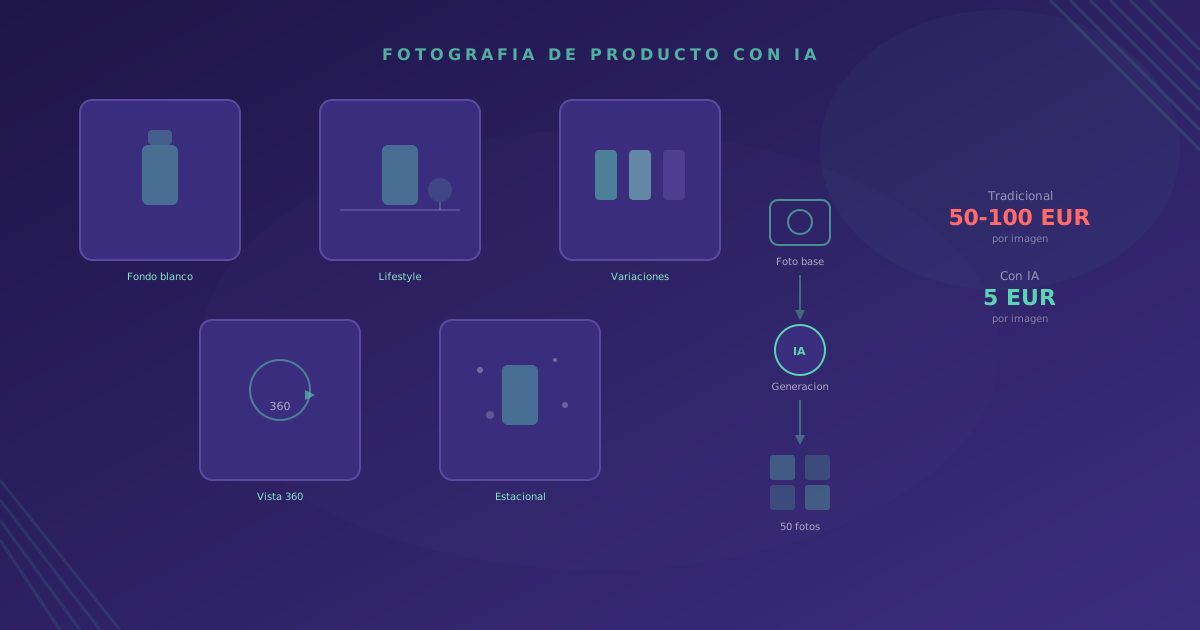
Professional product photography for ecommerce costs between 20 and 100 EUR per image with a photographer and professional studio. For a catalog of 200 products with 5 photos each (1,000 images), the budget can exceed 20,000 EUR. With generative AI, the same catalog can be produced for 2,000 to 5,000 EUR, with delivery times of days instead of weeks.
Let’s break down the typical costs of a traditional photo session:
- Professional photographer: 200-500 EUR/day (produces 20-40 final photos per day).
- Studio rental: 100-300 EUR/day.
- Styling and props: 50-200 EUR per session.
- Retouching and post-production: 5-20 EUR per photo.
- Coordination and logistics: product shipping, planning, briefing.
For a fashion brand with 100 garments and 5 photos per garment, we’re talking about 3-5 days of studio work and a budget of 10,000-25,000 EUR. And every season it needs to be repeated.
AI Tools for Product Photography in 2026
Background and Scene Generation
The most mature use case is background replacement. You start with a real photo of the product (even taken with a phone) and AI generates professional backgrounds:
- Flux (via ComfyUI): the most powerful open-source model for image generation. Produces photorealistic results. Free with a GPU, or from 10 USD/month on cloud platforms.
- Stable Diffusion + ControlNet: customizable pipeline that maintains the exact shape of the product while generating new backgrounds and lighting styles.
- Adobe Firefly: integrated into Photoshop. Excellent for background editing and image expansion.
All-in-One Platforms
- Pebblely: platform specialized in AI product photos. Upload your photo, choose a style, and generate. From 19 USD/month.
- Flair.ai: similar, with more scene customization options. From 10 USD/month.
- Photoroom: background removal and product integration into scenes. Freemium.
Step by Step: How to Generate Product Photos with AI
1. Capture the Base Photo
The base photo is the starting point. You don’t need a professional studio, but you should follow minimum rules: uniform lighting, neutral background, multiple angles, high resolution, and a clean product.
2. Background Removal
The first processing step is isolating the product: Photoroom, remove.bg, or Photoshop’s AI selection tool do this in seconds.
3. Scene Generation with AI
With the product isolated, feed the AI with the cutout and a prompt describing the desired scene. From “white background, soft shadows, studio lighting” to “product on a marble surface, Scandinavian minimalist style.”
4. Review and Adjustment
AI doesn’t always get it right the first time. It’s normal to generate 5-10 variations and select the best ones. Check proportions, coherent shadows, product details, and realism.
5. Final Post-Production
Even with AI, a final touch is usually needed: color and exposure adjustment for catalog consistency, cropping to exact marketplace dimensions, and optimized compression for web.
Quality Comparison: AI vs Traditional Photography
Where AI equals or surpasses traditional:
- Clean white backgrounds: AI generates perfectly uniform backgrounds.
- Color variations: generating the same product in 10 different colors is trivial with AI.
- Volume and speed: 50 photos in 24 hours vs 2-3 days of studio work.
- Consistency: all catalog photos have exactly the same style.
Where traditional photography is still superior:
- Complex textures and materials: leather, fabric, glass with reflections.
- Microscopic details: jewelry, watches, electronics with lit screens.
- Interaction with human models: AI still has limitations with hands and natural poses.
- Products with complex transparencies: glass bottles, glasses, etc.
Best Practices for AI Product Photography
- Invest in good base photos: the better the original product photo, the better the AI result.
- Maintain visual consistency: define a style and apply it across the entire catalog.
- Use descriptive, specific prompts: detailed prompts work better than vague ones.
- Generate multiple variations: generate 10 versions and select the best 2-3.
- Review photos at full size: what looks good in thumbnail may have visible artifacts when enlarged.
- Don’t try to deceive the customer: the photo must faithfully represent the product.
When You Still Need a Real Photographer
AI doesn’t replace all product photography. Use a professional photographer for premium brand launches, artisanal products, fashion lookbooks with real models, and food photography.
The practical recommendation is to use a photographer for key pieces (hero shots, home pages, brand campaigns) and AI for all volume catalog work.
Next Step
If you sell online and want to try AI product photography risk-free, request a free trial pack. We’ll generate 5 professional photos of one of your products from base photos you send us. No commitment and in less than 48 hours.
You can also explore our AI video advertising and digital avatar services to cover all your ecommerce audiovisual needs.