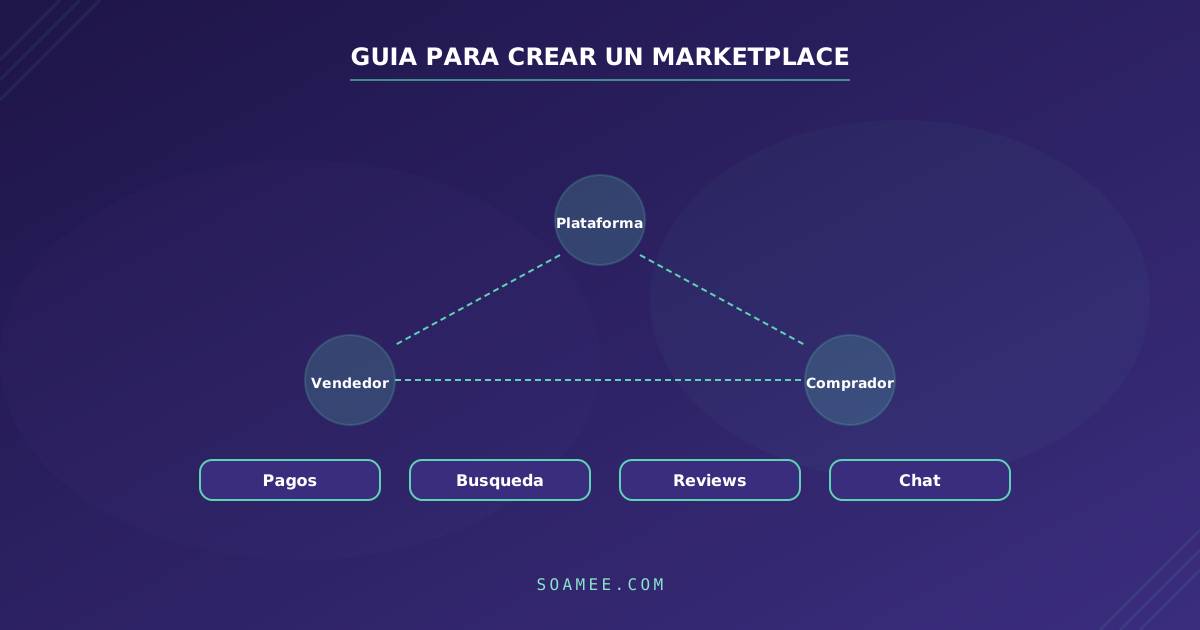
Building a marketplace is one of the most complex software projects that exist. It is not just a website with listings: it is an ecosystem of two or more sides with payments, trust, matching, verification, and network mechanics that all have to work together.
At Soamee we have built four distinct marketplaces: ElDomi (student housing), trasterOne (storage), Brytspace (event spaces), and Invisible Homes (real estate). Each with its own particularities, but all sharing common architectural patterns.
This guide collects everything we have learned.
Types of Marketplaces
Before talking about technology, you need to understand what type of marketplace you are going to build, because the architecture changes radically.
B2C Marketplace (Business to Consumer)
Businesses sell to end consumers. Examples: Amazon, Booking, Airbnb.
Technical characteristics:
- Large catalog with advanced search and filters
- Reviews and ratings system
- Payments with split (platform commission)
- Logistics or fulfillment (if physical product)
B2B Marketplace (Business to Business)
Businesses sell to other businesses. Examples: Alibaba, Faire.
Technical characteristics:
- Volume pricing and negotiation
- Approval and credit processes
- Complex invoicing (different countries, VAT)
- ERP integration
C2C Marketplace (Consumer to Consumer)
Users sell to other users. Examples: Wallapop, Vinted.
Technical characteristics:
- Identity verification
- Integrated messaging system
- Escrow (deposit guarantee)
- Dispute resolution
Service Marketplace
Connects service providers with clients. Examples: Upwork, Fiverr, Booking.
Technical characteristics:
- Availability and calendar
- Real-time booking system
- Algorithmic matching (supply-demand)
- Geolocation
Technical Architecture of a Marketplace
Recommended Stack in 2026
| Layer | Technology | Why |
|---|---|---|
| Web frontend | Next.js 15 (App Router) | SSR, SEO, performance, React ecosystem |
| Mobile frontend | React Native / Expo | Shared web-mobile code, native performance |
| Backend API | Node.js (Fastify/Hono) or Next.js API routes | Performance, JS ecosystem, DX |
| Database | PostgreSQL + Redis | Mature relational + cache/sessions |
| Search | Elasticsearch or Meilisearch | Full-text search, faceted filters, geo-search |
| Payments | Stripe Connect | Split payments, integrated KYC, marketplace-ready |
| Files | AWS S3 + CloudFront | Global CDN, low cost, scalable |
| Infrastructure | AWS (ECS/Fargate) or Vercel | Auto-scaling, managed services |
| Messaging | Stream/Sendbird or custom | Real-time chat between users |
| Notifications | AWS SES + SNS or Resend | Transactional email + push |
With trasterOne we used Next.js for the frontend with a Node.js backend, PostgreSQL for data, and Stripe Connect for split payments. This architecture allowed us to launch an MVP in 10 weeks and scale without rewrites.
Essential Data Model
Every marketplace needs these core entities:
Users
  ├── Buyers (buyer profile)
  ├── Sellers (seller profile)
  └── Admins

Listings
  ├── Categories / Types
  ├── Dynamic attributes
  ├── Media (photos, video)
  ├── Price / Availability
  └── Geolocation

Transactions
  ├── Bookings / Orders
  ├── Payments (split: seller + platform)
  ├── States (pending, confirmed, completed, disputed)
  └── Reviews

Messages
  ├── Conversations (buyer ↔ seller)
  └── System notifications
Search and Matching
Search is the most critical functionality of a marketplace. If the user cannot find what they are looking for in less than 3 seconds, they leave.
Minimum requirements:
- Full-text search with typo tolerance
- Faceted filters (price, location, category, attributes)
- Geo-search (search by map or radius)
- Sorting by relevance, price, recency, rating
- Suggestions and autocomplete
Advanced search:
- Semantic search (understands intent, not just keywords)
- Personalized recommendations based on history
- Algorithmic matching (connecting the best supply with demand)
With Invisible Homes we implemented intelligent search in real estate with filters by zone, price, features, and matching with user preferences. The difference between a basic and an intelligent search can be a 30% increase in conversion.
Payment System for Marketplaces
Split Payments (Commission)
The business model of most marketplaces is to charge a commission per transaction. This requires a payment system that:
- Charges the buyer the full price
- Retains the commission for the platform
- Pays the seller the net amount
- Manages refunds partial and total
Market options:
| Provider | Fee | Integrated KYC | Integration Ease |
|---|---|---|---|
| Stripe Connect | 1.5% + 0.25 EUR | Yes | High |
| Mangopay | 1.8% + 0.18 EUR | Yes | Medium |
| Adyen for Platforms | Negotiable | Yes | Medium-low |
| PayPal Commerce Platform | 2.9% + 0.30 EUR | Yes | High |
Escrow (Deposit Guarantee)
For service marketplaces or high-value products, escrow is essential. The money is held until the buyer confirms they have received the service/product.
With ElDomi, we implemented a system where the student accommodation payment is held until the student confirms check-in. This builds trust on both sides of the marketplace.
Subscriptions vs Commissions
| Model | Advantage | Disadvantage |
|---|---|---|
| Transaction commission | Aligned with seller success | Incentivizes bypass (negotiating off-platform) |
| Monthly subscription | Predictable revenue | Barrier to entry for sellers |
| Freemium + premium features | Low barrier, later monetization | More complex to implement |
| Listing fee + commission | Filters serious sellers | May discourage small sellers |
KYC/Verification and Trust
Identity Verification (KYC)
European regulation (PSD2, AML5) requires verifying the identity of users who receive payments. This includes:
- Identity document verification
- Proof of address
- For companies: verification of legal representative and corporate structure
Stripe Connect and Mangopay integrate KYC into their onboarding flow, which greatly simplifies implementation.
Trust & Safety
Trust is a marketplace’s most important asset. Without trust, there are no transactions.
Essential trust mechanisms:
| Mechanism | Function | Priority |
|---|---|---|
| Bidirectional reviews | Visible reputation | Critical |
| Profile verification | Confirmed identity | High |
| Verified photos | Prevent bait-and-switch | High |
| Payment escrow | Financial protection | Critical |
| Dispute system | Conflict resolution | High |
| Content moderation | Catalog quality | Medium |
| Fraud detection | Prevention | High |
With Brytspace, the event space marketplace, we implemented space verification with photos and reviews, a dispute resolution system, and escrow payments. Trust was key for event organizers to book spaces without visiting them first.
Development Phases and Costs
Phase 1: MVP (8-12 weeks)
Features:
- Registration and profiles (buyers + sellers)
- Listings with basic search and filters
- Payment system with split
- Basic messaging
- Admin panel
Market cost: 30,000-60,000 EUR
Phase 2: Growth (12-16 weeks)
Features:
- Advanced search (geo, faceted, autocomplete)
- Reviews and ratings system
- Notifications (email + push)
- Seller dashboards (basic analytics)
- SEO optimized (indexable pages per listing)
- Responsive / basic mobile app
Market cost: 40,000-80,000 EUR
Phase 3: Scale (16-24 weeks)
Features:
- Native mobile app (iOS + Android)
- Full KYC/verification
- Dispute system
- Personalized recommendations
- Marketing tools for sellers
- Advanced analytics
- Third-party integrations (ERP, CRM, logistics)
Market cost: 60,000-150,000 EUR
Realistic Total Timeline
| Phase | Duration | Recommended Team |
|---|---|---|
| Discovery and design | 3-4 weeks | 1 PM + 1 Designer + 1 Tech Lead |
| MVP | 8-12 weeks | 2-3 Devs + 1 Designer + 1 PM |
| Beta launch | 2-4 weeks | Testing + adjustments |
| Growth features | 12-16 weeks | 2-4 Devs + 1 Designer + 1 PM |
| Scale | Ongoing | 3-5 Devs + product team |
Real Soamee Cases
ElDomi: Student Housing Marketplace
ElDomi connects international students with accommodation owners. The main challenge was trust: a student from another country books an apartment without seeing it.
Solution: Owner verification, verified photos, payment escrow, and dispute resolution system. Next.js for the frontend with map search and advanced filters.
trasterOne: Storage Marketplace
trasterOne connects people who need storage with owners who have available space. A very niche vertical marketplace with high recurrence (monthly contracts).
Solution: Map search with geolocation, recurring payment system with Stripe, owner dashboards, and booking flow optimized for conversion.
Brytspace: Event Space Marketplace
Brytspace connects event organizers with unique spaces (rooftops, lofts, galleries). The challenge: every space is different and event requirements vary widely.
Solution: Dynamic attribute system to describe spaces, search with advanced filters (capacity, equipment, event type), real-time availability calendar.
Invisible Homes: Real Estate Marketplace
Invisible Homes is a real estate platform with intelligent search. The challenge: differentiating in a saturated market of property portals.
Solution: Semantic search that understands user preferences, intelligent matching with properties, and a premium user experience that goes beyond the classic listing.
Key Marketplace Metrics
| Metric | What It Measures | Target for Traction |
|---|---|---|
| GMV (Gross Merchandise Value) | Total transaction value | MoM growth > 15% |
| Take rate | Effective commission % | 10-25% (depends on sector) |
| Liquidity | Ratio of successful transactions vs listings | > 30% |
| Repeat purchase rate | % of buyers who repeat | > 25% |
| Time to first transaction | Time from signup to first purchase | < 7 days |
| NPS | User satisfaction | > 40 |
| Supply/demand ratio | Balance of both sides | 1:3 to 1:10 (depends) |
Frequently Asked Questions
How much does it cost to maintain a marketplace in production?
Depending on traffic: 500-5,000 EUR/month in infrastructure + SaaS tools (payments, email, search, monitoring). Plus the development team for new features.
Should I start with supply or demand side?
Almost always supply. Without a catalog there is nothing to buy. But you need enough demand quickly so that sellers see traction. It is the classic “chicken and egg problem” of marketplaces.
Can I use a no-code solution for the MVP?
To validate the concept, yes (Sharetribe, Arcadier). To scale, no. No-code marketplaces have serious limitations in search, custom payments, matching, and performance. Most of our clients came to us after exhausting no-code possibilities.
How long until a marketplace is profitable?
The industry consensus is 3-5 years. Marketplaces have a “cold start problem” that requires significant investment in acquiring both sides. But once critical mass is reached, network effects generate a very strong competitive moat.
Conclusion
Building a marketplace is a considerable technical and business challenge, but marketplaces that work generate extraordinarily defensible businesses thanks to network effects.
The key is to start with a scoped MVP, solve the trust problem from day one, and iterate quickly with real data.
If you are considering building a marketplace, we can help. At Soamee we have direct experience with four marketplaces in production and a team specialized in web development with the technologies a marketplace needs. Book a free consultation and we will analyze your case.