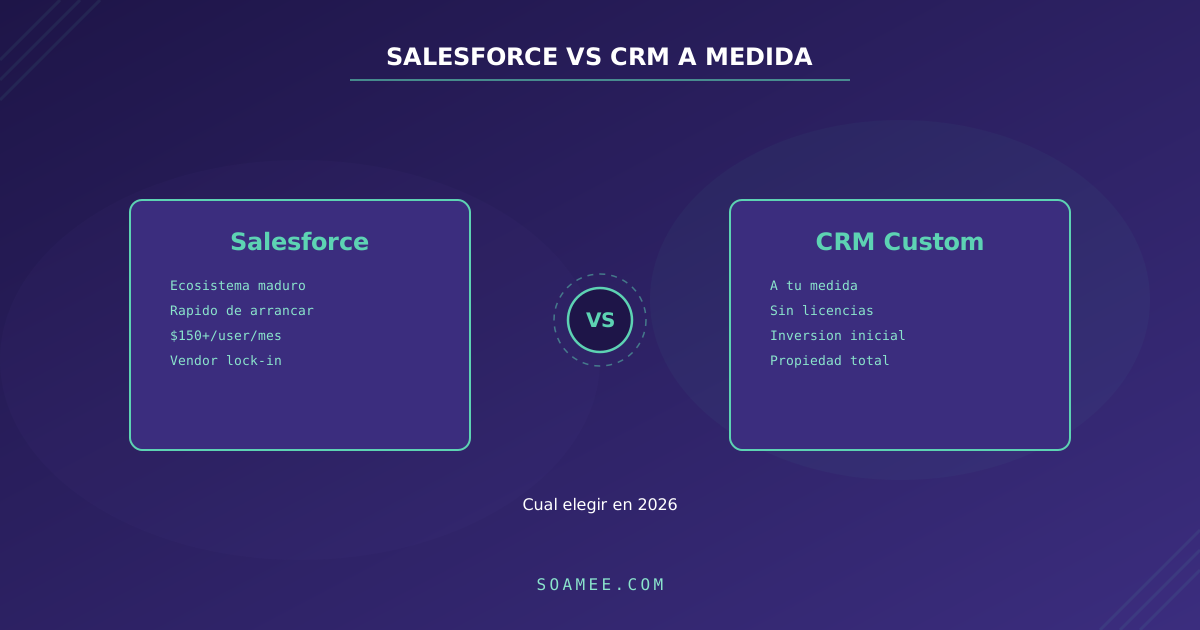
Choosing between Salesforce and a custom CRM is one of the most important technology decisions for any company with a sales team. There is no universal answer: it depends on your sales process, your budget, your time horizon, and the level of customization you need.
At Soamee we have built custom CRMs for companies that came from Salesforce frustrated by limitations and costs, and we have also recommended clients to stay with Salesforce because it was the right choice for their case. This guide shares what we have learned so you can make an informed decision.
Quick Comparison: Salesforce vs Custom CRM
| Criteria | Salesforce | Custom CRM |
|---|---|---|
| Initial cost | Low (monthly SaaS) | High (development) |
| 3-year cost (20 users) | 108,000 - 216,000 EUR | 50,000 - 120,000 EUR |
| Time to productive | 2-8 weeks | 8-16 weeks |
| Customization | Limited by platform | Unlimited |
| Integrations | AppExchange + API | Any API |
| Vendor lock-in | High | None |
| Scalability | Automatic | Requires planning |
| Maintenance | Included in license | Your responsibility |
| AI integration | Einstein (extra cost) | Custom models |
| Data ownership | On Salesforce servers | On your infrastructure |
When Salesforce Is the Best Option
Your sales process is standard
If your sales cycle follows a classic pattern (lead, opportunity, proposal, close) without significant sector-specific peculiarities, Salesforce covers it perfectly. Its kanban pipeline, contact management, and standard reporting are mature and functional. Don’t reinvent the wheel if you don’t need a different wheel.
You need to be operational in weeks, not months
Salesforce can be configured and deployed in 2-4 weeks for a small team. If you have an urgent deadline (new sales team starting, investment round requiring metrics, or sales season kicking off), Salesforce’s deployment speed is unbeatable.
Your team already knows Salesforce
The Salesforce talent ecosystem is enormous. If you already have people on your team who master it, or if you recruit sales profiles who already know it, the learning curve is practically zero. With a custom CRM, you need to train the entire team from scratch.
You need the AppExchange ecosystem
Salesforce has thousands of applications in its marketplace extending its capabilities: from e-signatures to data enrichment, commission management, and CPQ. If you need many of these features, building them from scratch is expensive.
Your company is a corporation with compliance requirements
Large corporations need vendors with SOC 2, ISO 27001 certifications and BAA capability for health data. Salesforce has all of that. A custom CRM can meet the same standards, but you need to implement them yourself.
When a Custom CRM Is Better
Your sales process is complex or sector-specific
If your sales cycle has peculiarities that don’t fit Salesforce’s standard model, a custom CRM is the answer. Real examples we have seen:
- Technical sales with quotes requiring engineering validation before sending to client
- B2B2C sales where you need to manage relationships with distributors and end customers simultaneously
- Professional services where the sale includes hour estimation, team, and planning that automatically becomes a project upon closing
- Regulated sectors where each interaction must be certified or audited specifically
With Attomo we developed a sector-specific CRM for education that manages school relationships, platform implementation tracking, and adoption metrics. No standard CRM contemplates that workflow.
Salesforce per-user cost has spiraled
Salesforce Enterprise costs between 165 and 330 euros per user per month in 2026. For a team of 30 sales reps:
- Salesforce Enterprise: 30 users x 165 EUR x 12 months = 59,400 EUR/year
- Salesforce Unlimited: 30 users x 330 EUR x 12 months = 118,800 EUR/year
Add to that add-on licenses (Einstein AI, CPQ, Pardot) and implementation partner costs. In three years you can easily exceed 300,000 euros.
A custom CRM for 30 users can cost 80,000-120,000 euros in initial development and 15,000-25,000 euros annually for maintenance. At 18-24 months you have already recovered the investment compared to Salesforce.
You need truly integrated AI in your process
Salesforce Einstein is powerful, but operates within platform constraints. A custom CRM lets you integrate AI models specific to your business: lead scoring trained on your historical data, churn prediction based on your specific patterns, or sentiment analysis of communications with your clients.
With eEvidence we integrated complex business logic into their customer management system that would be impossible to implement in Salesforce without developing a completely custom module within the platform.
You don’t want vendor lock-in
With Salesforce, your data sits on their servers, in their format, with their logic. Migrating out of Salesforce is a project in itself that can cost 50,000+ euros and months of work. With a custom CRM, the code is yours, data is on your infrastructure, and you can change development providers without losing anything.
The Hybrid Model: Salesforce + Custom Modules
An often-overlooked option is using Salesforce as a base and building custom modules that integrate via API. This gives you the best of both worlds:
- Salesforce’s robustness and ecosystem for standard contact and opportunity management
- Custom modules for your specific business processes that Salesforce doesn’t cover
This approach works well when 70% of your process fits Salesforce and the remaining 30% is highly specific.
Alternatives to Consider
Before deciding between Salesforce and custom, evaluate if HubSpot might suffice for your case. HubSpot CRM is free in its basic version and covers the needs of many small and medium sales teams. If your team has fewer than 10 sales reps and your process is relatively standard, HubSpot may be the most efficient option.
Recommended Decision Process
- Document your current sales process with all steps, exceptions, and peculiarities
- Evaluate what percentage fits a standard CRM: if over 80%, go with Salesforce or HubSpot
- Calculate the total 3-year cost including licenses, implementation, customizations, and maintenance
- Value the opportunity cost: how much you lose by not having the ideal CRM versus having it 3 months later
- Consider the hybrid model if the answer isn’t clear
Conclusion
There is no universally correct answer. Salesforce is the best option for companies with standard processes that need speed and ecosystem. A custom CRM is better for companies with complex processes, high user volume, or very specific needs where Salesforce’s cost isn’t justified.
If you need help evaluating which is the best option for your case, at Soamee we offer a free consultation where we analyze your sales process and recommend the solution that best fits. You can also explore our custom CRM solution to understand what a custom development includes.