You have an idea that keeps you up at night. You are convinced it will work. But before investing 30,000, 50,000, or 100,000 euros in development, you need to answer one fundamental question: Is anyone willing to pay for this?
At Soamee, we have seen dozens of projects that came to us after months of development spent building something nobody wanted. We have also helped entrepreneurs validate their ideas in weeks, with budgets between 500 and 3,000 euros, before writing a single line of product code.
This guide compiles everything we have learned about business idea validation. This is not academic theory: these are techniques we use with our clients that work in real markets.
Why Most Ideas Fail (And It Is Not Because of Technology)
90% of startups fail. But the interesting part is that only 10% of those failures are due to technical problems. The rest fail because of lack of market, wrong business model, or incorrect timing.
This means the most important decision is not which framework to use or whether to go with microservices. The most important decision is: Am I solving a real problem that someone has and would pay for?
Validating before building is not wasting time. It is the investment with the highest ROI you can make.
The 5-Phase Validation Framework
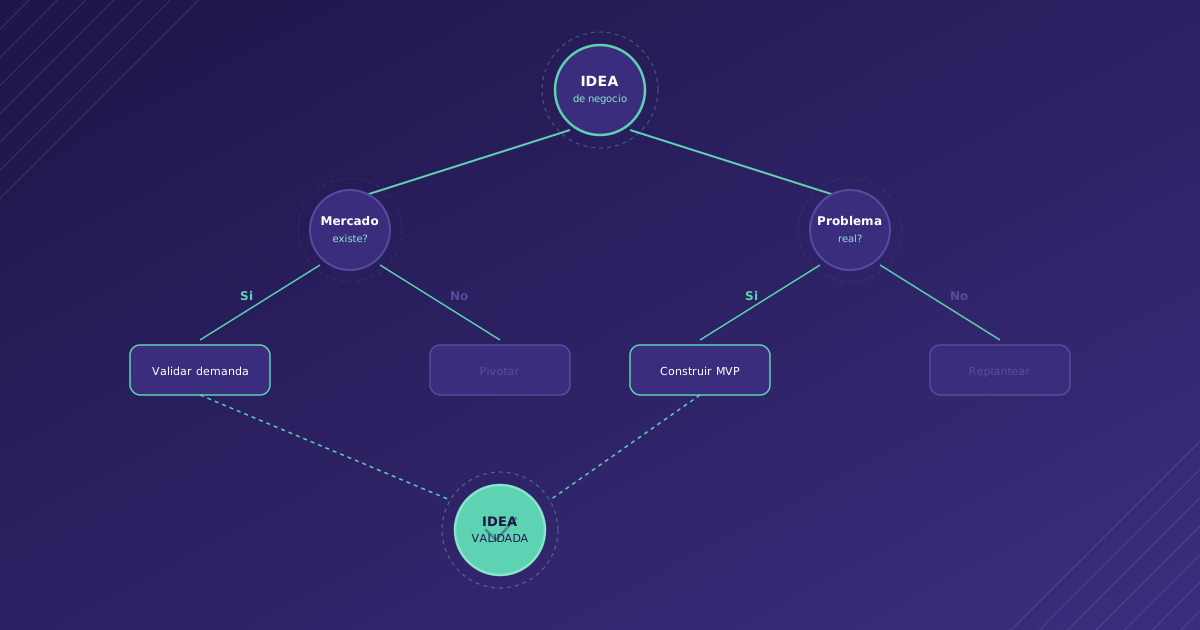
Decision Diagram: Business Idea Validation
Let’s look at each phase in detail.
Phase 1: Problem Interviews (Not Solution Interviews)
This is the most important phase and the one most entrepreneurs skip. The goal is not to ask “Would you like an app that does X?” but to deeply understand the problem you want to solve.
How to Conduct Effective Interviews
Golden rule: Do not talk about your solution. Only ask about the problem.
Questions that work:
- “Tell me how you currently manage [process].” This open-ended question reveals the real workflow, not the idealized one.
- “What is the most frustrating part of that process?” Identifies real pain points.
- “What have you tried to solve it?” If they have already looked for solutions, the pain is real.
- “How much time/money does that problem cost you each week?” Quantifies the economic impact.
- “If you could solve that problem with a snap of your fingers, what would change in your daily life?” Reveals perceived value.
Questions you should NOT ask:
- “Would you use an app that does X?” (they always say yes out of politeness)
- “Would you pay 29 euros per month for this?” (hypothetical answers are worthless)
- “What features would you like it to have?” (they are not designing your product)
How Many Interviews Do You Need
Minimum 15, ideally 20-25. After 15 interviews, you will start hearing the same patterns over and over again. That repetition is the signal that you have found something real.
Where to Find Interviewees
- LinkedIn: Search for profiles that match your buyer persona and send them a direct message asking for 20 minutes of their time. Expected response rate: 5-10%.
- Specialized communities: Slack, Discord, niche forums, professional Facebook groups.
- Your personal network: Ask friends and acquaintances to introduce you to someone who works in the target sector.
- Events and meetups: Both in-person and online.
How to Interpret the Results
After the interviews, look for these indicators:
- Strong signal: 50% or more describe the same problem with emotional intensity. They have already tried to solve it. They can quantify the cost.
- Moderate signal: 30-50% acknowledge the problem but do not consider it urgent. There may be a segment issue.
- Weak signal: Less than 30% connect with the problem. You need to pivot the problem or the segment.
Phase 2: Validation Landing Page
If the interviews confirm the problem, the next step is to create a landing page that presents your solution and measures real interest.
What Your Validation Landing Page Should Have
You do not need a perfect design. You need clarity and a measurable call to action.
Recommended structure:
- Headline that describes the problem (not your solution): “Tired of losing 3 hours a day on administrative tasks?”
- Subheadline with the value proposition: “Automate 80% of your repetitive tasks and reclaim your time for what matters.”
- 3-4 main benefits: With icons, not technical features.
- Social proof: Even if it is “used by 50 professionals in beta” or logos of companies that have shown interest.
- Clear CTA: “Request early access” or “Reserve your spot” with an email form.
Tools for Creating the Landing Page
Do not build anything custom at this stage. Use what already exists:
- Carrd.co: 19 USD/year. Simple and fast. Perfect for validation.
- Unbounce or Instapage: More powerful but more expensive. Useful if you plan to do serious A/B testing.
- Webflow: If you need something more elaborate and have design skills.
How Much Traffic Do You Need
To obtain statistically significant data, you need at least 200-300 unique visitors. With an expected conversion rate of 5-15% for early adopters, that would give you between 10 and 45 leads.
How to get that traffic:
- Google/Meta Ads: 200-500 EUR in targeted ads. This gives you fast, controlled data.
- Community posts: Share valuable content (not spam) in the same channels where you found your interviewees.
- Personal LinkedIn: Write about the problem you discovered. If you conducted the interviews well, you will have interesting data to share.
Key Landing Page Metrics
- Email conversion rate: Above 10% is a very strong signal. Between 5-10% is promising. Below 3%, something is wrong.
- Cost per lead (CPL): Depends on the sector, but for B2B a CPL of 5-20 EUR is reasonable at this stage.
- Follow-up email open rate: If your leads open your emails at 40%+, they are truly interested.
Phase 3: Fake Door Test
The fake door test is a technique that consists of offering something that does not yet exist and measuring how many people try to buy or use it. It is not about deceiving anyone: it is about validating real purchase intent.
How to Implement It
- On your landing page, add a “Buy now” or “Start free trial” button.
- When someone clicks, take them to a page that explains: “We are in the launch phase. Leave your email to be among the first to access it. As an early adopter, you will get a 30% discount.”
- Measure the buy button CTR. If more than 5% of your visitors click “Buy,” there is real demand.
Advanced Fake Door Variations
- Pricing page: Create a page with 3 pricing plans and measure which one gets the most clicks. This helps you validate your pricing model before building anything.
- Feature voting: Present 5-6 potential features and let users vote on which one they want first. This helps you prioritize development.
- Pre-sale with refund: Offer early purchase with a money-back guarantee if it does not launch within X months. If someone pays, the validation is definitive.
Phase 4: Concierge MVP
The concierge MVP means manually doing what your product would do automatically. Instead of building software, you deliver the service by hand for your first customers.
Why It Works
- Validates willingness to pay: If someone pays for a manual service, they will pay for an automated one.
- You learn the real workflow: You discover problems and needs you would never have anticipated from behind a desk.
- You generate revenue from day one: You partially fund future development.
Real Examples
Case 1: Automated accounting platform
Before building the platform, the founder offered a “smart accounting” service where he personally processed invoices for 10 clients using Excel and basic scripts. In 3 months, he learned that what clients valued most was not automatic categorization (what he thought) but real-time tax estimation. That completely changed the product roadmap.
Case 2: Recruiting tool
The team started by manually matching candidates with job offers, using a Google Form and a spreadsheet. The first 5 clients paid 200 EUR/month for the service. When they automated 6 months later, they already had 15 clients and a product designed exactly for what the market needed.
How to Execute a Concierge MVP
- Define the manual service: What will you do exactly for your first clients?
- Set a price: It must be enough to make paying feel meaningful (otherwise it is not real validation), but low enough to be accessible. 50-70% of the final target price usually works.
- Get 5-10 clients: Use your leads from the landing page.
- Deliver the service for 4-8 weeks: Document everything you learn.
- Measure retention: If clients renew, you have early product-market fit.
Phase 5: Validation Metrics and Investment Decision
After the previous phases, you should have enough data to make an informed decision. These are the metrics we use at Soamee to recommend whether our clients should invest in development:
“Green light” metrics (go ahead with development)
- 15+ interviews confirm the problem with intensity
- Landing page conversion rate > 8% with qualified traffic
- 3+ clients paying for the concierge MVP
- Retention rate > 60% on the manual service
- Clients refer others without being asked (organic growth)
“Yellow light” metrics (pivot or iterate)
- Interviews are ambiguous or the problem is not urgent
- Landing conversion between 3-8%
- Clients try but do not renew
- Feedback is “it’s fine” instead of “this saves my life"
"Red light” metrics (do not invest in development)
- Less than 30% of interviewees acknowledge the problem
- Landing conversion below 3%
- No one is willing to pay, not even a reduced price
- CPL is so high that the business model does not work
How Much Time and Money Do You Need to Validate
A complete validation process can be done in 4-8 weeks with a budget of 1,000-5,000 EUR:
| Phase | Time | Cost |
|---|---|---|
| Problem interviews | 2-3 weeks | 0 EUR (only your time) |
| Landing page | 1 week | 100-300 EUR (tool + domain) |
| Traffic for landing | 2-3 weeks | 300-1,500 EUR (ads) |
| Fake door test | In parallel with landing | 0 EUR additional |
| Concierge MVP | 4-8 weeks | 500-2,000 EUR (tools) |
Compare these numbers with the 30,000-100,000 EUR it costs to develop a complete digital product. Validation is, by far, the investment with the best return you can make as an entrepreneur.
Common Validation Mistakes
1. Asking Friends and Family
Your friends will tell you your idea is great because they love you. Not because it is true. Always validate with strangers who fit your customer profile.
2. Confusing Interest with Purchase Intent
“What a great idea, I would sign up” is not the same as “here, take my credit card.” Until someone pays (or at least tries to pay), you have not validated anything.
3. Over-building the Landing Page
We have seen entrepreneurs spend 3,000 EUR and 6 weeks on a validation landing page. A simple page built in a weekend with Carrd serves exactly the same purpose.
4. Not Segmenting Traffic
If you send generic traffic to your landing page, the metrics will be noise. Segment your ads to reach exactly the profile of person you interviewed.
5. Giving Up Too Soon
The first version of the landing page never converts well. Iterate the copy, change the headline, test different CTAs. Give it at least 2-3 iterations before concluding there is no market.
6. Falling in Love with the Solution
The most dangerous mistake. If the interviews tell you the problem does not exist, listen. Do not look for excuses to push forward with your original idea. The best entrepreneurs pivot quickly.
Recommended Tools for Each Phase
For Interviews
- Calendly: To schedule interviews
- Otter.ai or Grain: To automatically transcribe and analyze
- Notion or Airtable: To organize insights by category
For Landing Pages
- Carrd.co: The fastest and cheapest
- Google Analytics 4 + Hotjar: To measure behavior
- Mailchimp or ConvertKit: To capture and manage emails
For Fake Door Tests
- Google Optimize (or Webflow): For A/B testing
- Stripe: For real pre-sales
- Typeform: For follow-up surveys
For Concierge MVP
- Google Workspace: Forms, spreadsheets, email
- Zapier or Make: To connect tools without code
- Slack or WhatsApp Business: For direct communication with clients
Real Case: From Idea to Validation in 6 Weeks
We share a recent case (anonymized) from a Soamee client:
Original idea: Project management platform for architecture studios.
Week 1-2: Interviews with 18 architects and project managers. Key discovery: the problem was not project management (they already used tools), but communication with non-technical clients about changes and approvals.
Week 3: Landing page focused on “simplified project communication for architecture studios.” 12% conversion with LinkedIn Ads traffic.
Week 4-5: Fake door test with pricing page. The 49 EUR/month/project plan was the most clicked (64% of clicks). Price validation achieved.
Week 6: Concierge MVP with 4 studios. A private Slack channel per project was used where the team manually handled communications and approvals. 3 out of 4 studios renewed after the first month.
Result: The client invested in development with confidence. The technical MVP focused on communication and approvals (not generic project management), and reached 50 paying clients in 6 months.
Conclusion: Validating Is the Best Investment You Can Make
Do not build something nobody wants. Dedicate 4-8 weeks and a few thousand euros to validating your idea before committing tens of thousands to development. The techniques we have described (interviews, landing pages, fake doors, concierge MVP) do not require advanced technical knowledge and will give you real data on which to base your decisions.
At Soamee, we help entrepreneurs and companies navigate this path: from validation to product development. If you have an idea and want to validate it with methodology, let’s talk. It will save you time, money, and many headaches.