Smart agriculture is no longer a futuristic concept. It is a reality that is transforming farms around the world, reducing water consumption by up to 30%, optimizing fertilizer use, and increasing yields per hectare.
At Soamee we have experienced this transformation first-hand working with Spherag, a company that has developed solar IoT devices for real-time agricultural monitoring. We built their data platform, dashboards, and alert systems. This guide collects both technical knowledge and practical experience.
What Is Smart Farming
Smart farming combines IoT sensors, data analytics, and automation to make decisions based on real information, not intuition or fixed schedules.
The flow is simple in concept, complex in execution:
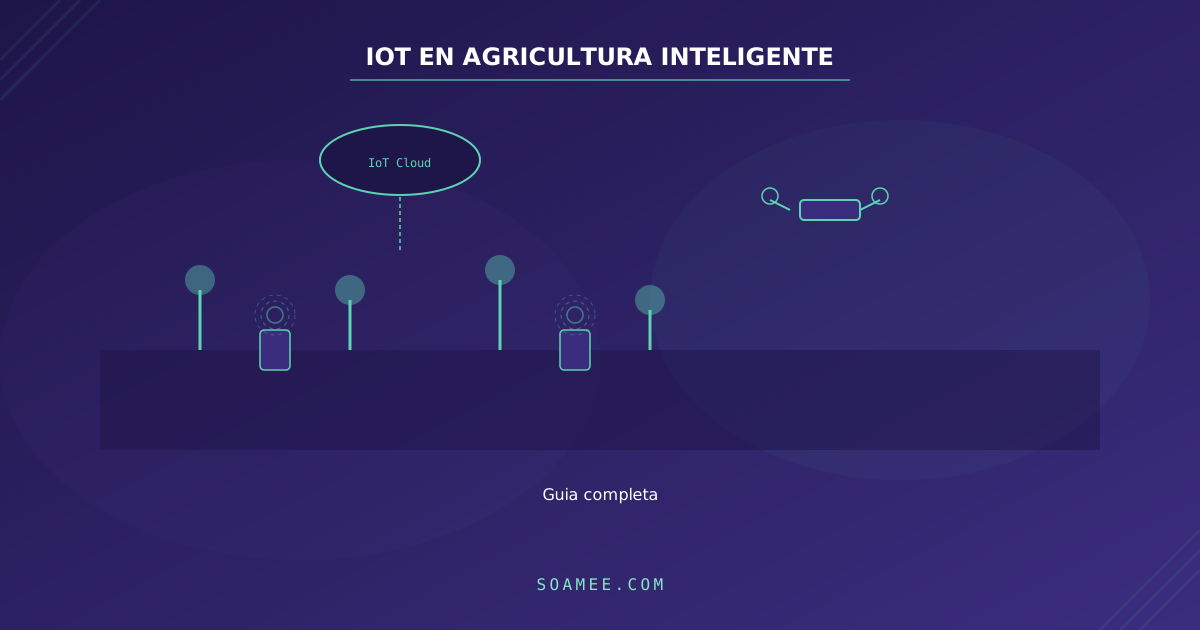
Field sensors → Data transmission → Cloud processing → Dashboards → Decisions/AutomationWhy Now
Three factors have made smart farming viable for any farm:
- Sensor cost: A soil moisture sensor that cost 500 EUR in 2018 costs less than 50 EUR in 2026
- Rural connectivity: LoRaWAN, NB-IoT, and Sigfox cover rural areas where 4G/5G does not reach
- Solar energy: IoT devices with solar panels eliminate dependence on electrical grid and replaceable batteries
Types of Agricultural Sensors
Soil Sensors
| Type | What It Measures | Primary Use | Price Range |
|---|---|---|---|
| Volumetric moisture | Water content in soil | Precision irrigation | 30-150 EUR |
| Electrical conductivity | Soil salinity | Fertilization control | 50-200 EUR |
| Soil temperature | Degrees at depth | Frost prediction, sowing | 20-80 EUR |
| pH | Acidity/alkalinity | Soil amendments | 80-300 EUR |
| Tensiometers | Soil water tension | Advanced precision irrigation | 100-400 EUR |
Weather Sensors
| Type | What It Measures | Primary Use | Price Range |
|---|---|---|---|
| Weather station | Temp, humidity, wind, rain | Prediction and alerts | 200-1,500 EUR |
| Pyranometer | Solar radiation | Evapotranspiration calculation | 100-500 EUR |
| Rain gauge | Precipitation | Irrigation adjustment | 30-150 EUR |
| Leaf wetness sensor | Leaf humidity | Disease prevention | 50-200 EUR |
Crop Sensors
| Type | What It Measures | Primary Use | Price Range |
|---|---|---|---|
| NDVI (drone/satellite) | Vegetation index | Crop health | Variable |
| Dendrometer | Trunk growth | Tree water status | 200-800 EUR |
| Smart trap | Insect captures | Pest control | 300-1,000 EUR |
| Multispectral camera | Spectral reflectance | Early disease detection | 1,000-5,000 EUR |
Architecture of an Agricultural IoT Platform
Device Layer
IoT devices in the field must meet specific requirements:
- Energy autonomy: Solar panel + battery to operate without electrical grid
- Durability: IP67 minimum (dust and water), temperature range -20 to 60 degrees
- Low power: The device must operate for months on a single charge
- Rural connectivity: LoRaWAN or NB-IoT for open field coverage
Spherag solved this with self-sufficient solar devices that transmit data via LoRaWAN and have a lifespan of more than 5 years without maintenance. This approach eliminates the main barrier to adoption: nobody wants to go change batteries in the middle of an olive grove.
Communication Layer
| Technology | Range | Power | Data Rate | Ideal For |
|---|---|---|---|---|
| LoRaWAN | 5-15 km rural | Very low | 0.3-50 kbps | Soil sensors, weather |
| NB-IoT | Mobile coverage | Low | 200 kbps | Sensors with more data |
| Sigfox | 10-50 km | Very low | 100 bps | Simple alerts |
| WiFi | 50-100 m | High | 100+ Mbps | Greenhouses |
| 4G/5G | Mobile coverage | High | 10+ Mbps | Cameras, video |
Data Layer (Cloud)
The typical data pipeline for agricultural IoT includes:
- Ingestion: Data arrives via MQTT or HTTP to a broker (AWS IoT Core, Azure IoT Hub)
- Real-time processing: Alert rules (moisture below threshold, imminent frost)
- Storage: Time-series database (InfluxDB, TimescaleDB)
- Batch processing: Daily evapotranspiration calculations, water needs prediction
- API: Endpoints for dashboards and mobile applications
At Soamee we build these pipelines using AWS managed services to minimize operational cost. You can see more about our approach in Cloud and DevOps.
Visualization and Decision Layer
Dashboards must be useful for those who use them. A farmer in the field does not need complex charts; they need:
- Traffic lights: red/yellow/green by zone
- Push alerts when something requires attention
- Clear recommendations: “Zone 3 needs irrigation in the next 12 hours”
- Simple history to compare with previous seasons
Voice-First Interfaces for the Field
One of the most interesting innovations we have explored is the voice interface for farmers. When you are in the field with dirty hands, looking at a dashboard on your phone is not practical.
A voice-first system allows:
- “What is the moisture in the north plot?” → Immediate voice response
- “Activate irrigation in zone 3 for 45 minutes” → Automatic execution
- “Alert me if the temperature drops below 2 degrees tonight” → Alert configuration
We have developed voice-first interface solutions for agriculture that connect voice assistants with IoT platforms. The farmer interacts with their data without needing a screen.
Real Case: Spherag and Water Savings
Spherag is the most illustrative case of agricultural IoT we have implemented. The numbers speak for themselves:
The challenge: Farmers irrigating by calendar or intuition, wasting water and applying fertigation without real soil data.
The solution: Solar IoT devices that measure soil moisture, conductivity, temperature, and weather. Data is transmitted via LoRaWAN to a cloud platform that generates dashboards and alerts.
Public results:
- 30% reduction in water consumption
- Real-time plot monitoring
- Automatic alerts for critical conditions
- Zero device maintenance (solar energy)
Implemented Architecture
Spherag devices (solar + LoRaWAN)
    ↓
LoRaWAN gateway on farm
    ↓
AWS IoT Core (ingestion)
    ↓
Lambda + Kinesis (processing)
    ↓
TimescaleDB (storage)
    ↓
REST API + WebSocket
    ↓
Web dashboard + Mobile app + Alerts
ROI Calculation for Farmers
Scenario: Olive Farm (100 hectares)
| Concept | Without IoT | With IoT |
|---|---|---|
| Annual water consumption | 450,000 m3 | 315,000 m3 (-30%) |
| Water cost (0.15 EUR/m3) | 67,500 EUR | 47,250 EUR |
| Fertilizer cost | 25,000 EUR | 20,000 EUR (-20%) |
| Losses from frost/drought | 15,000 EUR (average) | 5,000 EUR (-67%) |
| Annual savings | - | 35,250 EUR |
| IoT Investment | Cost |
|---|---|
| 50 soil devices | 5,000-10,000 EUR |
| 3 weather stations | 1,500-4,500 EUR |
| 5 LoRaWAN gateways | 1,000-2,500 EUR |
| Cloud platform (annual) | 3,000-6,000 EUR |
| Total year 1 investment | 10,500-23,000 EUR |
Year 1 ROI: 50-230% Payback period: 4-8 months
From the second year, investment drops drastically (only cloud platform and minimal maintenance), while savings continue.
Scenario: Greenhouse (5,000 m2)
| Concept | Without IoT | With IoT |
|---|---|---|
| Disease losses | 8,000 EUR/year | 3,000 EUR (-62%) |
| Energy consumption (climate control) | 12,000 EUR | 9,000 EUR (-25%) |
| Production per m2 | 45 EUR | 52 EUR (+15%) |
| Annual improvement | - | 43,000 EUR |
Emerging Technologies to Watch
Autonomous Drones
Drones that fly automatically over crops, capture multispectral images, and feed AI models. Drones-as-a-service already exists at 15-30 EUR/hectare/flight.
Field Robots
Autonomous robots for mechanical weeding (no herbicides), selective harvesting, and localized application of plant protection products. Still expensive for small farms, but the cost drops every year.
High-Frequency Satellites
Constellations like Planet Labs offer daily images at 3-meter resolution. Combined with field sensor data, they allow monitoring crops at a regional scale.
AI Models for Harvest Prediction
Machine learning that combines soil, weather, satellite, and historical data to predict yields by zone weeks in advance.
Frequently Asked Questions
Do I need mobile coverage on my plots for IoT?
Not necessarily. LoRaWAN works without mobile coverage; you only need a gateway with internet connection (can be via satellite). One gateway covers 5-15 km in open field.
How many sensors do I need per hectare?
It depends on the crop and soil. As a general rule: 1 moisture sensor every 2-5 hectares in extensive farming, 1 every 500-1,000 m2 in intensive horticulture.
Is the data mine?
It depends on the provider. Always demand access to your data via API and the ability to export it. Avoid platforms that hold your data hostage.
Can I start small?
Yes. Start with a pilot plot (5-10 hectares), measure results for one season, and scale if the numbers add up.
Conclusion
Agricultural IoT has gone from being an experimental technology to a tool with demonstrable ROI. The combination of affordable sensors, rural connectivity, and mature cloud platforms makes the barrier to entry lower than ever.
The Spherag case demonstrates that with the right implementation, return on investment is measured in months, not years. And the benefits go beyond savings: better product quality, environmental sustainability, and data for informed decision-making.
If you are exploring the digitalization of your farm, we can help. At Soamee we combine IoT experience, cloud infrastructure, and platform development to build custom solutions. Book a free consultation and we will analyze your case.