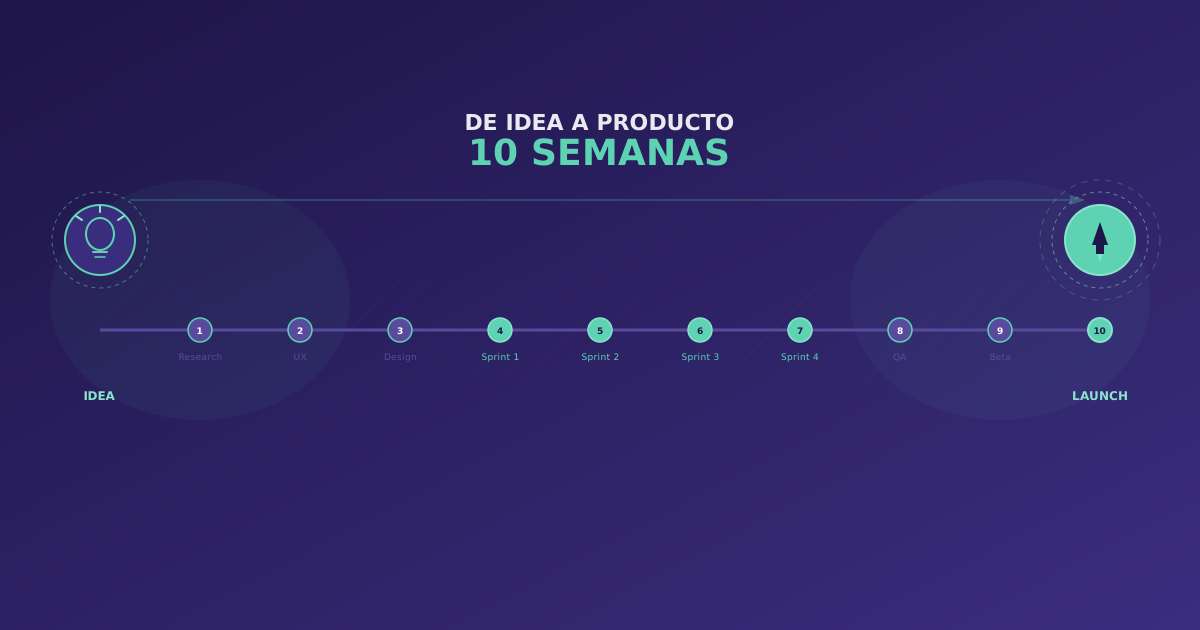
Building an MVP (Minimum Viable Product) is the first step to validate any digital business idea. But “minimum” does not mean “bad,” and “viable” does not mean “complete.” At Soamee we have launched over 30 MVPs in the last 4 years, and we have distilled a process that works consistently in 10 weeks.
What an MVP Is (and What It Is Not)
An MVP is:
- The simplest version of your product that allows you to validate your main business hypothesis
- A functional product that real users can use
- A tool for learning, not for impressing
An MVP is not:
- A prototype or mockup (that is a prior step)
- A version with bugs “because it is an MVP” (quality is non-negotiable)
- An excuse to launch something half-baked and see what happens
The key question: What is the one thing your product needs to do well so that a user pays for it (or comes back to use it)?
The Week-by-Week Plan
Week 1: Discovery and Validation
Objective: Confirm that the problem exists and that your solution makes sense.
Activities:
- Interviews with 10-15 potential users (not friends or family)
- Competitive analysis: who solves the problem today and how
- Definition of unique value proposition
- Identify the 3-5 metrics that will define MVP success
Deliverables:
- Hypothesis document: “We believe that [segment] has the problem of [problem] and would pay for [solution]”
- Prioritized feature list (MoSCoW: Must, Should, Could, Won’t)
- Success metrics with numerical targets
Common mistake: Skipping this phase. 42% of startups fail because there is no real product demand. One week of validation can save you months of development.
Week 2: UX Design and Architecture
Objective: Design the user experience and define the technical architecture.
Activities:
- User flows: the path the user follows to complete key tasks
- Low-fidelity wireframes (Figma, paper, whiteboard)
- Technology stack decision
- Database and API architecture
- Project setup: repo, CI/CD, environments
Deliverables:
- Wireframes validated with at least 3 users
- Architecture document (one page, not a book)
- Repository set up with deployment pipeline
Tip: Do not spend more than 3 days on visual design at this stage. Functional wireframes are enough. The “pretty” design comes after validation.
Weeks 3-4: Core Feature
Objective: Build the main functionality of the product.
This is the feature that justifies your product’s existence. Everything else is secondary.
Example: If you are building a booking platform for restaurants, the core is: the user can see availability and make a booking. Not the review system, not the loyalty program, not push notifications.
Development principles:
- Small and frequent commits
- Continuous deployment (every merge to main deploys)
- Code review on every PR
- Tests for critical business logic (not 100% coverage, but smart coverage)
// Example: test for the core booking logic
describe('ReservationService', () => {
  it('should create a reservation if availability exists', async () => {
    const result = await reservationService.create({
      restaurantId: 'rest-1',
      date: '2026-04-15',
      time: '20:00',
      guests: 4,
      userId: 'user-1'
    });
    expect(result.status).toBe('confirmed');
    expect(result.confirmationCode).toBeDefined();
  });

  it('should reject if no tables are available', async () => {
    // Fill all tables
    await fillAllTables('rest-1', '2026-04-15', '20:00');

    await expect(
      reservationService.create({
        restaurantId: 'rest-1',
        date: '2026-04-15',
        time: '20:00',
        guests: 4,
        userId: 'user-2'
      })
    ).rejects.toThrow('No availability');
  });
});
Weeks 5-6: Secondary Features and Authentication
Objective: Add functionalities that complement the core.
Typically includes:
- User authentication (login, registration, password recovery)
- Basic user profile
- 1-2 “should have” features from MoSCoW
- Basic notifications (transactional email)
Authentication tip: Use services like Supabase Auth, Clerk, or Auth0. Implementing authentication from scratch in an MVP is a classic mistake that wastes 1-2 weeks unnecessarily.
Week 7: Integrations and Payments
Objective: Connect the necessary external services.
If your MVP includes payments (it should, if possible — charging is the ultimate validation):
- Stripe for card payments (integration in 2-3 days)
- Stripe Connect if it is a marketplace (seller + buyer)
- Webhooks to manage payment states
- Confirmation transactional emails
Other typical integrations:
- Analytics (Mixpanel or PostHog for product, Plausible for web)
- Transactional email (Resend, Brevo)
- Monitoring (Sentry for errors, Uptime Robot for availability)
Week 8: Visual Design and Polish
Objective: Transform functional wireframes into an attractive and professional interface.
Now, visual design:
- Apply design system (colors, typography, spacing)
- Responsive design (mobile-first)
- Key micro-interactions (user feedback)
- Loading states and empty states
- Clear and helpful error messages
Do not:
- Complex animations
- Custom illustrations (use libraries like unDraw or Storyset)
- Dark mode (not in an MVP)
- Support for 10 languages
Week 9: Testing and QA
Objective: Ensure everything works correctly before putting real users in.
QA checklist:
- Critical flows work in Chrome, Safari, Firefox
- Responsive on mobile (iOS Safari + Android Chrome minimum)
- Forms validate correctly
- Payments work in production mode (not just test)
- Emails arrive in inbox (not spam)
- Acceptable performance (LCP < 2.5s, FID < 100ms)
- Basic SEO (title, description, OG tags)
- Privacy policy and cookies (legal)
Closed beta: Invite 20-50 users from your validation list. Observe how they use the product (Hotjar, recorded sessions). Do not tell them what to do, watch what they do.
Week 10: Launch
Objective: Put the product in the hands of real users and start measuring.
Launch checklist:
- Domain and DNS configured
- SSL active
- Monitoring and alerts configured
- Automated database backup
- Analytics working and verified
- Status page (optional but recommended)
Launch strategy for MVPs:
- Soft launch (days 1-3): Share with your close network and early adopters
- Product Hunt / Beta list (days 4-7): Publish on discovery platforms
- Content marketing (day 7+): Publish the “building in public” story
- Direct outreach: Personally contact 50 potential users
Recommended Tech Stack for MVPs in 2026
| Layer | Technology | Alternative | Why |
|---|---|---|---|
| Frontend | Next.js 15 | Nuxt 4 | SSR, SEO, ecosystem |
| Mobile | React Native + Expo | Flutter | Share logic with web |
| Backend | Supabase | Firebase | PostgreSQL, auth, storage, realtime |
| Hosting | Vercel | Railway | Trivial deploy, preview deploys |
| Payments | Stripe | Lemonsqueezy | The standard, excellent documentation |
| Resend | Brevo | Simple API, high deliverability | |
| Analytics | PostHog | Mixpanel | Open source, product analytics |
| Monitoring | Sentry | - | Essential from day 1 |
Mistakes We Have Seen (and Made)
1. Building Features Nobody Asked For
64% of software features are rarely or never used (Standish Group). In an MVP, every feature that is not core is dead weight.
2. Technical Perfectionism
You do not need microservices. You do not need Kubernetes. You do not need event sourcing. A well-built monolith on Supabase + Next.js scales to thousands of users without issues.
3. Not Charging From Day 1
If your business model is to charge, charge from the MVP. “We will charge when we have more features” is the most expensive way to discover that nobody wants to pay for your product.
4. Not Talking to Users During Development
Weeks 3-8 are not just about code. Every week you should talk to at least 2-3 potential users, show them what you are building, and adjust.
5. Launching and Disappearing
The launch is not the end, it is the beginning. The 4 weeks after launch are the most critical. Respond to every piece of feedback, fix bugs in hours (not days), and talk to every user.
Post-Launch Metrics That Matter
Do not get lost in vanity metrics. Measure these:
- Activation rate: Percentage of users who complete the “aha moment” (the first valuable action)
- Retention D7/D30: Percentage of users who return at 7 and 30 days
- NPS: Simple question: “From 0 to 10, would you recommend this product?”
- Time to value: How long it takes a new user to get value
- Willingness to pay: If you do not charge yet, ask: “Would you pay X EUR/month for this?”
Conclusion
10 weeks is enough time to go from an idea to a functional product in the hands of real users. It is not easy, it requires discipline and the ability to say “no” to features that are not essential. But it works.
If you have an idea and want to turn it into a product, at Soamee we accompany you through the entire process: from validation to launch. Let us talk.