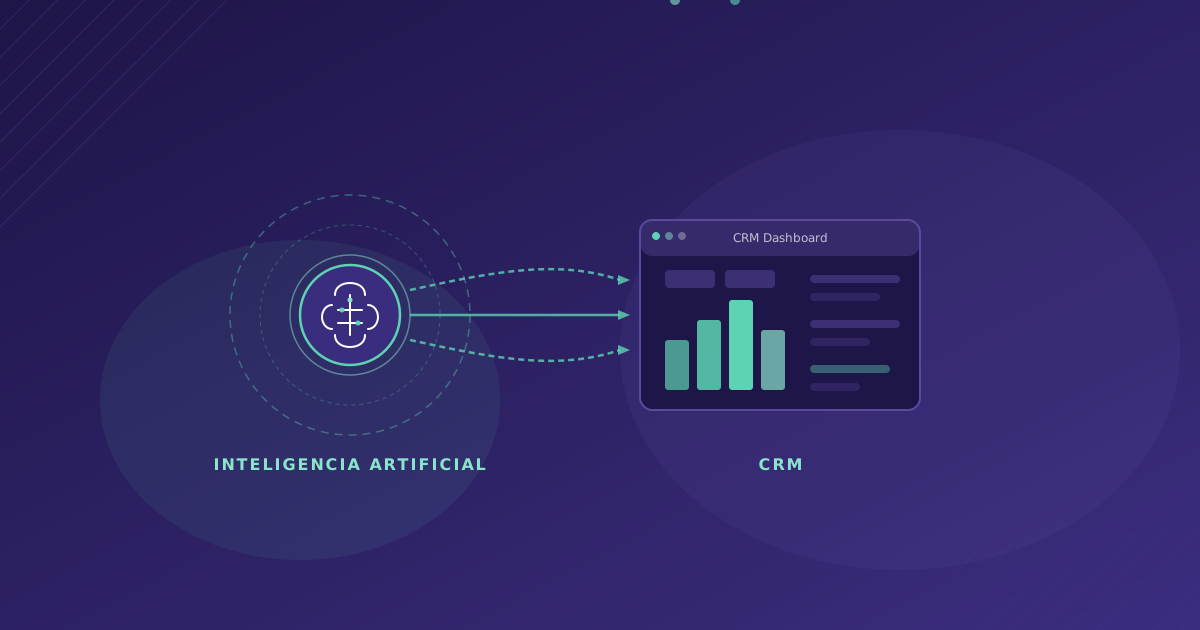
Artificial intelligence has moved beyond being a buzzword to become a real competitive advantage in customer relationship management. At Soamee we have implemented AI integrations in CRMs like Salesforce, HubSpot, and custom solutions, and in this guide we share exactly how to do it.
Why Integrate AI into Your CRM
Before diving into the technical side, it is worth understanding the real impact. Based on our experience with clients in B2B and SaaS sectors:
- 40% reduction in lead qualification time thanks to predictive scoring
- 25% increase in conversion rate through personalized recommendations
- 15 hours saved per salesperson per week on data entry and follow-up tasks
These numbers are not theoretical. They are measured results from real projects with teams of 10 to 50 salespeople.
Reference Architecture
The architectural pattern we recommend for integrating AI into a CRM follows a three-layer structure:
Layer 1: Data Ingestion
The CRM is the source of truth, but AI needs enriched data. We set up pipelines that extract data from the CRM and combine it with external sources.
// Ingestion pipeline with Node.js and Bull queues
import { Queue, Worker } from 'bullmq';

const ingestionQueue = new Queue('crm-ingestion', {
  connection: { host: 'redis', port: 6379 }
});

// Schedule extraction every 15 minutes
await ingestionQueue.add('sync-contacts', {
  source: 'hubspot',
  endpoint: '/crm/v3/objects/contacts',
  enrichWith: ['clearbit', 'linkedin-insights']
}, {
  repeat: { every: 900000 }
});

const worker = new Worker('crm-ingestion', async (job) => {
  const contacts = await fetchFromCRM(job.data);
  const enriched = await enrichData(contacts, job.data.enrichWith);
  await storeInDataLake(enriched);
  await triggerMLPipeline(enriched);
}, { connection: { host: 'redis', port: 6379 } });
Layer 2: AI Engine
This is where the magic happens. Depending on the use case, we implement different models:
Predictive Lead Scoring
We use a classification model trained on historical CRM data. The main features include:
- Company size (number of employees)
- Industry and sub-sector
- Previous interactions (emails opened, pages visited, demos requested)
- Time since last contact
- Acquisition source
# Lead Scoring model with scikit-learn
import pandas as pd
from sklearn.ensemble import GradientBoostingClassifier
from sklearn.model_selection import cross_val_score

# Prepare features
features = [
    'company_size', 'industry_encoded', 'emails_opened',
    'pages_visited', 'demos_requested', 'days_since_last_contact',
    'acquisition_source_encoded', 'engagement_score'
]

X = df[features]
y = df['converted']  # 1 if the lead converted, 0 if not

model = GradientBoostingClassifier(
    n_estimators=200,
    max_depth=5,
    learning_rate=0.1,
    min_samples_split=20
)

# Cross-validation to ensure generalization
scores = cross_val_score(model, X, y, cv=5, scoring='roc_auc')
print(f"Mean AUC: {scores.mean():.3f} (+/- {scores.std():.3f})")

model.fit(X, y)
Sentiment Analysis in Communications
We process emails, call notes, and support tickets to detect customer sentiment and alert when there is a churn risk.
// Sentiment analysis with OpenAI
async function analyzeSentiment(communication: string): Promise<SentimentResult> {
  const response = await openai.chat.completions.create({
    model: 'gpt-4o',
    messages: [
      {
        role: 'system',
        content: `Analyze the sentiment of this business communication.
        Return a JSON with: sentiment (positive/neutral/negative),
        score (-1 to 1), key_topics (array), churn_risk (low/medium/high),
        suggested_action (string).`
      },
      { role: 'user', content: communication }
    ],
    response_format: { type: 'json_object' }
  });

  return JSON.parse(response.choices[0].message.content);
}
Layer 3: Action and Feedback
The AI engine results are written back to the CRM via webhooks or the native API.
// Write results to HubSpot
import { Client } from '@hubspot/api-client';

const hubspot = new Client({ accessToken: process.env.HUBSPOT_TOKEN });

async function updateLeadScore(contactId: string, score: number, insights: string[]) {
  await hubspot.crm.contacts.basicApi.update(contactId, {
    properties: {
      ai_lead_score: score.toString(),
      ai_insights: insights.join(' | '),
      ai_last_scored: new Date().toISOString(),
      ai_recommended_action: score > 0.8
        ? 'Contact within 24h - High conversion probability'
        : score > 0.5
        ? 'Nurture with relevant content'
        : 'Monitor - Low current interest'
    }
  });
}
Complete Flow: From Data to Action
The end-to-end flow works as follows:
- CRM Event: A lead fills out a form, opens an email, or visits a page
- Webhook triggers ingestion: The CRM sends a webhook to our service
- Enrichment: We query external APIs (Clearbit, LinkedIn) to complete the profile
- Scoring: The ML model assigns a score from 0 to 100
- Context Analysis: GPT-4 analyzes recent communications
- CRM Update: Results are written as contact properties
- Notification: If the score exceeds the threshold, the salesperson is notified via Slack
- Feedback loop: When the salesperson marks the lead as won or lost, that data feeds back into the model
Technology Selection
For Cloud CRMs (HubSpot, Salesforce, Pipedrive)
| Component | Recommended Technology | Alternative |
|---|---|---|
| Orchestration | AWS Step Functions | Temporal.io |
| Message Queue | Amazon SQS / BullMQ | RabbitMQ |
| ML Model | SageMaker / Vertex AI | MLflow + EC2 |
| LLM | OpenAI API / Anthropic | Open source models (Llama 3) |
| Data Lake | S3 + Athena | BigQuery |
| API Gateway | AWS API Gateway | Kong |
For Custom or On-Premise CRMs
If your CRM is a custom solution, integration is more straightforward. We recommend exposing an internal gRPC service that acts as an intermediary between the CRM database and the AI models.
service CRMIntelligence {
  rpc ScoreLead (LeadRequest) returns (ScoreResponse);
  rpc AnalyzeCommunication (CommRequest) returns (SentimentResponse);
  rpc GetRecommendations (ContactRequest) returns (RecommendationList);
  rpc RetrainModel (RetrainRequest) returns (TrainStatus);
}

message LeadRequest {
  string contact_id = 1;
  map<string, string> features = 2;
  bool include_enrichment = 3;
}

message ScoreResponse {
  float score = 1;
  repeated string insights = 2;
  string recommended_action = 3;
  float confidence = 4;
}
Real Implementation Costs
We break down the typical monthly costs for a company with 5,000 active contacts in the CRM:
- Cloud infrastructure (AWS/GCP): 150-300 EUR/month
- AI APIs (OpenAI/Anthropic): 100-500 EUR/month (depends on text analysis volume)
- Enrichment APIs (Clearbit): 200-400 EUR/month
- Initial development: 15,000-40,000 EUR (one-time)
- Maintenance and retraining: 2,000-4,000 EUR/month
Expected ROI: With an average deal size of 5,000 EUR and a team of 10 salespeople, the 25% increase in conversion typically translates to 50,000-100,000 EUR additional revenue per quarter. The typical payback period is 2-4 months.
Common Mistakes We Have Seen
1. Over-engineering From Day One
You do not need a distributed data lake to get started. A PostgreSQL with pgvector and an OpenAI API can give you 80% of the value with 20% of the effort.
2. Ignoring CRM Data Quality
If salespeople do not fill in CRM fields correctly, no AI model will work well. Before integrating AI, audit your data quality:
- Percentage of required fields completed
- Consistency in naming conventions (e.g., “Technology” vs “Tech” vs “IT”)
- Record update frequency
3. Not Closing the Feedback Loop
The model needs to know if its predictions were correct. Always implement a mechanism for salespeople to validate or correct AI scores.
4. Deploying Without Monitoring Metrics
Always measure:
- Scoring accuracy (comparing predictions vs actual results)
- Pipeline latency (from event to CRM update)
- Adoption rate (how many salespeople actually use AI recommendations)
- Model drift (changes in data distribution that degrade performance)
Step-by-Step Implementation
Weeks 1-2: Data Audit and Preparation
- Audit CRM fields and data quality
- Define relevant features for scoring
- Export historical data for training
- Set up development environment
Weeks 3-4: Scoring Prototype
- Train basic lead scoring model
- Create REST API to serve predictions
- Integrate with CRM sandbox
- Validate results with the sales team
Weeks 5-6: Enrichment and NLP
- Connect data enrichment APIs
- Implement sentiment analysis
- Create monitoring dashboards
- Configure alerts
Weeks 7-8: Production and Feedback
- Deploy to production with feature flags
- Train the sales team
- Implement feedback loop
- Measure baseline metrics
What if you want to build an AI-powered CRM from scratch?
Everything above assumes you already have a CRM and want to make it smarter. But there is an increasingly common scenario: companies whose sales process does not fit Salesforce or HubSpot and who consider building a CRM with AI baked in from day one.
In that case the order of decisions changes: data model first (entities defined by your process, not the vendor’s template), AI as a native layer inside the workflow rather than a plugin, and a total cost of ownership that removes per-seat licences — from 15-20 users onwards the numbers usually work out.
This is exactly the kind of project we cover in our custom CRM service, and our Salesforce vs custom CRM comparison breaks down with numbers when each path pays off.
Conclusions
Integrating AI into your CRM is not a science fiction project. With current tools, a team of 2-3 developers can have a functional MVP in 4-6 weeks. The key is to start with a specific use case (lead scoring is the most profitable), measure real impact, and expand gradually.
If what you need is the conversational layer without building it from scratch, our AI assistant already solves that part: RAG over your documentation and data, with cited answers and no hallucinations, connectable to the CRM you already use.
If you are considering this integration for your business, at Soamee we can help you define the optimal architecture and execute the implementation. Contact us for a no-obligation initial consultation.