Manual invoicing is one of the biggest time sinks in any SMB. Generating invoices, sending them, tracking payments, reconciling with the bank, and preparing tax returns. If you add up all the hours your team dedicates to this each month, you will probably be surprised: the average is between 15 and 40 hours monthly for companies with 10-50 employees.
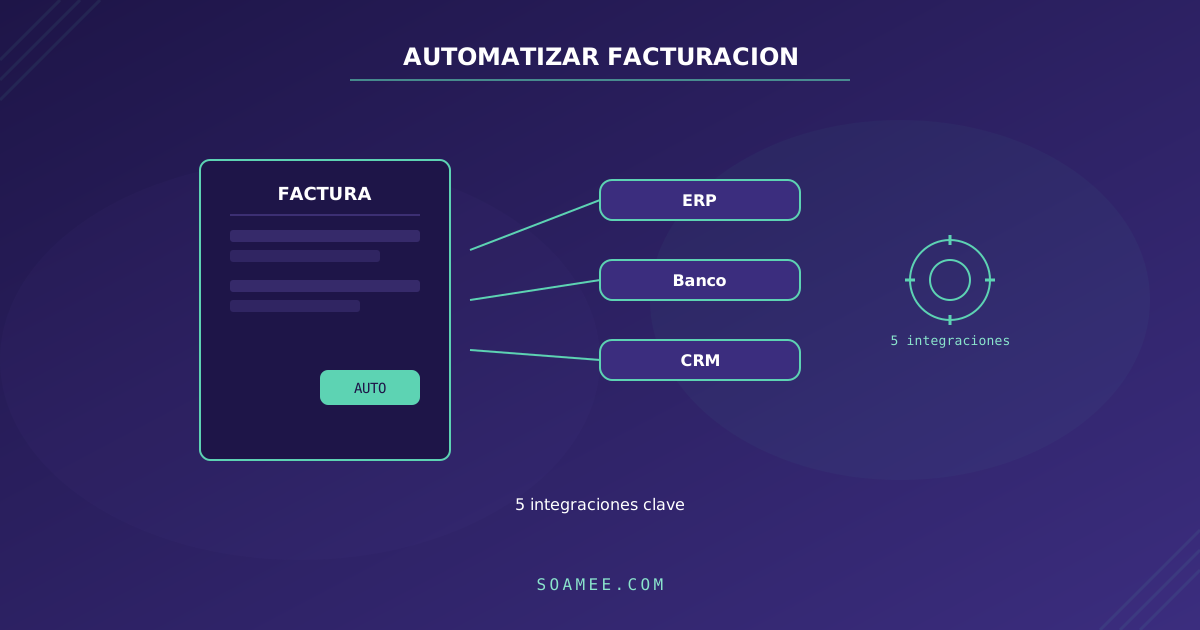
The good news is that 90% of these tasks can be automated with the right integrations. I explain the 5 integrations with the highest impact, with real implementation examples and expected ROI.
The Real Cost of Manual Invoicing
Before investing in automation, quantify your current cost:
| Task | Typical monthly hours |
|---|---|
| Generating invoices | 4-8h |
| Sending invoices by email | 2-4h |
| Payment follow-up | 3-6h |
| Bank reconciliation | 3-5h |
| Tax return preparation | 2-4h |
| Error correction | 2-4h |
| Total | 16-31h |
If an admin costs your company 2,500-3,500 EUR/month, you are spending between 800 and 1,800 EUR monthly on invoicing alone. Over 10,000 EUR per year. With that budget, you can automate the entire process.
Integration 1: Stripe for Automatic Payments
Estimated savings: 5-8 hours/month
Stripe is not just a payment gateway. It is a complete billing platform that can automate the entire payment cycle for businesses with recurring billing.
What it automates
- Recurring payments: automatic SEPA direct debits or card charges every month
- Failed payment management (dunning): automatic retries with personalized client emails
- Client portal: client updates their payment method without your intervention
- Usage-based billing: metering API to charge for actual usage
- Automatic prorations: plan changes, upgrades, and downgrades without manual calculations
Real example: ElDomi
With ElDomi, the student housing platform, we implemented Stripe Billing to automate monthly rent collection. The system charges automatically, generates receipts, manages failed payments with retries, and notifies the property owner. What previously required 2 dedicated people now runs autonomously.
ROI
Implementation cost: 5,000-15,000 EUR (depending on complexity). Annual savings: 6,000-12,000 EUR in personnel time + 15-30% reduction in late payments.
Integration 2: Accounting Software for Automatic Bookkeeping
Estimated savings: 4-6 hours/month
Modern accounting tools like Holded, Xero, or QuickBooks have powerful APIs. Integration allows invoices to be generated and booked automatically from your management system.
What it automates
- Invoice generation from orders or contracts in your system
- Automatic bookkeeping: each invoice generates accounting entries without intervention
- Bank reconciliation: connects with your bank via PSD2 and reconciles transactions automatically
- Tax returns: generates draft tax forms from registered invoices
- Client delivery: invoice by email with custom template and open tracking
Typical automated flow
[Your system] → [Accounting API: create invoice] → [Auto-bookkeeping]
                                                           ↓
                                                   [Email delivery]
                                                           ↓
                                                   [Bank reconciliation]
                                                           ↓
                                                   [Tax return draft]
ROI
Implementation cost: 3,000-8,000 EUR. Annual savings: 5,000-8,000 EUR in time + elimination of accounting errors.
Integration 3: Bank (PSD2/Open Banking) for Reconciliation
Estimated savings: 3-5 hours/month
Manual bank reconciliation is especially tedious: open the bank portal, download transactions, compare them one by one with issued invoices, mark matching ones. With bank integration via PSD2 (Open Banking), this is 95% automated.
What it automates
- Transaction import: direct connection with your bank, movements every hour
- Automatic matching: system crosses amounts, references, and descriptions with pending invoices
- Late payment alerts: notification when an invoice passes due date without payment
- SEPA direct debits: automatic generation and submission of payment collection batches
- Real-time cash flow: dashboard with cash flow forecast based on pending invoices
ROI
Implementation cost: 4,000-10,000 EUR. Annual savings: 4,000-6,000 EUR + DSO (days sales outstanding) reduction of 5-10 days.
Integration 4: Automated Email for Payment Follow-up
Estimated savings: 3-5 hours/month
Payment follow-up is an ungrateful task nobody wants to do. Calling clients to remind them of pending invoices consumes time and creates tensions. Automation solves it with tact and persistence.
What it automates
- Pre-due reminder: email 3 days before due date with amount and payment method
- Post-due reminder: email the day after due date, cordial but firm
- Progressive escalation: second reminder at 7 days, third at 15, fourth with more serious tone
- Internal escalation: notification to your sales team when a client is 30+ days overdue
- Formal letter: automatic generation of formal demand letter at 60 days
Example sequence
| Day | Action | Tone |
|---|---|---|
| -3 | Reminder email | Informative |
| +1 | Collection email | Cordial |
| +7 | Second email | Firm |
| +15 | Third email + suggested call | Urgent |
| +30 | Sales team notification | Internal |
| +60 | Formal letter | Legal |
ROI
Implementation cost: 2,000-5,000 EUR. Annual savings: 3,000-5,000 EUR + 20-40% reduction in late payments.
Integration 5: Automatic Tax Reporting
Estimated savings: 2-4 hours/month
Tax return preparation is repetitive and error-prone. Automating it eliminates the risk of penalties and frees up your finance team’s time.
What it automates
- VAT returns: automatic calculation from issued and received invoices
- Annual summaries: automatic identification of clients/suppliers exceeding thresholds
- Intra-community operations: detection and calculation of cross-border transactions
- Real-time reporting: automatic submission of invoices to tax authorities
- E-invoicing compliance: automatic compliance with electronic invoicing regulations
ROI
Implementation cost: 5,000-12,000 EUR (depending on applicable regulations). Annual savings: 3,000-6,000 EUR + elimination of tax penalty risk (which can be 1-4% of the tax amount).
How to Start: Implementation Plan
Don’t try to automate everything at once. The recommended order is:
- Month 1: Integration with accounting tool for automatic invoice generation
- Month 2: Automatic bank reconciliation
- Month 3: Payment follow-up emails
- Month 4: Stripe (if you have recurring billing) or SEPA direct debits
- Month 5: Automatic tax reporting
Each integration is validated before moving to the next. In 5 months you have the complete circuit running.
Alternative: Complete System from Day One
If you prefer an all-in-one approach instead of integrating piece by piece, our invoice automation solution includes all these integrations in a cohesive system. More upfront investment but less operational complexity.
Conclusion
Automating invoicing is not a luxury: it’s a necessity for any company issuing more than 50 invoices per month. The 5 integrations I described represent a total investment of 15,000-40,000 EUR (depending on complexity) and annual savings of 15,000-30,000 EUR. The ROI is 6-18 months, and after that it’s net savings year after year.
If you want to evaluate which of these integrations have the most impact for your case, schedule a free consultation and we’ll analyze your current invoicing flow. We’ll tell you exactly where the recoverable hours are.